OUR CLIENTS.
Select Partnerships.

Culture works for businesses, culture works for employees, culture works internally in companies to facilitate organizational change, stop churn and make productivity soar.
We solve the problem of churn, lack of productivity and inefficient or noncompliant internal processes. We are experts at implementing organization-wide value and role alignment. We are not like other HR companies. We think and live outside the box. Our team fits into your culture.
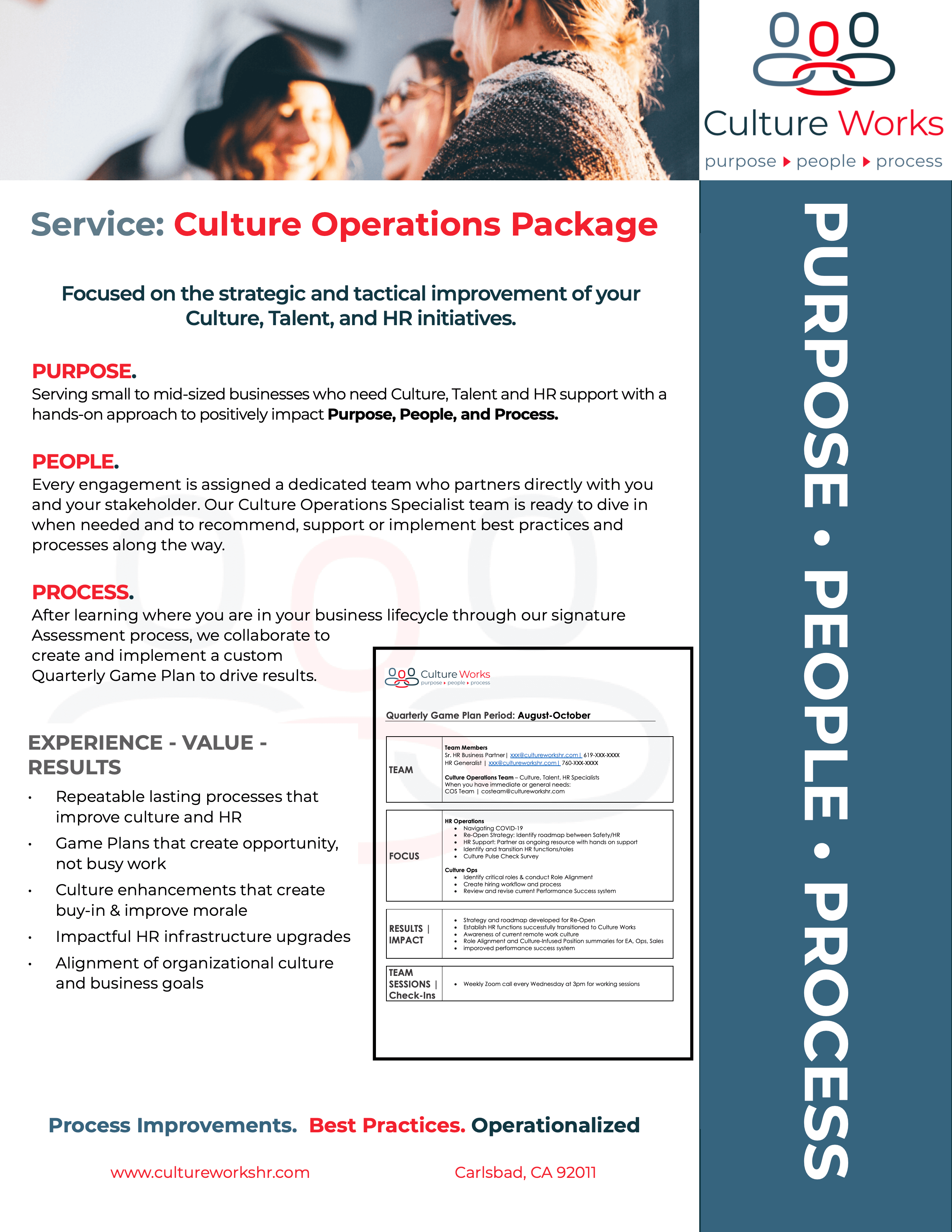
Your purpose creates our success. Our focus is culture infused QGPs. Our team impacts culture & talent by aligning & integrating people and processes.
Our team transforms role alignment which in turn increases engagement, creating an operationalized culture, aligned values and most importantly… RESULTS.
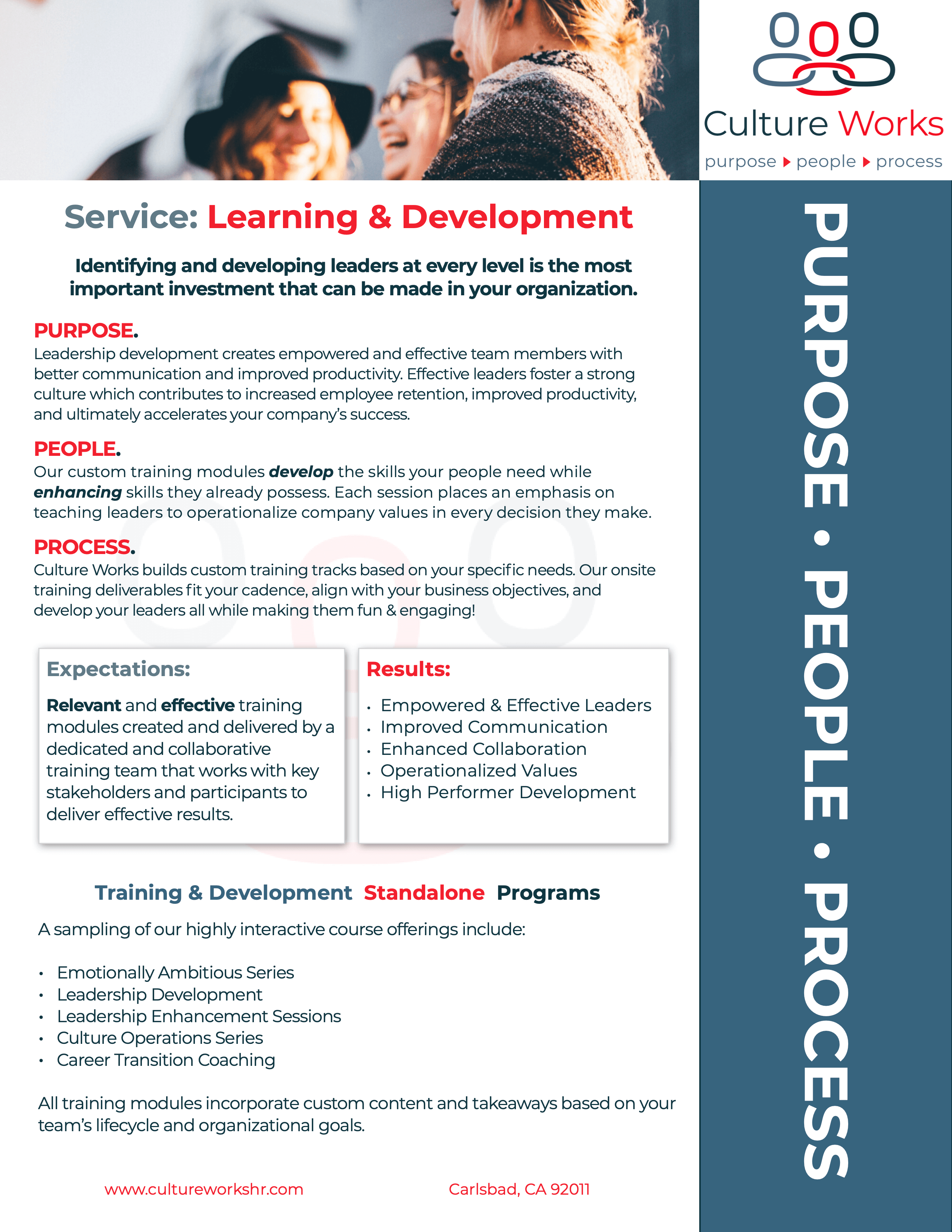

Top 6 Ways to Implement L&D into Your Business
NewsLearning and development (L&D) programs are essential to the success of any organization. L&D, also known as training and development, aligns employee goals and performance with the company. The aim is to provide employees with the necessary skills and resources they need to flourish in their roles.
Unfortunately, many companies may struggle to experience the positive benefits of these programs on a long-term basis. In fact, Harvard Business Review estimates that only 10% of the $200 billion spent every year on corporate training and development in the United States delivers real results.
The good news is leaders can use purposeful strategies to better implement L&D into their business. These strategies focus on creating an environment where employees can learn, practice, and apply their skills.
Let’s take a look at what strategies aren’t working and discuss more successful methods of implementing L&D into your business.
What Strategies Aren’t Working to Implement L&D into Businesses
According to research presented by Harvard Business Review, companies face a few challenges in implementing L&D into their businesses. These common challenges include:
Training that Takes Place Outside of the Organization
Learning and development trainings tend to occur outside of the organization. This makes it difficult for the employees to translate the skills learned in the classroom into the workplace.
When we work with clients to implement L&D programs into their organization, we ensure that these programs are integrated into the workplace. A learning and development initiative should be a main part of your company’s strategic initiatives.
Training that Requires Employees to Invest Their Own Time
Learning and development training that requires employees to invest their personal time are less likely to be successful than trainings that focus on building these skills during work. When leaders expect their team to fulfill their regular work responsibilities and compromise their personal time, leaders are not setting their employees up to successfully grow these skills.
Training With Minimal Follow-Up
When leaders implement minimal follow-up after the training, the responsibility to retain and use the new skills is placed on the learner. Leaders should maintain responsibility for learning and development in order to experience the best results.
Successful Strategies to Implement L&D into Your Business
According to Forbes, learning and development training helps organizations to gain and retain top talent, build employee satisfaction, boost morale and improve productivity. Let’s dive into how leaders can implement L&D to experience these benefits on a long-term basis.
1. Contextualize the Learning
Research has shown that learners are less likely to apply what they learn if it is taught in a different context than it will be applied. Many traditional learning and development programs are held outside of the workplace, which leads to issues translating the skills into the new context.
One strategy to combat this issue is to create customized training programs. In these programs, instructors target specific topics on a team or individual level. This can help learners to apply and implement these new skills into their daily work.
2. Break Learning and Development Trainings into Portions
Research suggests that dividing training into smaller increments can help learners retain and apply information. Leaders may experience more positive benefits of learning and development programs if they break up training into small, structured portions.
For example, leaders can encourage learners to participate in short online courses that can be easily integrated into their work schedules. These classes should be prioritized and completed while employees are on the clock to avoid shifting the responsibility of the training onto the learner.
3. Measure Progress and Benchmark Performance
Your L&D strategy should include clear objectives and performance indicators. Leaders should consistently measure progress by utilizing these indicators. In reviewing the performance of the L&D strategies, leaders can review:
However, it is important for leaders to remember that learning is an individual process, and each learner may provide different results. While leaders should check in with individuals, they should consider measuring progress based on teams or levels within the organization.
4. Provide Helpful Reminders
Leaders can offer short, helpful reminders for their teams to use the skills from the learning and development trainings. These reminders, which can take the form of an email or push notification, should be contextual, friendly, and just a few sentences. These nudges can be as simple as “this project would be a great opportunity to try!”
The purpose of these reminders is to keep the ideas from the training at the front of the learner’s mind as they navigate their day-to-day responsibilities. In each reminder, leaders should consider referencing a specific behavior and including a call to action.
5. Follow Up and Reflect
To effectively employ learning and development strategies, leaders should encourage learners to reflect on how the skills and tools they have learned can be used in the workday. Leaders may also choose to set aside time for learners to reflect after the training and then on a weekly or bi-weekly basis.
Leaders can follow up after learning and development trainings in a few different ways. For instance, leaders can check in with individuals during 1:1 meetings or the team during group meetings. Leaders can guide discussion with questions such as:
6. Provide Additional Resources to Support Employee Growth
Employee growth doesn’t have to stop at the end of the training or when they click off that last assigned online course. Leaders can support their employees in growing through reimbursement programs, webinars, books as well as other resources.
Need Help Implementing L&D into Your Business?
At Culture Works, we value the opportunity to help businesses implement learning and development programs into their company culture. Our team of experts is ready to partner with your team to build greater organizational success. Contact us today to learn how we can help your business implement these programs and contribute to positive company culture.Interested in more information? Read on to see how learning and development can transform your company culture here.
How to Make Layoffs The Right Way
NewsLayoffs are an unfortunate, but often a necessary choice for businesses for several reasons. Some may include an economic crisis, a change in business strategy, or a general reorganization.
The Bureau of Labor Statistics reports that in 2009, during the height of the Great Recession, 2.1 million Americans were laid off. As the American economy is at risk of entering another recession, companies are beginning to take measures to prepare. Companies may turn to layoffs as a means to survive during the economic downturn.
Company leaders may not realize that layoffs do not only affect only the people leaving the organization, but carry long-term effects on the company culture, such as lowered employee productivity, retention, and satisfaction.
However, employers can implement specific, purposeful strategies to navigate layoffs and preserve company culture. Let’s begin by discussing how these changes can affect the team.
How Layoffs Affect the Team
Employees that stay at a company after layoffs experience a 20% decline in job performance, a 36% decline in organizational commitment, and a 41% decrease in job satisfaction. Why? Because layoffs can cause employees to feel as if they have lost control, stability as well as trust in their management.
Let’s review some strategies to combat these issues.
Strategies to Navigate Layoffs
While layoffs will never be easy, companies can take steps to make the transitions as smooth as possible for their employees.
Find a Way to be Fair
One of the most common complaints from employees following a layoff is that it wasn’t fair. By fair, we mean that employees did not understand the criteria or how the leadership decided which employees stayed and which were laid off.
Company leaders should take the time to create a system for determining who will stay and who will go in the process of making layoffs. These criteria can be designed to clearly identify employee roles, traits, skills, or knowledge that will help the company reach its goals as well as align with company values.
A fair selection process, especially one that is communicated to the team, can help employees better understand the reasons for layoffs and set them up for success moving forward.
Be Respectful
Leaders should approach layoffs with intention, respect, and compassion. This approach can result in significant benefits for your employees and your company.
Layoffs will inevitably cause negative reactions amongst employees. Respect can help to soften these reactions.
For example, companies may choose for leadership to personally speak with employees about the changes. Leaders should avoid impersonal actions such as sending out a generic email detailing the layoff decision.
Prioritize Transparency: Talk About It
Leaders should consider having an open dialogue about the layoffs. Why? Because after the announcement of layoffs, gossip and hurt feelings are inevitable. By making the effort to speak to their teams, leaders are taking the opportunity to control the narrative of why these changes are happening.
According to PR Newswire, more than 86% of employees stated that their loyalty would be affected if a company “fails to be transparent regarding slowing company growth, hiring freezes, and layoffs.”
Consistency is Key
Layoffs can cause a workplace to feel inconsistent or unstable to employees. Leaders can prioritize consistency by maintaining consistent expectations, communication and behaviors across conversations. This can help employees to feel more stable in their workplace and help to boost productivity.
Provide Choices
Employees are likely to feel out of control during the process of layoffs, whether they stay or leave the company. Leaders can combat this issue by providing employees with as many choices as possible, even the little things.
For instance, allowing employees to take select office supplies or select their last date of employment can show care and allow exiting employees to feel more in control. Further, this display of extra care will boost morale and trust for the employees staying with the organization.
Show Extra Care
In the event of a layoff, small actions can make all the difference for both the employees exiting the organization and the employees staying. Leaders can show extra care by providing all employees with information about unemployment resources, job search resources, communication, and support. The care leaders show to exiting employees will matter to those staying with the company.
Is There a Wrong Way to Make Layoffs?
Harvard Business Review defines “bad layoffs” as “layoffs that aren’t fair or perceived as fair by employees and that have lasting negative knock-on effects.”
For example, companies should avoid performing layoffs with the goal of achieving short-term cuts instead of implementing long-term strategic change. When used as a quick means to support a short-term goal, these choices often prove to cause more issues than solutions.
Need Help With Your Company Culture?
At Culture Works, we understand that sometimes layoffs can’t be avoided. These changes don’t have to negatively impact your company culture on a long-term basis. With the right strategies and structures in place, we can operationalize the elements of your company culture that drive productivity, retention, and results.
Learn more about us and what we do, here.
Then read on to why hiring the right people can help your business in a recession (and prevent layoffs in the future) here.
Why Hiring the Right People Can Help Your Business in a Recession
NewsFor many companies, an initial reaction to a recession (or any significant financial crisis) may be to stop hiring. Employers believe that this will allow them to save money and focus their resources on their existing staff.
However, hiring during a recession is essential to the growth and success of your business. Why? Because hiring the right people can improve employee retention, foster innovation, and save time in the long run.
Before we dive into why hiring the right people is important, let’s discuss why businesses should resist hiring freezes.
Resist Hiring Freezes
While hiring freezes may save money in the short term, they can often be more harmful than helpful to a company. If your business is not hiring new people, it is not progressing and growing.
Freezing hires may have the following negative impacts:
Issues with Retention and Loss of Your Best Talent
Hiring freezes will likely result in your existing staff covering the work that a new hire would be taking on. Many employers depend upon their best talent to pick up the slack in a time of financial crisis.
However, additional work with limited resources can lead to employee burnout and increased turnover. Further, employees will be more likely to leave your organization if there aren’t opportunities for them to grow within the company.
According to PR Newswire, more than 86% of employees stated that their loyalty would be affected if a company “fails to be transparent regarding slowing company growth, hiring freezes, and lay-offs.”
Loss of Revenue
Hiring freezes mean that you don’t fill your revenue-generating positions. This results in a lost opportunity to earn more revenue for your company.
Additionally, if your organization isn’t properly staffed and your employees are stretched thin, you hinder them from doing their job to the best of their ability. Limited staffing can frustrate your employees, affect the quality of the work, and therefore, impact your customers.
Missing Out on Talent Opportunities
Company-wide hiring freezes mean that your organization won’t be able to consider exceptional talent. This means you’re missing out on the positive impact new talent could make on your business. Moreover, if your organization doesn’t use them, another company will!
So, what’s our solution to helping your business in a recession? Focus on hiring the right people.
Why Hiring the Right People is Important in a Recession
Improved Employee Retention
According to PR Newswire, a report surveying over 1,500 employees in the United States found that 57% of employees would actively look for a new job if we enter an economic recession in 2022.
Further, the report stated that over 70% of respondents believe we will be in a recession within six months or less.
So, what does this mean for employers? Employee retention should be a priority during a recession.
The right new hire can improve employee retention by decreasing workloads for your current employees, boosting morale, and showing your employees that there is opportunity to grow within your company.
By decreasing the workload alone, the right new hire can make your team feel supported as well as give them the time they need to complete quality work at an effective pace. This can cut down on employee burnout and give employees the tools they need to flourish within your organization.
Foster Innovation
A new hire can bring a fresh perspective to your organization. Through this perspective, the new hire can introduce innovative ideas, such as how to make current processes more efficient.
Innovation, in addition to helping the team, can also help prevent workflows from becoming stagnant.
Saves Time and Resources
By hiring the right people, you save time in the following ways:
Less Time Spent Hiring
Taking the time to hire the right candidate means you only have to do the hiring process once.
Quicker Onboarding Process
Additionally, hiring the right person will likely lead to a quicker onboarding process. If this candidate is well-aligned with the position, they are more likely to pick up their responsibilities and seamlessly transition into the role.
Improved Efficiency
By hiring the right people, employers make their teams more efficient. When everyone on the team can execute their responsibilities well and support each other, the team becomes more successful as a whole.
How to Hire the Right People
Now that we’ve discussed why to hire the right people, let’s discuss how to do it. Begin with the following steps.
Assess Your Company’s Needs
To recruit the best people, you need to be aware of your company’s exact needs. Consider questions such as:
Create a Detailed Job Description
Creating a detailed job description can define what exactly you want from this role and how it will benefit your organization. Plus, a detailed job description can help draw the best-fitting candidates to your company.
Prepare a Structured Interview
Use the interview to ensure the candidate is meeting the expectations you’ve set for the role. We suggest preparing questions or an itinerary to keep the interview as focused and productive as possible.
Look Beyond the Resume
While the skills and experience listed on the resume are important, it is also essential to review other qualities when selecting a new hire. These qualities can include their values (and if these values align with the company values) as well as their ambitions and their soft skills.
Need a Little Help Hiring the Right People?
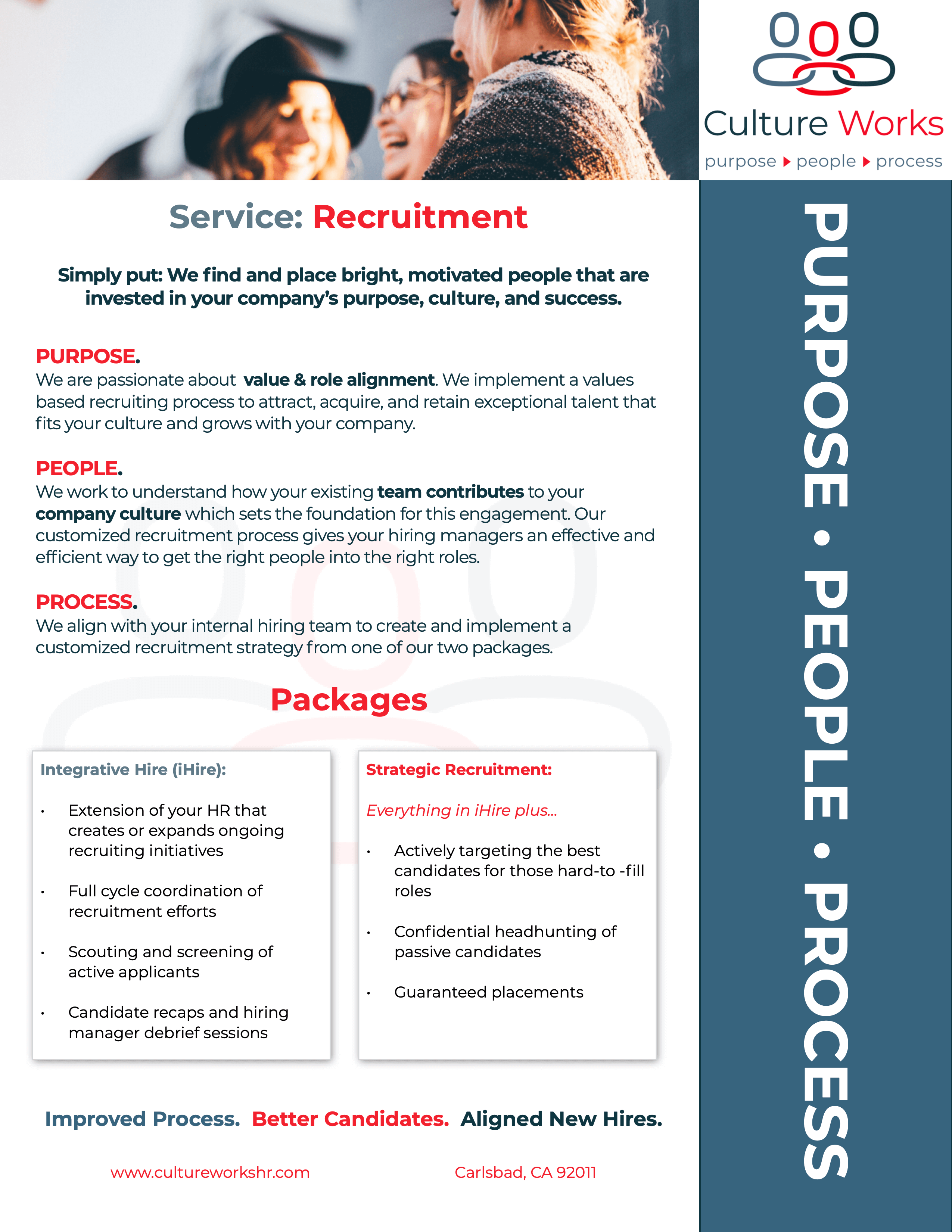
Taking the time to hire the right people will have a host of benefits in the long run. Finding the best fit may not be as easy as a gut feeling and a round of interviews. Luckily, Culture Works is here to help.
At Culture Works, our team is focused on value and role alignment. Our team creates processes for your hiring manager to implement that make the hiring process efficient and effective. We carefully review and screen each candidate, administer customized assessments, and deliver value and role-aligned people to fit your needs.
Read on to learn more about what we do. Then, read on to learn how to build trust with your employees.
People Partners Are the New HR
NewsWhat do you think of when you think of HR?
The friendly co-worker always sipping lemon tea and bringing donuts? Thursday morning workshops squeezed into the schedule? The adorably decorated office visit to talk about benefits? Some might even think of impersonal conversations about rules and regulations. (It’s okay, you can say it.) We’ll let you in on a little secret: we don’t like those impersonal conversations either. That’s why we’re leaving them in the old HR.
We’ll tell you what we think of when we think of HR: people.
And as much as we love lemon tea, workshops, and decorated offices, we want employees to primarily associate HR with one thing: resources.
How will we accomplish this? We’re so glad you asked. Let’s dive into the new HR.
What Do We Mean By People Partners?
People partners function as a system of strategic practices that will humanize impersonal processes and prioritize employees. By focusing on employee happiness and satisfaction, people partners improve employee development, engagement, and retention.
Sounds like a win-win, right? Let’s look into the goals of people partners in greater detail.
What Are the Goals of People Partners?
Connecting With Employees
The main goal of people partners is to strengthen the connection between HR and employees. At Culture Works, we believe that successful HR practitioners put their people first.
Making HR a Resource Instead of Policing Employees
Some may associate HR with awkward conversations enforcing rules and policies. People partners shift these impersonal conversations into humanized processes. The new HR will use these processes not to enable people, but rather to empower them.
Operating With a Mindset of Growth
People partners place importance on the growth and development of employees.
Coordinating with Employees of All Levels
HR practitioners utilizing the principles of people partners work alongside co-workers of all levels. Through these collaborations, HR practitioners have the opportunity to learn the business partners from each level of the organization.
Impact Change through Purpose, People, and Process
We like to think of it like this:
Purpose: HR practitioners assess and identify goals as well as value alignment.
People: People partners will help integrate, support, and guide performance accountability amongst the team. Further, HR practitioners familiarize themselves with roles and success indicators and align employees accordingly.
Process: HR practitioners implement humanized processes to connect to employees and create change.
Learn more about purpose, people, and process, here.
How Are People Partners Different From the Old HR?
The old and new HR will have many differences, ranging from details in processes to broad responses to problems. Let’s go over a few examples.
This is the New HR. Ready to Get Started?
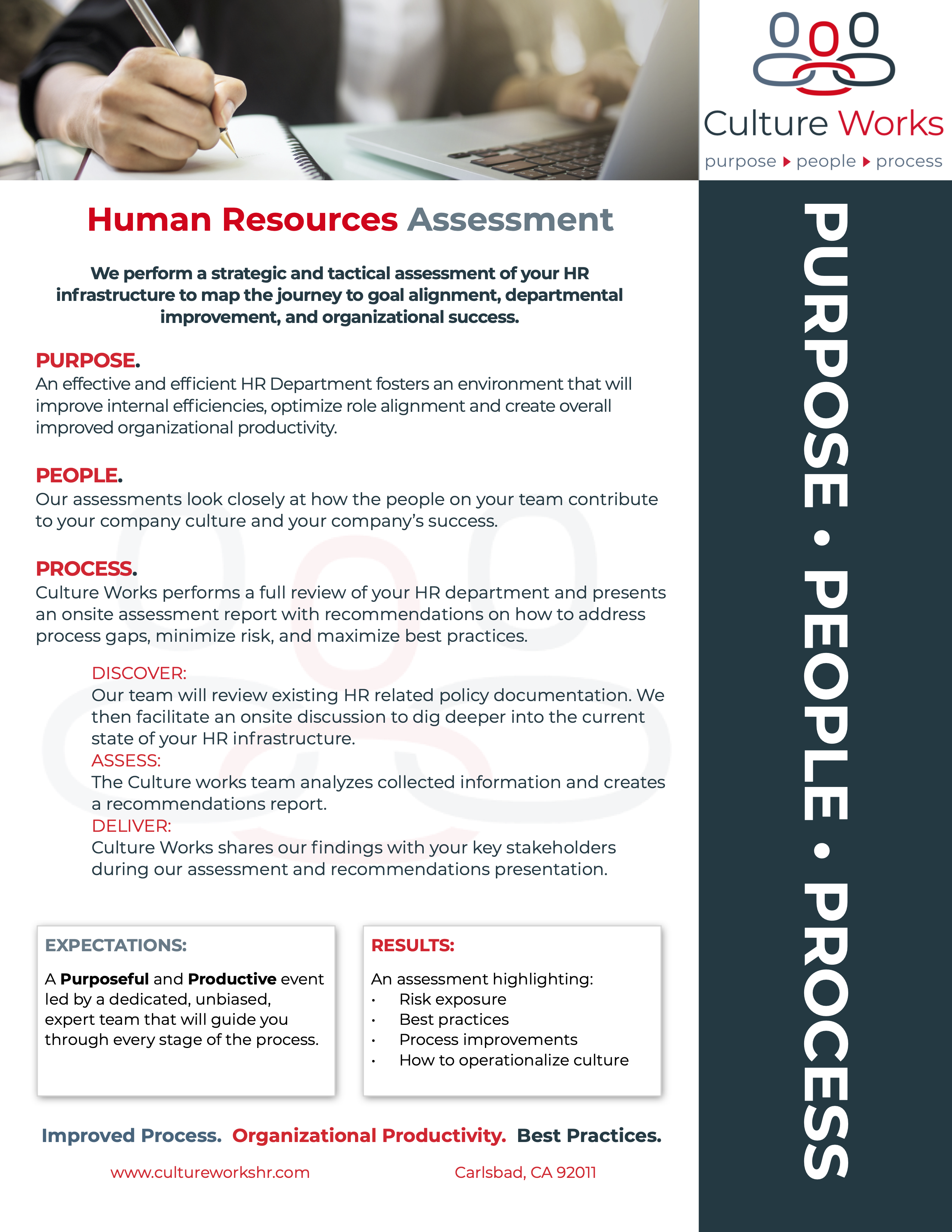
Consider Culture Works. Our goal is to work with you for as long as you and your stakeholders need us! We do this by operationalizing your culture, fostering the development of your leadership teams, and driving HR initiatives.
We build Quarterly Game Plans that are focused on Culture, Talent, and HR initiatives and real results.
Learn more about our services, here.
How to Manage Self
News, PersonalHow to Manage Time, Wellness, and Self: Part Three
With an increasing number of companies transitioning to a hybrid or fully remote work environment, self-management is an essential skill to have in both personal and professional life.
Through learning to manage yourself, you can increase your productivity, flexibility, and quality of work. Additionally, successful self-management can lead to stronger emotional intelligence and self-awareness.
What Does Managing Yourself Mean?
Self-management is a set of strategies and practices designed to direct your behaviors and emotions into a productive course of action.
For instance, managing yourself can involve regulating your:
Let’s review some effective self-management strategies to help you build each of these skills.
Practice Being Self Aware
Practicing self-awareness is an excellent starting point in learning how to self-manage. Observe and access your own characteristics, such as work habits, how long you can stay focused, your most frequent stressors, and emotional responses. Use these observations to recognize your strengths as well as habits that need improvement.
Organize Your Space
Organize your space to improve functionality and streamline your daily tasks.
By sorting your space, you can help improve your time management as well as prevent a few stressors from appearing. For instance, maintaining updated organizational systems for the files on your computer can result in you taking less time to search for a specific document or resource – isn’t it always in that folder you swear you checked twice already? – and frees your time for a more productive project.
Other solutions may be:
Create Routines
Design consistent routines that can help you to manage your time and tasks. You can try strategies such as:
Set Clear Goals
When creating your goals, consider using the SMART goal method. Goals should be specific, measurable, achievable, relevant, and time-bound.
You can use your current projects to work towards these goals, such as improving how well you navigate on a particular software or becoming comfortable with public speaking in front of your colleagues.
Make Your Own Deadlines
Before you get too excited– we’re not saying to spontaneously decide the presentation due at the end of the week is actually due next week. Instead, we suggest creating your own deadlines within stages of a project or throughout tasks. This can hold you accountable in your time management practices and drive you toward reaching your goals.
Develop Healthy Responses to Stress
When you start to feel stressed, try to respond in a healthy way, even if it begins with just pausing and taking a breath.
Find responses that work for you; some find exercising or taking a walk around the block to help relieve stress, some take a few minutes to meditate or do breathing exercises and some may carve out time in their schedule to participate in a hobby they enjoy.
Practice Self-Care
Set aside time to rest and practice self-care. Self-care can take the form of eating healthy foods, participating in activities that bring you joy as well as making a cognizant effort to disconnect from work. Through these efforts, you can recharge your energy and will often find yourself more productive when you reconnect to work.
Focus on What You Can Control
We can plan everything; collaborate with an excellent team at work, set strong objectives, and manage our time well ahead of the project deadline – but things always come up and change the plan.
In the event something pops up and hinders your current plans, consider pausing, taking a short break, and deciding how to best navigate the situation before proceeding.
We may not be able to control our circumstances, but we can control our response.
Evaluate and Adjust
Consider checking in with yourself on a weekly basis. You can use this time to identify areas you can improve as well as come up with plausible solutions to work towards these improvements.
For instance, instead of setting the objective of spending less time on your phone, try blocking out “phone time” and “no phone time” in your schedule.
You’ll be more likely to keep this specific goal instead of trying to avoid going on your phone altogether.
Additionally, keep in mind that you may have to adjust your practices and goals while you build your time management skills. Be patient with yourself and remember:
“The biggest room in the world is the room for improvement.” – Helmut Schmidt.
Ready to learn more?
Read on to learn how to support your company culture through human connection.
Connect with Culture Works to learn how we can provide the processes to operationalize culture in your organization and why we do what we do.
How to Build Trust with Your Employees
News, PersonalDid you know that employees in high-trust organizations are consistently more productive, energetic, and collaborative than employees in organizations with a lack of trust? In fact, employees in high-trust companies report 74% less stress, 40% less burnout, and 50% higher productivity. Wowza!
However, building trust with employees isn’t always as easy as throwing monthly pizza parties or implementing casual Fridays. While these perks can temporarily boost morale, they aren’t likely to have lasting effects on employees’ happiness.
The good news is that business owners have many options to try and build a culture of trust in their organization. But before we get to that, let’s review what trust means in a workplace and how it can improve a business.
What Does Trust Mean in the Workplace?
In a workplace, trust means that employees:
In a strong culture of trust, employees should trust their leadership and colleagues; and vice versa.
How Does Trust Improve the Workplace?
When leadership focuses on building trust with employees, there are several subsequent benefits–that’s why 96% of CEOs rate trust with employees a high priority.
These benefits can range from increased quality of work to employee retention. In fact, Harvard Business Review found that compared to employees in a low-trust company, employees in a high-trust organization report:
Sound good to you? Let’s review a few strategies that leaders can use to build trust with their employees.
Recognize Successes and Wins
According to neuroscience research, recognition has the strongest effect on trust. Leaders can recognize excellence in a variety of ways. For starters, when providing recognition, positive feedback is the most impactful when it is:
For instance, employees may find a specific comment on their contribution to a particular project more meaningful than a vague “you’ve been doing great!”
Further, leaders publicly addressing successes not only celebrates the employees and their accomplishments but also can inspire other team members to pursue their own successes. In addition, the public discussion of a win gives the excelling employee a platform and opportunity to share their strategies, helping the team to learn and improve even more.
Provide Flexibility With How Employees Complete Their Work
Employees value flexibility and discretion with how they complete their work. In fact, a survey conducted by Citigroup and LinkedIn found that nearly half of employees would give up a 20% raise for greater control over how they work.
By trusting their employees to manage their work, leaders display their confidence in their employees as well as provide a space for innovation.
Share Information Throughout the Organization
Did you know only 40% of employees report that they feel well informed about their company’s current goals and strategies? By widely sharing this information throughout the organization, leaders can help their employees to feel confident, stable, and part of the company’s future.
Prioritize Consistency
Business owners can reduce stress and improve productivity by creating a stable workplace for their employees. Leaders can create consistency through clear performance expectations and positive feedback practices.
Encourage Coaching and Guidance
Research shows that leadership plays a crucial role in creating trust in a workplace through guidance and coaching. If business owners opt for a coaching approach over traditional management, employee performance and retention are more likely to improve on a long-term basis.
For example, a leader may choose to guide employees through mistakes and find solutions instead of disciplining them. This approach may lead to the employee feeling more comfortable asking questions and performing high-quality work in the future.
For more examples, read on in our article “What’s the Difference Between a Manager and a Leader?”
Facilitate Purposeful Conversations
When management regularly engages in safe, open dialogue with employees, employee retention can improve. Why? Because challenges are addressed, discussed, and resolved early on.
Value Soft Skills
Nonverbal communication can help leaders further connect with their employees. For example, positive body language can create a welcoming environment—eye contact and nodding can imply interest and attentiveness.
In combination with purposeful conversations and active listening, nonverbal communication can make leaders approachable and help to develop trust with employees.
Try Active Listening
Active listening builds trust among team members and encourages employees to voice their concerns, find answers to their questions, and communicate their ideas. Employees who feel heard are 4.6 times more likely to feel empowered to perform better at work.
Read on to learn more about unique ways to support your company culture through human connection.
How to Manage Wellness in the Workplace
News, PersonalHow to Manage Time, Wellness, and Self: Part Two
To manage personal wellness, individuals need to make conscious efforts with the goal of improving physical, emotional, mental, and spiritual health.
While often associated with yoga classes, seminars, and green juice smoothies, personal wellness should be more a long-term, evolving process than a short-term, achievable goal. Although we admit, we do enjoy yoga, seminars, and green juice smoothies – Who says you can’t have both?
Wellness isn’t only significant at home or in the workplace. You should consider and adjust both aspects of your life in your journey toward personal wellness.
So, we’re here with the second part of our three-part series. Today, we’re discussing strategies to manage your personal well-being in the workplace.
What is Wellness in the Workplace?
Wellness in the workplace refers to the mental and physical health of employees in the company. Therefore, your efforts to improve wellness may include elements intended to support healthy behaviors as well as reduce risks to both mental and physical health. By addressing these risks and practicing healthy behaviors, you can improve your work life as well as prevent more serious health issues in the future.
How Do Companies Improve Employee Wellness?
Companies may take a number of approaches to improve employee wellness. For example:
In addition to utilizing the wellness resources provided by your company, you can also implement several strategies to manage your own wellness in the workplace. Let’s dive in.
How to Manage Your Personal Wellness
For many people, wellness can be difficult to prioritize amongst packed schedules, demanding projects, and a busy personal life. However, investing in your personal well-being can help you build healthy habits to better navigate these obstacles.
Prioritize a Proper Sleep Schedule
According to Fort HealthCare Business Health, reducing your sleep by as little as an hour and a half for just one night could result in daytime alertness being reduced by as much as 32%. Further, reduced sleep can also impair your brain’s ability to process and store information as well as problem-solve.
The adult body requires approximately six or seven hours of sleep per night to function correctly. Prioritize sleep by first deciding what your schedule will be including a goal time to wake up and a goal time to go to sleep. Consider implementing strategies to help you keep this schedule, such as:
Take Steps to Manage Your Stress
Work-related stress can cause you to feel unhappy with both your job and your personal life. The good news is that there are a few strategies you can use to manage your stress and improve your personal wellness.
Find Your Stressors
Try to pinpoint your stressors by asking yourself what exactly is making you feel stressed and why? You may choose to keep a journal to record your thoughts as well as information about stressful circumstances. This technique can help you to learn more about your specific stressors so you can better prepare for and respond to similar events in the future.
Develop Healthy Responses to Stress
Common poor responses to workplace stress may include stress-eating and shutting down. These habits can be tough to break so we suggest slowly transitioning into healthier options– seems a little counterintuitive to stress yourself out about not responding to stress correctly, right?
Instead, replace these habits with healthier alternatives. Consider a quick walk around the block in the sunlight, a meditation break, or even just a couple of minutes of breathing exercises to allow yourself to slow down, process, and figure out the best way to navigate the situation.
Set Aside Time to Recharge
Brains and bodies require rest to recharge and function efficiently. To recharge, you should be taking time to completely disconnect from work–no thinking about work while making dinner, no tinkering with a project while watching tv at night. When you come back to work after recharging, you’ll likely find yourself feeling focused and productive.
Socialize and Communicate
Isolation and a lack of communication can negatively impact your mental health and well-being, both in your work and personal life. Socializing can sharpen cognitive skills, reduce stress as well as contribute to your sense of happiness and well-being. Set aside time to spend with your friends and family and try to keep these plans.
As for socializing in the workplace, communication can foster relationships among colleagues and ensure you are getting the support you need.
Learn more about supporting your company culture through human connection, here.
Be Patient With Yourself
At Culture Works, we want to remind you that personal wellness is a constant process and deliberate effort; don’t be hard on yourself if you struggle to pick up these habits right away! Be patient with yourself in your journey toward personal wellness.
“Strive for continuous improvement, instead of perfection.” — Kim Collins.
Stay Tuned for Part Three!
Stay tuned for part three of our series, where we’ll discuss how to manage self.
Do you have a positive company culture? Find out by reading our article “Five Signs You Have a Positive Company Culture.”
How to Leverage Learning and Development to Improve Employee Retention
NewsRecently, employees’ priorities and desires have shifted—especially as a result of the pandemic.
Many individuals previously valued high-end office amenities and compensation above all else. Now, however, the list of desires has changed dramatically. (That’s not to say that brag-worthy offices and compensation don’t matter!)
There is one element that employers can leverage to improve employee retention: enter learning and development (L&D). Let’s continue this conversation on how to leverage learning and development to improve employee retention.
What is Learning and Development?
Learning and development (L&D) is an HR function defined as “a systematic process to enhance an employee’s skills, knowledge, and competency, resulting in better performance in a work setting.”
In Human Resource Management, Back to Basics by Filip Lievens, it’s written that the goal of L&D is “to develop or change the behavior of individuals or groups for the better, sharing knowledge and insights that enable them to do their work better, or cultivate attitudes that help them perform better.”
So, what does this look like in real life? L&D can look like a variety of things depending on the business making the investment. For example:
What Are the Benefits of Learning and Development?
There are various benefits—for both employees and employers—when it comes to implementing an effective L&D strategy for your business. Some of the benefits include:
How Learning and Development Improves Employee Retention
Increased employee retention is one of the best benefits of a successful learning and development strategy. In fact, according to a LinkedIn study, “94% of employees would stay at a company for longer if the business was investing in their career development.” Wow, that’s a statistic that can’t be ignored!
Moreover, L&D is something that you can’t ignore—especially given the Great Resignation that we’re observing now. The job market is HOT, and research shows that 86% of professionals would change jobs if a new company offered more opportunities for professional development.
PS: Employers who are fearful of the Great Resignation… Check out one of our latest articles on how to prevent the Great Resignation in your business.
How Can You Make Learning and Development Possible for Your Business?
We know, all of this L&D talk sounds great… But how can you make L&D possible for YOUR business? Below, we’ve listed three tips for getting started.
Incorporate Learning and Development Right Off The Bat
Many employers make the mistake of not implementing learning and development for new hires until they’re “comfortable” in their roles. Professional development, however, should be accessible from the get-go. This will ensure L&D has a more profound impact on an employee’s experience.
Build Learning and Development into Everyone’s Schedules
We know, everyone is busy! Whether it’s monthly or quarterly, it’s important to set aside a designated time for L&D on everyone’s calendars.
Make Learning and Development Accessible
Contrary to popular belief, L&D doesn’t have to break the bank. In fact, it’s often cheaper than many of the other perks you might offer your employees. That being said, learning and development opportunities should be spread across the board—and not just available to key employees and executives.
In fact, coaching has been named one of the most requested employee benefits, and the results are a win-win for both employee and employer. The bottom line? All of your employees are worth the investment of L&D!
Interested in learning more? Read on to see how learning and development can transform your company culture.
How to Manage Time
NewsHow to Manage Time, Wellness, and Self: Part One
Today, the average employee has a lot on their plate. In addition to work, they have to worry about managing their time, their own personal wellness, and self. At Culture Works, we recognize that many might not know where to start. (Yes, it can be overwhelming!)
Moreover, sharing these tips with your employees from the top down can prove extremely beneficial.
So, we’re here with the first part of our three-part series. Today, we’re talking about time management.
How to Level Up Your Time Management Skills
What is time management anyway? According to MindTools, time management is “the process of organizing and planning how to divide your time between different activities.”
At Culture Works, we believe that there are three pillars that contribute to successful time management.
Let’s talk about each in a bit more detail.
Awareness
What is awareness? When it comes to time management, awareness is thinking realistically about your time by understanding it’s a limited resource.
There are many practices to develop awareness. Here are two practices that we’ve found to work at Culture Works:
Define Your Peak Performance Time
Break your typical day into three to four time slots. For example:
Your time slots, based on your work and self, might look different! Perhaps you have three slots of longer time as opposed to four. The options are endless.
Anyway, once you’ve broken apart your day, over the course of a week, rank-order these slots from your most to least productive. Then, organize your to-do list based on your hours of peak productivity.
Shift Your Perspective
Another practice to develop awareness is by gaining some perspective. When working, ask yourself: How will the tasks I am doing right now help or hurt me in the future?
Then, adjust your work accordingly.
Arrangement
Let’s move on to the second pillar of time management: Arrangement. Proper arrangement means designing and organizing your goals, plans, schedules, and tasks to use time effectively.
There are many practices to take control of arrangement. Here are two practices that we’ve found to work at Culture Works:
Schedule Protected Time
Interruptions happen, especially with remote work—so plan for it! Make calendar appointments with yourself to ensure focused time dedicated to your most important projects.
This will help build accountability.
Prioritize Activities and Obligations
Make these things a priority. Oftentimes, it is not enough to simply list out your tasks, to-do lists, and meetings.
Adaptation
The third and final pillar of time management is adaptation. Adaptation is when you monitor time while performing activities and adjust to interruptions.
There are, of course, practices to master adaptation. Here are two ideas that we’ve found to work:
Sprints, Not Marathons
We know… Marathons are impressive! When it comes to work, however, using a short burst of effort toward completing a task can be effective. Remember, progress, no matter how small, is still progress.
Use Meaningful Reminders
The reminders you set in place should have detailed explanations or descriptions.
Time Management Capacity (and Time Blocking!)
Another practice we recommend is the use of capacity buckets to hit targets. This is a simple, four-step process you can use to manage your time successfully:
However, we believe number three could use a bit more detail.
What is Time Blocking?
“If you don’t control your schedule, it will control you.” —Todoist
First, what is time blocking? Time blocking, according to Todoist, “is a time management method that asks you to divide your day into blocks of time. Each block is dedicated to accomplishing a specific task, or group of tasks, and only those specific tasks.”
Time blocking, for some, might look like the below:
But how do you time block?
Not yet seeing the benefit? Below, we’ve provided an example of someone who doesn’t time block vs. someone who does.
Using Covey’s Four Quadrants to Unlock Time Management Success
Lastly, we’d like to introduce the four quadrants of the Covey Time Management Matrix. We promise – it is not as scary as it sounds… (And it’s definitely not as scary as the 1999 Keanu Reeves film!)
Covey’s four quadrants help prioritize your tasks based on urgency and importance. Each task lies in one of four quadrants labeled one through four.
Take a peek below.
For example, an HR emergency would land in quadrant one whereas long-term planning or relationship building might land in quadrant two. Quadrant three might be home to interruptions, emails, calls, meetings, and so on. Try to steer clear of tasks in quadrant four; for example, busy work and time sucks.
Stay Tuned for Parts Two and Three!
So, there you have it! Our best tips on how to level up your time management skills. Stay tuned for parts two and three of our series, where we’ll discuss how to manage your personal wellness and self.
Interested in benefitting your employees? Read on for 10 unique ways to support your company culture through human connection.