How Learning and Development Can Transform Your Company Culture

What Is Learning and Development?

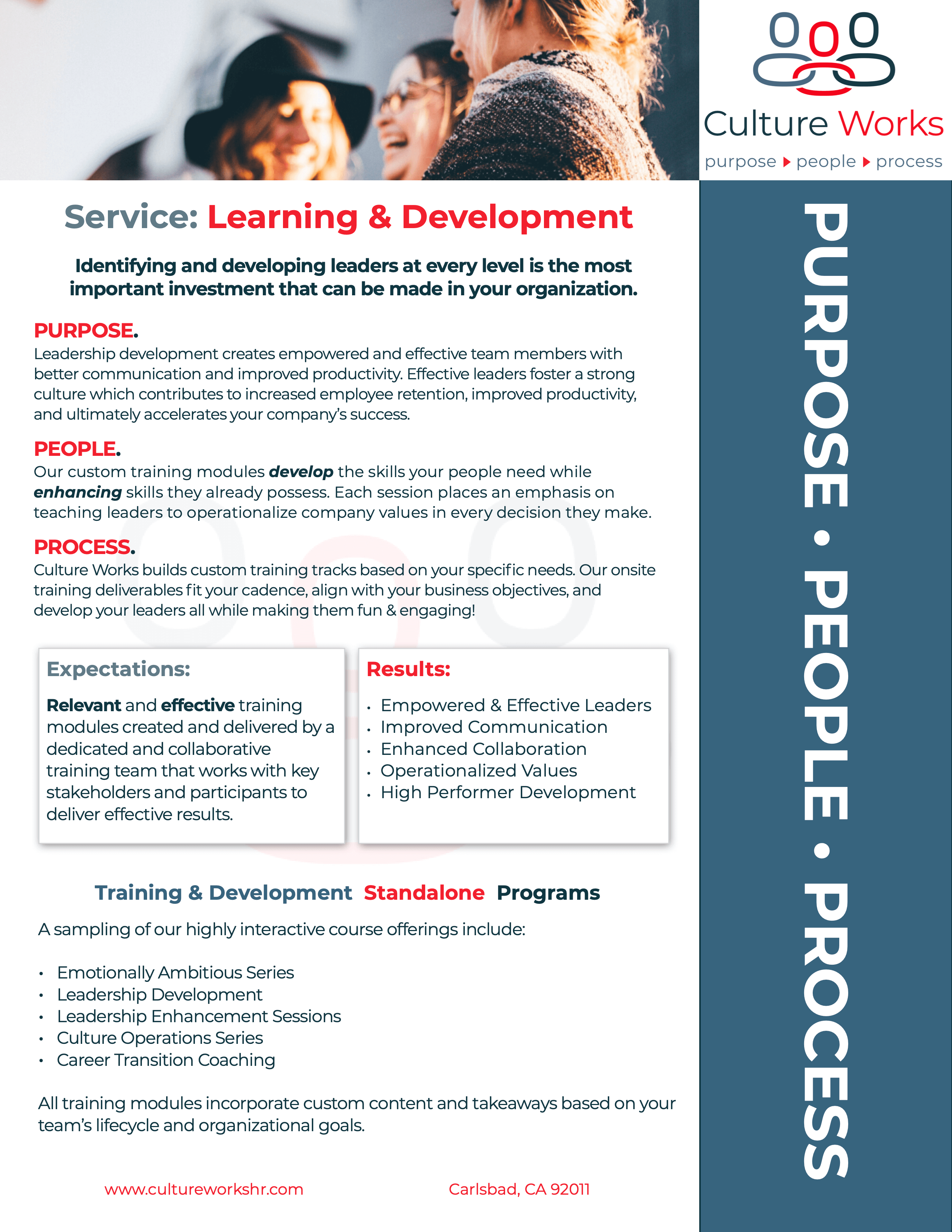
Learning and development (L&D), also known as training and development, is a core function of HR that connects employee growth with business outcomes. The purpose of L&D is to identify gaps in knowledge, skills, and behaviors, then implement training programs to address them.

Key Responsibilities of an L&D Team

  • Evaluate organizational and employee development needs
  • Align learning strategies with business objectives
  • Deliver training programs through online courses, live sessions, and blended formats
  • Communicate the value of training to secure employee and manager participation
  • Measure outcomes and adjust programs based on feedback and performance

For many companies, building an L&D strategy can be a challenge. At Culture Works, we help organizations design and implement learning programs that are practical, effective, and aligned with company values.

Recognize the Difference Between Skills and Behaviors

Understanding the difference between skills and behaviors is key to creating a successful learning culture.

What Are Skills?

Skills are teachable and transferable. They can be developed through structured learning such as workshops, certifications, and online courses. Examples include software training, project management, or public speaking.

What Are Behaviors?

Behaviors reflect how people act in different situations. They are shaped by mindset, communication style, and organizational norms. Teaching behaviors requires coaching, context, and cultural alignment.

For example, if your company values direct communication, employees need more than presentation skills. They need support in giving and receiving feedback, navigating conflict, and building trust within teams.

Tailor your training programs to support both skill development and behavioral change.

Engage Your Managers in Learning and Development

Manager engagement is a critical factor in the success of any learning and development strategy. While senior leadership sets the tone, managers are responsible for reinforcing learning on the ground.

How Managers Support L&D

  • Participate in training with their teams
  • Reinforce lessons in daily workflows
  • Provide consistent feedback and support
  • Act as mentors and advocates for growth

In addition, managers should understand the difference between holding employees accountable and merely assigning responsibility. True accountability requires follow-through, coaching, and clear expectations.

When managers actively participate in the development process, employees are more likely to take ownership of their growth.

Measure and Adapt Your Learning Programs

Tracking the success of your learning and development programs is essential. Without measurement, it is difficult to improve or justify continued investment.

What to Measure in L&D

  • Pre-training assessments to establish benchmarks
  • Post-training surveys to evaluate engagement and satisfaction
  • Performance data to track skill application and results
  • Retention and promotion rates tied to development programs

If your team is not taking advantage of available resources, revisit your delivery method, training topics, or internal communication strategy. Flexibility and responsiveness are key to long-term success.

Secure Buy-In from Senior Leadership

Company-wide learning culture starts with support from the top. Executives must not only endorse the initiative but also lead by example.

Why Executive Support Matters

  • Sets a clear tone that learning is a business priority
  • Encourages other employees to engage with the program
  • Helps normalize failure as part of the growth process
  • Reinforces the importance of ongoing development across departments

Leadership should communicate that it is acceptable to take risks, ask questions, and make mistakes in pursuit of growth. When employees feel safe to learn, they are more willing to innovate and improve.

Focus on Capabilities, Not Just Performance Metrics

Traditional performance reviews often focus on KPIs. While performance is important, it should not be the only measure of success.

Shift the Focus to KSAs

KSAs stand for knowledge, skills, and abilities. These are the building blocks of employee potential. When companies focus on developing KSAs, they create an environment where continuous improvement is both expected and supported.

Encourage employees to see development as part of their job, not something separate from it. When growth is integrated into the workday, it becomes part of your company culture.

Make Learning Part of Everyday Communication

Communication is the backbone of a strong learning culture. Without it, even the best-designed programs will fall flat.

How to Integrate Learning into Communication

  • Share learning goals and updates in team meetings
  • Connect training to real business outcomes
  • Recognize employees for progress and growth
  • Encourage open dialogue about challenges and lessons learned

When learning becomes part of daily conversations, it becomes part of how your team operates. Over time, that consistency builds a culture of curiosity, resilience, and accountability.

Ready to Build a Learning Culture That Lasts?

At Culture Works, we help organizations embed learning and development into their company culture in a way that drives real results. Our team builds customized strategies that align with your business goals, support your managers, and keep your people growing.

Contact us today to learn how we can help your business implement effective learning and development programs that support retention, engagement, and long-term success.

When we think about business success, we often focus on things like growth, profits, and innovation. But there’s one area that doesn’t always get the attention it deserves: operational HR. HR isn’t just about hiring and payroll—it plays a huge role in turning company strategy into action. Let’s take a look at why tactical HR matters so much and how it can drive business success.

Let’s explore why 2025 is shaping up to be the year of exceptional HR execution and how businesses can prepare for success.

When HR Execution Goes Wrong

Execution is often invisible when done well, but glaringly obvious when it fails. A stark example is Uber’s 2017 failure to address sexual harassment claims, which led to widespread damage to its culture, public scandals, and the departure of the CEO. This incident underscored the importance of implementing robust HR policies and processes to prevent crises before they arise. It’s a painful reminder that operational HR is not something to be neglected or underestimated—it’s crucial for maintaining organizational health and ensuring business success.

Turning HR Strategy into Action

1. Give HR the Right Tools and Resources

For HR to make things happen, they need the right support. This means giving them enough time, the right technology, and the right people.

  • Technology: Tools like AI and chatbots can improve HR productivity by 30%, making processes faster and smoother. From recruitment automation to employee performance tracking, technology frees up HR professionals from administrative tasks, allowing them to focus on strategic priorities that directly impact business outcomes. HR teams equipped with advanced tools can build better employee experiences, provide data-driven insights, and respond more efficiently to company needs.
  • Staffing and Budgets: If HR teams are understaffed or lack the resources they need, things fall through the cracks. Adequate staffing and budgets help HR meet business goals quickly and effectively. Ensuring HR departments are sufficiently resourced allows them to focus on developing effective people strategies, supporting recruitment, onboarding, and retention initiatives, and fostering a positive company culture.

2. Encourage Collaboration Across HR Teams

HR is made up of different departments, like recruitment, employee relations, and training. But sometimes these teams work in isolation, which can lead to fragmented and inconsistent results.

By promoting collaboration, HR teams can create smarter, more cohesive strategies that work across the entire employee lifecycle—from hiring to development to retention. For example:

  • A shared approach to onboarding ensures that all employees, regardless of department, experience consistent training and company culture from day one.
  • Integrating AI with human insight can help streamline HR processes, creating faster, more effective solutions. For example, AI-powered recruitment tools can analyze resumes and identify high-potential candidates, while human interviewers focus on assessing cultural fit and team dynamics.

The cross-functional collaboration within HR teams, as well as between HR and other departments, ensures that people strategies are not siloed but are instead aligned with broader business goals. This ultimately results in a more engaged workforce, a higher level of productivity, and better retention rates.

3. Build Well-Rounded HR Professionals

HR pros today need more than just expertise in one area. They need to have a deep understanding of their specialty, but also know enough about the bigger picture to collaborate across different parts of the business. This is why we need “T-shaped” HR professionals: people who are experts in their field but also understand the broader business needs.

  • T-shaped professionals are adaptable, bringing fresh ideas to the table while also understanding the intricacies of their department. These HR professionals can collaborate with marketing, finance, operations, and other departments, ensuring that people strategies are designed in harmony with overall business objectives. A well-rounded HR professional is capable of balancing both the human element of HR and the data-driven side that helps businesses thrive.
  • Continuous Learning and Development: The HR landscape is constantly evolving, and HR professionals must be committed to ongoing development. By keeping up with trends in leadership, technology, and organizational culture, they can better support the company’s strategic initiatives. This ensures that HR teams not only manage current needs but are also equipped to anticipate and address future challenges.

4. Empower Line Managers

Line managers are the ones on the front lines, working directly with teams every day. To make sure HR strategies work, we need to give line managers the power to make decisions that impact their teams.

When line managers are empowered:

  • They can make quicker, more effective people decisions. Having authority to hire, give feedback, and even decide on promotions creates a sense of ownership and accountability among managers. This results in more aligned decision-making at all levels.
  • HR teams can focus on supporting the bigger picture, while line managers handle the day-to-day. Line managers are the first line of defense in implementing HR initiatives on the ground. For example, if the company is rolling out a new performance management system, it’s the line managers who will be most involved in guiding employees through the process. By empowering them to make key decisions, you’re ensuring that HR policies have a direct impact at the team level.

Research shows that 55% of CHROs are shifting more decision-making power to line managers, and it’s making a big difference in the workplace. Empowered managers are more engaged and more capable of fostering positive employee experiences, which contributes to the overall success of HR strategies.

HR as a Business Partner

HR is no longer just a back-office function—it’s becoming a key player in business strategy. In fact, 93% of CHROs now regularly attend board meetings, helping guide major decisions. By integrating HR into strategic discussions, companies can ensure that their people strategies align with their overall goals.

When HR works closely with other departments, it can help align people strategies with business goals. Cross-department rotations, for example, give HR professionals a chance to see how other parts of the business operate, which helps them create solutions that better meet company needs. This collaborative approach enables HR to influence decision-making at the highest levels and to provide valuable insights that drive business performance.

Furthermore, as companies navigate changes in the workforce—such as remote work, flexible scheduling, and the rise of the gig economy—HR professionals will play a pivotal role in adapting company culture, refining people strategies, and ensuring that business objectives are met.

Learn More About Culture Works

At Culture Works, we want to partner with your company to create success for your team– whatever that looks like for your specific company. Our passionate HR team has the experience you need in culture ops and hospitality to create success. Our approach is centered upon the importance of humanizing, customizing, and simplifying. We believe in what we do, and we want to help your company operationalize culture, talent, and HR to create ongoing success. Read on to learn more about what we do

AI, HR and the Future of Workforce Management

Artificial intelligence (AI) is shaking things up in the HR world—and we’re here for it. From streamlining hiring processes to improving employee engagement, AI is becoming an essential tool for HR professionals. But with all the hype, how can HR teams actually use AI to their advantage? And what does this mean for the future of work?

Let’s break it down.

How AI is Changing HR

AI isn’t here to replace HR professionals (phew!). Instead, it’s a powerful tool that helps make HR more efficient, data-driven, and personalized. Think of it as the ultimate HR sidekick—handling repetitive tasks, analyzing vast amounts of data, and freeing up HR teams to focus on people, not paperwork.

Here’s how AI is already reshaping the industry:

1. Smarter Recruitment

Remember the days of manually sifting through hundreds (or thousands) of resumes? AI can handle that for you. AI-powered tools can:

  • Automatically screen resumes based on qualifications and experience.
  • Identify top candidates faster.
  • Help recruiters find passive job seekers who might be a perfect fit.
  • Conduct initial candidate assessments using chatbots or AI-driven interview tools.

This means HR teams can spend less time on admin tasks and more time on what really matters—building relationships with candidates and ensuring the best culture fit.

Plus, AI can help reduce bias in hiring by focusing purely on qualifications rather than unconscious preferences, making recruitment a fairer process.

2. Employee Management Made Easy

Once employees are hired, AI can help keep them engaged and performing at their best. AI-driven platforms can:

  • Analyze employee sentiment through surveys and feedback.
  • Predict burnout and suggest interventions before issues escalate.
  • Offer personalized learning and development recommendations.
  • Automate administrative tasks like scheduling, payroll, and benefits management.

Think of AI as your assistant that helps you stay ahead of employee concerns before they become full-blown problems. By analyzing workplace patterns, AI can highlight trends—like which departments may be struggling with morale or which employees might be at risk of leaving.

3. Data-Driven Decision Making

HR has always been a mix of strategy and intuition. AI strengthens the strategy side by providing data-backed insights. HR teams can use AI to:

  • Identify patterns in employee performance.
  • Forecast hiring needs based on company growth.
  • Make fairer, bias-free promotion and compensation decisions.
  • Measure the effectiveness of employee benefits and engagement programs.

It’s not about replacing human judgment—it’s about making better decisions with the right information at hand. When HR teams have access to real-time data, they can proactively address challenges before they impact the business.

4. Enhancing Talent Development

The best companies don’t just hire great employees—they help them grow. AI can:

  • Personalize training programs based on employee skills and goals.
  • Suggest mentorship opportunities by analyzing professional networks.
  • Predict which employees are likely to leave and offer retention strategies.
  • Identify gaps in skills and recommend upskilling programs.

This proactive approach helps HR teams focus on retaining top talent and keeping employees engaged long-term. After all, employees who feel valued and supported are far more likely to stick around.

How HR Can Adapt to AI

AI isn’t a passing trend—it’s here to stay. So, how can HR professionals ensure they’re ready for the AI-driven future?

1. Invest in Digital Infrastructure

HR teams need the right technology to support AI-powered tools. This could mean upgrading applicant tracking systems (ATS), integrating AI-driven HR software, or ensuring employee data is properly managed and protected.

Companies that lag behind in tech adoption may find it harder to compete in attracting and retaining talent. Now is the time to future-proof HR systems.

2. Ensure Ethical AI Use

AI is only as good as the data it’s trained on. HR professionals must:

  • Watch for biases in AI-driven hiring and promotion tools.
  • Ensure AI is used fairly and transparently.
  • Regularly audit AI tools for ethical concerns.

Just because a machine makes a decision doesn’t mean it’s always right—HR teams still need to provide oversight. The key is to use AI as a guide, not the final decision-maker.

3. Upskill HR Professionals

HR pros don’t need to become data scientists, but they do need to understand AI basics. Investing in training programs that help HR teams interpret AI insights and leverage new technologies will be crucial.

Workshops, webinars, and AI certification courses can help HR professionals stay ahead of the curve. After all, the best way to use AI is to truly understand it.

4. Foster a Culture of Agility

AI will continue to evolve, and HR teams need to be flexible. Encouraging employees to adapt to new technologies and fostering a mindset of continuous learning will help businesses stay ahead of the curve.

Some ways to foster agility include:

  • Encouraging cross-functional collaboration.
  • Supporting employees in learning new digital tools.
  • Creating a feedback loop where employees can share their experiences with AI-powered HR systems.

5. Lead the Charge in Workplace Innovation

HR is in a unique position to lead AI adoption within organizations. By embracing AI as a tool for efficiency and engagement, HR can help create more dynamic, responsive, and fulfilling workplaces.

Rather than resisting AI, HR teams should take the lead in demonstrating how it can be used to create better employee experiences.

The Future of Work with AI

So, where is all of this heading? The future of work will be:

  • More Flexible – AI-powered tools make remote and hybrid work models easier to manage.
  • More Data-Driven – Decision-making will be based on predictive analytics rather than guesswork.
  • More Personalized – Employee experiences will be tailored to individual needs and career paths.
  • More Automated – Repetitive HR tasks will be handled by AI, freeing up HR professionals for strategic work.

At the end of the day, AI isn’t replacing HR—it’s enhancing it. The human element of HR will always be essential, but AI helps HR professionals work smarter, not harder.

Final Thoughts

HR is changing fast, and AI is a big part of that evolution. By embracing AI as a tool (rather than fearing it), HR teams can create better hiring experiences, improve employee engagement, and build a more agile workforce.

The key? Stay informed, stay flexible, and lead with a people-first mindset.

Learn More About Culture Works

At Culture Works, we want to partner with your company to create success for your team– whatever that looks like for your specific company. Our passionate HR team has the experience you need in culture ops and hospitality to create success. Our approach is centered upon the importance of humanizing, customizing, and simplifying. We believe in what we do, and we want to help your company operationalize culture, talent, and HR to create ongoing success. 

Read on to learn more about what we do

Have you ever felt like your HR budgets vanish into thin air, leaving you scrambling to patch up issues reactively? It’s high time to rewrite the playbook and shift the focus from chaotic firefighting to proactive HR budgeting.

At Culture Works, we’re here to guide you on this transformational journey, helping you view your HR budgets in a whole new light. Let’s dive into the world of HR budgeting and explore how you can proactively shape the future of your organization.

Employment Law Budgets: Proactivity vs. Reactivity

Consider your employment law budget. Is it merely a safety net for when legal issues arise, or can it serve as the foundation for creating a compliant and harmonious workplace? It’s time to rethink your strategy and take a proactive approach to employment law compliance.

Understanding the Importance of Employment Law Budgets

Employment law is a critical aspect of HR management that often doesn’t receive the attention it deserves in budgeting. Many organizations allocate funds to deal with legal issues reactively, addressing problems only when they surface. However, this reactive approach can be costly and disruptive to the workplace.

To truly harness the power of your HR budget and create a thriving work environment, it’s essential to view your employment law budget as a strategic investment rather than just a safety net. Here’s why:

Legal Compliance: Employment laws are constantly evolving, and non-compliance can lead to costly fines and legal disputes. By proactively allocating resources to ensure compliance, you not only mitigate legal risks but also build a reputation as a responsible employer.

Workplace Harmony: A proactive approach to employment law can foster a harmonious workplace. When employees feel their rights are protected, they are more likely to be engaged and satisfied, leading to improved morale and productivity.

Cost Savings: Investing in measures to prevent legal issues is often more cost-effective than dealing with lawsuits and penalties. By addressing potential problems before they escalate, you can save your organization significant financial resources.

Talent Attraction and Retention: Companies that prioritize legal compliance and employee rights tend to attract top talent and retain their best employees. Job seekers often consider an organization’s reputation for ethical and legal practices when deciding where to work.

Creating a Proactive Employment Law Budget

To shift from a reactive to a proactive employment law budgeting strategy, consider the following steps:

Regular Compliance Audits: Conduct regular audits to ensure that your organization complies with all relevant employment laws. Allocate resources for these audits in your budget.

Training and Education: Invest in training programs for HR personnel and managers to stay updated on changing laws and best practices. Well-informed staff can help prevent legal issues.

Employee Resources: Allocate funds for resources like employee handbooks, policies, and procedures that clearly outline the rights and responsibilities of both employees and the organization.

Legal Counsel: Establish relationships with legal professionals who specialize in employment law. Having access to legal advice can help you navigate complex legal issues effectively.

Dispute Resolution Mechanisms: Develop effective dispute resolution mechanisms within your organization to address conflicts before they escalate to legal action.

Contingent Agency Recruiters: Breaking Free from the Waiting Game

Navigating the world of contingent agency recruiters often feels like trying to hail a cab in a bustling city during rush hour—a competitive and frustrating experience. But what if you could transform your hiring process to stand out in the talent market? 

Let’s explore strategic decisions that can set your company apart and reduce reliance on external recruiters.

Prioritizing the Essentials

Every company is unique, and so are their HR needs. We’ll discuss the importance of prioritizing HR operations, nurturing company culture, and enhancing culture accountability. Your HR budget should align with your organization’s specific requirements, and we’ll show you how to tailor it accordingly.

Risk Management: Shielding Your Organization from Legal Pitfalls

Lawsuits, litigation, and class actions can be HR’s worst nightmares. However, proactive budgeting can serve as your shield. We’ll delve into strategies for maintaining pay transparency and aligning your compensation strategy with your entire workforce, ultimately creating a fair and equitable workplace that reduces the risk of legal issues.

Final Notes

In the realm of HR, budgeting is not just about numbers; it’s about strategy. Let’s bid farewell to outdated HR budgeting practices and usher in a new era of proactive budgeting that architects success. At Culture Works, we’re your partners on this journey, ensuring that your budget becomes a force to be reckoned with.

Need Some Help With HR Budgeting?

At Culture Works, we want to partner with your company to create success for your team– whatever that looks like for your specific company. Our passionate HR team has the experience you need in HR and Operations to create success. Our approach is centered upon the importance to humanize, customize, and simplify. We believe in what we do, and we want to help your company operationalize culture, talent, and HR to create ongoing success. 

Read on to learn more about what we do. Then, read on to learn why hiring the right people can lead your business to success in a recession.

HR strategies for attracting engineers and architects

As technology and innovation continue to change the world of engineering and architecture, the need for fresh, skilled talent has never been higher. But attracting the next generation of engineers and architects isn’t as simple as posting a job ad and waiting for applications to roll in. With so much competition for top talent, it’s important to update your HR strategies to match what young professionals are looking for today.

So, how can you attract and keep the best engineers and architects? Here are some easy-to-follow HR strategies that will help you stand out and connect with this new generation of talent.

1. Build a Strong Company Culture and Share Your Values

The younger generation of engineers and architects wants more than just a paycheck—they want to work for a company that shares their values. Many young professionals care deeply about sustainability, social responsibility, and innovation. If your company works on green building projects or has a strong commitment to community outreach, make sure to share that.

You also need to create a positive, supportive culture where employees feel like they belong and their voices are heard. A collaborative team environment where everyone is encouraged to contribute will make your company much more attractive to potential hires.

2. Offer Competitive Pay and Benefits

Yes, culture matters—but salary and benefits are still a key part of the equation. Engineers and architects today want to feel like their skills are valued. Offering a competitive salary is important, but it’s not just about pay. Benefits like health insurance, retirement savings plans, and paid time off are essential to attract the right talent.

But don’t stop there. Many young professionals are looking for flexibility in their work. Offering things like flexible hours or the option to work from home can make a big difference. Work-life balance is a big deal for younger workers, so make sure your compensation package reflects that.

3. Encourage Professional Growth

Young engineers and architects are always looking to learn and grow. Providing opportunities for professional development shows that your company values growth and is willing to invest in your team’s future. This could include offering to pay for certifications, sending employees to industry conferences, or creating a mentorship program.

When you encourage continuous learning, it benefits both the employee and the company. Young professionals want to know that they can move up and take on new challenges, so make sure they can see a clear path to career advancement.

4. Use Technology to Your Advantage in Recruiting

The next generation of engineers and architects are digital natives, so it’s essential to use technology in your recruiting efforts. This means making your job postings easy to find, mobile-friendly, and clear.

Consider using social media platforms like LinkedIn, Instagram, or even TikTok to reach younger candidates. You can share behind-the-scenes looks at your company, highlight cool projects, or simply give a glimpse into your workplace culture. This helps potential candidates connect with your company even before they apply.

It’s also important to streamline the application process. Using tools like applicant tracking systems (ATS) makes it easier for both candidates and your HR team to manage the process smoothly and efficiently.

5. Promote Work-Life Balance and Flexibility

Work-life balance is no longer a nice-to-have perk—it’s a must-have for younger workers. Today’s engineers and architects value their personal time, and they want employers who respect that. Offering flexible work schedules or remote work options can make your company stand out.

By offering these types of flexible arrangements, you’re sending the message that you care about your employees’ well-being. Programs that support mental health, like paid wellness days or access to counseling, are becoming increasingly important to younger professionals.

6. Show Off Your Projects and Impact

Engineers and architects are passionate about the work they do, and they want to know that the projects they’re working on are making a difference. Highlighting your company’s exciting, meaningful projects can help attract candidates who want to be part of something big.

For example, if you’re working on sustainable buildings, infrastructure that improves communities, or cutting-edge designs, make sure to showcase these in your recruiting efforts. Younger workers want to know they’re contributing to something that matters, so showing how your projects align with their values will make your company more appealing.

7. Emphasize Diversity and Inclusion

Diversity and inclusion are top priorities for the next generation of engineers and architects. They want to work for companies that celebrate different perspectives and backgrounds. To attract top talent, make sure your hiring practices are diverse and that your company culture is inclusive.

This means actively recruiting candidates from a variety of backgrounds and ensuring that everyone feels welcomed and respected. Companies that embrace diversity tend to be more innovative and successful, which makes them an attractive place to work for young professionals who value these ideals.

8. Offer Mentorship Opportunities

One of the best ways to attract and keep young talent is to offer mentorship opportunities. Many engineers and architects are eager to learn from experienced professionals who can guide them as they grow in their careers. A formal mentorship program can help new hires feel supported, learn the ropes more quickly, and build strong relationships within your company.

Mentorship also benefits your seasoned employees, as they get the chance to pass on their knowledge and contribute to the development of the next generation. It’s a win-win for everyone.

9. Create a Collaborative Work Environment

The new generation of engineers and architects thrives in environments where teamwork and collaboration are encouraged. They want to work with others who are as passionate about the work as they are. By promoting a collaborative environment, you create opportunities for employees to learn from each other and solve problems together.

Fostering creativity and innovation through collaboration can lead to better solutions and ideas. When young professionals see that their voices are heard and that they have the opportunity to work with others to bring new ideas to life, they’ll be more likely to stay engaged and excited about their work.

10. Focus on Sustainability and Social Impact

Sustainability and social responsibility are key priorities for many young engineers and architects. They want to work for companies that are making a positive impact on the world. By emphasizing your company’s commitment to sustainability—whether that’s through green building initiatives or community outreach—you can attract candidates who share these values.

If your projects have an environmental or social impact, make sure to highlight that in your recruiting efforts. Young professionals want to know they’re contributing to something bigger than just their paycheck.

Final Thoughts

Attracting the next generation of engineers and architects takes more than just offering a good salary. Today’s young professionals are looking for employers who value work-life balance, offer opportunities for growth, and foster a positive, inclusive culture. By updating your HR strategies to reflect these priorities, you’ll be able to attract the best talent and create a workplace where innovation and collaboration can thrive.

So, take a look at your hiring practices, think about what’s important to today’s workforce, and start implementing these strategies to bring in the next generation of engineers and architects. They’re out there, and with the right approach, your company can be their next career home.

Need a Little Help Hiring the Right People?

Taking the time to hire the right people will have a host of benefits in the long run. Finding the best fit may not be as easy as a gut feeling and a round of interviews. Luckily, Culture Works is here to help.

At Culture Works, our team is focused on value and role alignment. Our team creates processes for your hiring manager to implement that make the hiring process efficient and effective. We carefully review and screen each candidate, administer customized assessments, and deliver value and role-aligned people to fit your needs.

Read on to learn more about what we do. Then, read on to learn how to build trust with your employees.

In today’s competitive job market, helping employees grow and develop their skills is more important than ever. For business owners and managers, understanding how to support your team can lead to happier employees and better business results.

Here’s a simple guide on what to consider for effective talent development.

1. Get to Know Their Goals

To help your employees succeed, you need to understand their personal career goals. Regular one-on-one conversations can help you learn what they want to achieve. By knowing their interests and aspirations, you can create development opportunities that keep them motivated and engaged.

2. Create Clear Career Paths

Once you understand their goals, it’s essential to provide clear paths for career advancement within your company. Employees are more likely to stay if they see opportunities for growth. Outline different career options and help them know what steps they need to take to get there, whether it’s moving up in their current role or exploring new positions.

3. Offer Growth Opportunities

Investing in your employees’ growth is beneficial for everyone. Provide training, workshops, and mentorship programs that allow them to learn new skills. Whether it’s covering the cost of a certification or encouraging them to attend a conference, these opportunities show that you care about their future. Consider job shadowing or cross-training to help them learn from different parts of the business.

4. Build a Supportive Culture

Creating a supportive work environment is key to talent development. Encourage managers to give regular feedback and recognize employees for their hard work. This not only boosts morale but also helps employees feel valued. Setting up a mentorship program where experienced employees can guide newer ones fosters teamwork and community.

5. Be Flexible and Open to Change

The needs of your employees will change over time, so it’s important to stay flexible. Be ready to adjust your talent development strategies based on what your workforce needs. Regularly check in on employees to see if their goals have shifted, and adapt training programs accordingly. This adaptability helps your business stay ahead and shows employees that you care.

6. Measure Your Success

To know if your talent development efforts are working, you need to track progress. Keep an eye on employee development, retention rates, and overall satisfaction. Employee surveys can provide helpful feedback on what is working and what could be improved. Use this information to make your programs even better.

Final Notes

Helping your employees grow is essential for creating a positive work environment and a successful business. By getting to know their goals, offering clear career paths, and providing growth opportunities, you can build a team that is engaged and motivated. Remember, investing in your employees not only makes them happy but also strengthens your organization in the long run. Focus on talent development, and you’ll create a workplace where everyone can thrive.

Need Help Implementing L&D into Your Business?

At Culture Works, we value the opportunity to help businesses implement learning and development programs into their company culture. Our team of experts is ready to partner with your team to build greater organizational success. Contact us today to learn how we can help your business implement these programs and contribute to positive company culture.Interested in more information? Read on to see how learning and development can transform your company culture here.

Business Coaching

Let’s be honest—when you hear the word “coaching,” you might picture something reserved for top executives or someone struggling to keep up at work. But here’s the truth: coaching isn’t just for a select few; it’s for everyone. No matter where you are in your career—just starting out or running the whole show—coaching can help you grow, solve challenges, and achieve your goals.

Kristi Pastore, CEO and Founder of Culture Works, weighs in:

So, who exactly needs coaching? Spoiler alert: It’s all of us! Let’s break it down.

What is Coaching, Anyway?

Think of coaching as a supportive partnership. It’s not about someone telling you what to do. Instead, it’s about having someone in your corner to help you think bigger, work smarter, and figure out your next steps.

As Kristi puts it, “It’s a relationship where you create mutual accountability.” Your coach provides guidance, asks the tough questions, and cheers you on, but you’re the one who owns the process. It’s your growth journey, and coaching gives you the tools to make the most of it.

1. Coaching for New Hires

Starting a new job can feel like drinking from a firehose. There’s so much to learn, from the company culture to your actual role. Coaching can make this transition a whole lot smoother.

What It Looks Like:

  • Your coach helps you prioritize what to learn first.
  • They offer advice on how to fit in with the team.
  • You set small, manageable goals to build confidence.

Why It’s Worth It:

With a coach, you’ll hit the ground running, feel less overwhelmed, and start contributing faster.

2. Coaching for Up-and-Coming Leaders

Stepping into a leadership role is exciting, but let’s be real—it’s also nerve-wracking. Suddenly, you’re responsible for more than just your own work. Coaching can help you develop the skills to lead with confidence.

What It Looks Like:

  • Practice tough conversations, like giving feedback.
  • Learn how to delegate without micromanaging.
  • Get tips on managing your time and priorities.

Why It’s Worth It:

With coaching, you’ll feel ready to lead your team and tackle challenges without second-guessing yourself.

3. Coaching for Seasoned Leaders

Even if you’ve been in leadership for years, there’s always room to grow. Maybe you’re navigating a big change at work, or you want to level up your team’s performance. Coaching is the perfect space to work through those challenges.

What It Looks Like:

  • Brainstorming new strategies for your team or company.
  • Getting an outside perspective on your leadership style.
  • Setting big-picture goals that keep you motivated.

Why It’s Worth It:

Sometimes, a fresh perspective is all you need to go from good to great. Coaching can help you stay sharp and keep evolving.

4. Coaching for Struggling Employees

When someone’s not performing well at work, it’s easy to jump to conclusions. But often, there’s a deeper issue—maybe they’re unclear on expectations, or they’re feeling overwhelmed. Coaching can help get them back on track.

What It Looks Like:

  • One-on-one conversations to figure out what’s holding them back.
  • Setting clear, realistic goals to rebuild confidence.
  • Creating a plan to measure progress together.

Why It’s Worth It:

Instead of giving up on an employee, coaching gives them a chance to turn things around.

5. Coaching for High Performers

You might think, “If someone’s already killing it at work, why would they need coaching?” Here’s the thing: even top performers can benefit from support. Coaching helps them avoid burnout, find new challenges, and keep growing.

What It Looks Like:

  • Helping them map out their next career move.
  • Finding ways to keep their work exciting and fulfilling.
  • Offering tools to manage stress and stay motivated.

Why It’s Worth It:

Investing in your best employees shows them you value their growth and want them to stick around.

6. Coaching for Teams

When a team’s not clicking, it affects everything—deadlines get missed, stress levels rise, and people start pointing fingers. Coaching can help a team work better together and tackle challenges head-on.

What It Looks Like:

  • Team sessions to improve communication and build trust.
  • Setting shared goals that everyone’s excited about.
  • Helping the group find solutions to recurring problems.

Why It’s Worth It:

When a team is in sync, the results are incredible. Coaching helps get everyone on the same page.

Coaching is About Growth, Not Fixing Problems

One of the biggest misconceptions about coaching is that it’s only for people who are struggling. That couldn’t be further from the truth. Coaching is about helping people reach their full potential, no matter where they’re starting from.

It’s not about fixing what’s “broken.” It’s about building on strengths, overcoming obstacles, and taking steps toward the future you want.

How Coaching Fits into the Modern Workplace

Today, businesses are realizing that coaching isn’t just nice to have—it’s essential. Employees at all levels want to feel supported and empowered. Coaching provides a personalized way to invest in your team, whether it’s through one-on-one sessions or group coaching.

And the best part? The benefits go beyond the individual. When people feel confident, capable, and connected, the whole organization thrives.

Is Coaching Right for Your Team?

The short answer: yes. Whether you’re helping a new hire adjust, supporting a struggling employee, or pushing a high performer to new heights, coaching has something to offer.

At our fractional HR firm, we specialize in helping organizations like yours find the right coaching solutions. Whether you’re looking to develop leaders, improve team dynamics, or simply create a culture of growth, we’re here to help.

Ready to Get Started?

Let’s talk about how coaching can make a difference for your team. Contact us today to learn more.

Interested in learning more? Check out our blog Role Models in Leadership: Why They’re Important and How to be One, here.

Emotional Intelligence is the ability to recognize, understand, and manage our own emotions while being aware of the emotions of others. Leaders who lead with EQ build better relationships, inspire trust, and foster an environment where employees are motivated to perform their best.

EQ impacts every aspect of a leader’s role—from how they handle stress to how they communicate feedback. For leaders focused on development, high EQ means being more effective at helping team members reach their potential in a supportive, empowering way.

So, where does the difference between coaching and coaxing come into play?

Coaching vs. Coaxing: A Key Distinction

In guiding and motivating employees, leaders often lean on two primary methods: coaching and coaxing. These approaches sound similar but have vastly different impacts on team members and overall workplace morale.

Coaching: A coaching approach focuses on supporting and empowering employees. Coaching uses EQ to encourage employees to find solutions, recognize strengths, and explore growth opportunities. A coach provides constructive feedback, listens, and creates an environment of trust.

Coaxing: Coaxing, however, often relies on pressure and persuasion rather than genuine support. When coaxing, a leader may attempt to ‘convince’ employees to perform or meet expectations, sometimes resorting to short-term motivators like external rewards or subtle guilt.

The challenge with coaxing is that it rarely leads to lasting change or genuine buy-in from team members. Coaching, on the other hand, fosters growth, commitment, and resilience.

The Downsides of Coaxing in Leadership

Coaxing might achieve compliance, but it doesn’t foster engagement or development. Here are some reasons why coaxing can be counterproductive in a workplace:

Short-Lived Motivation: Coaxing often relies on temporary motivators or pressure, which can create compliance in the short term but fail to inspire real, lasting change.

Lack of Ownership: When employees feel coerced, they’re less likely to take ownership of their tasks. This can result in a team that does just enough to get by rather than striving for excellence.

Increased Frustration: Coaxing can lead to a toxic work environment if employees feel pressured or manipulated. Frustration can build, which lowers morale, increases turnover, and diminishes the team’s productivity.

Eroded Trust: When leaders use coaxing as a strategy, it can damage trust. Employees may feel they aren’t being genuinely supported, which can decrease engagement and damage relationships in the long run.

Shifting from coaxing to coaching can significantly change your team’s morale, growth, and trust.

The Benefits of a Coaching Mindset

Coaching with EQ isn’t just about avoiding coaxing; it’s about creating a culture of empowerment and support. Here’s why coaching with EQ is far more effective:

Builds Self-Motivation: Coaching helps employees find their own reasons for improvement, leading to more sustainable motivation.

Increases Engagement and Commitment: When employees feel supported and valued, they become more engaged in their work. Engagement leads to higher productivity, job satisfaction, and loyalty.

Encourages Growth and Resilience: Coaching supports personal and professional growth by allowing employees to reflect, set goals, and take ownership of their development. This approach promotes resilience and adaptability.

Strengthens Trust: Leaders who coach build trust and openness, creating a safe environment where team members feel valued. A coaching mindset fosters a positive work culture where employees know they can seek guidance and support.

Practical Tips for Coaching with EQ

Now that we’ve established the value of EQ in coaching, here are some actionable steps to shift your approach and build a coaching mindset:

Practice Empathy

Start by building an understanding of your team members’ perspectives. Listen actively to their concerns, motivations, and aspirations. Empathy is at the heart of EQ, allowing you to tailor your coaching approach to each person’s unique needs.

Use Open-Ended Questions

Encourage reflection by asking questions that allow employees to think critically about their work and personal goals. Instead of “Did you finish the project?” try “What challenges are you facing with the project, and how can I support you?”

Focus on Growth-Oriented Feedback

Coaching is about development, not criticism. Focus on feedback that points toward growth rather than focusing solely on what went wrong. For example, say “This approach worked well. Let’s explore how we can build on that for next time,” instead of “You didn’t do this right.”

Set Clear, Achievable Goals Together

Work with employees to set realistic and achievable goals that align with their strengths and career aspirations. Involving them in goal-setting increases their ownership and investment in the outcomes.

Recognize Efforts and Progress, Not Just Results

It’s easy to celebrate end results, but acknowledging efforts and progress along the way keeps employees motivated. Celebrate small wins, and provide encouragement for continuous improvement.

Encourage Self-Reflection

Incorporate regular check-ins and opportunities for employees to reflect on their progress. Encourage them to consider what’s working, what’s not, and how they can continue to grow.

Culture Works Can Help with Your Coaching

Culture Works can support your shift from coaxing to coaching by providing the tools, training, and resources to foster emotional intelligence and a coaching mindset within your team. We understand that building a workplace culture centered on trust, support, and growth is essential for long-term success. With our expertise, your leaders can master EQ-based coaching techniques that empower employees, boost engagement, and strengthen team morale. Let us help you create an environment where everyone feels valued, motivated, and ready to achieve their full potential.

Read on to learn more about what we do.

Coaching isn’t just for athletes or CEOs anymore. It’s for anyone who wants to grow, improve, and succeed—whether you’re just starting your career or have years of experience under your belt. 

Kristi Pastore, the CEO and Founder of Culture Works, has seen firsthand how coaching can make a huge difference in both personal and professional growth. 

But what makes coaching so valuable? How does it really help? Let’s break it down.

1. Unlock Your Full Potential

We all have untapped potential. Sometimes, it just takes a little help from a coach to see it and bring it out. Coaching helps you discover new strengths and talents that you may not even know you have. Whether you’re looking to become a better leader, improve your decision-making, or just gain more confidence, a coach can guide you to become the best version of yourself.

2. Stay Accountable and Achieve Your Goals

One of the biggest benefits of coaching is accountability. Having someone who checks in with you, asks tough questions, and makes sure you’re moving forward can help you stay on track. 

As Kristi puts it, “Coaching is about creating mutual accountability. You set goals, and your coach helps you take action to reach them.” It’s all about making sure you’re not just talking about your goals but actually working towards them.

3. Improve Your Leadership Skills

Coaching is an amazing tool for leaders who want to keep growing. Even if you’re a seasoned manager, coaching can help you become a more effective leader. It gives you a space to reflect, get feedback, and develop new strategies to connect with your team. Whether it’s working on communication, emotional intelligence, or team-building, coaching helps leaders level up.

4. Overcome Challenges with Confidence

We all face challenges—whether it’s a difficult situation at work or personal roadblocks. Coaching helps you think differently about problems and find solutions you might not have considered. With a coach, you can work through challenges more effectively and stay confident, even when things aren’t going as planned.

5. Strengthen Teamwork and Communication

Coaching isn’t just for individuals. It’s also a great tool for teams. If you want to improve communication, trust, and collaboration within your team, coaching can make a big difference. Coaches help teams identify strengths and weaknesses, work through conflicts, and find better ways to collaborate. When teams work well together, they’re more productive and successful.

6. Advance Your Career

Coaching isn’t just about personal development—it can also help you advance in your career. If you’re unsure about your next move or how to achieve your career goals, a coach can help you map out a plan and give you the guidance you need to take the next step. Whether it’s skill-building, navigating office politics, or figuring out your long-term career path, coaching gives you the tools to succeed.

7. Develop Emotional Intelligence

In today’s workplace, emotional intelligence (EQ) is just as important as technical skills. Coaching helps you develop your EQ, which includes self-awareness, empathy, and the ability to manage relationships. When you improve your emotional intelligence, you make better decisions, handle stress more effectively, and build stronger connections with others—whether at work or in your personal life.

8. Coaching Helps at Every Stage of Life

Coaching isn’t just for people at a specific stage in their careers. Whether you’re just starting out, thinking about a career change, or nearing retirement, coaching can help you make the most of where you are in life. Kristi shares, “Coaching meets you where you are and helps you get to where you want to be.” Every stage of life can benefit from the clarity and guidance that coaching provides.

Why Coaching Matters for Your Organization

Investing in coaching isn’t just good for individuals—it’s great for your entire organization. Coaching helps employees perform better, communicate more effectively, and feel more engaged. It shows that you’re committed to their growth, which leads to higher job satisfaction and retention. For companies, this translates to a more productive workforce and a stronger culture.

A Culture of Growth and Support

Coaching isn’t just about improving skills—it’s about creating a culture of growth within your organization. When coaching becomes part of your company’s DNA, it helps employees feel valued, supported, and encouraged to grow. A coaching culture leads to more engaged employees who are motivated to contribute to the company’s success.

Ready to Try Coaching?

If you’re ready to take the next step in your personal or professional development, coaching can help get you there.

At Culture Works, we offer the Coaxing Service with Kristi, combining coaching and consulting to create an individualized plan for purpose-driven leaders and businesses in the B2B sector. Kristi’s approach helps you stay on track, achieve your goals, and elevate your organization’s success. Ready to start your coaching journey? Reach out today to connect and see how Kristi can help you drive your purpose forward.

5 Signs you have a Positive Company Culture

Are you positive? Positive that you have a great company culture, that is? There are a LOT of factors that go into creating positive company culture.  Let’s look at some of the aspects of work that are improved by strong company culture. 

  • Office interpersonal relationships 
  • Employee retention
  • Team communication 
  • Ongoing employee growth and learning 

As you try to attract and retain the best and brightest workers in your business, you can be sure that potential employees are looking for a place where they will feel valued, and enjoy coming to work.  That doesn’t always mean smiles and high-fives. Positive company culture means one where accountability, high standards and the ability to give and receive feedback are present. Why is a positive work culture so important? We’re so glad you asked.

Now, what does a positive company culture actually look like in practice? And does your company have a positive company culture?

What are the green flags that let you know your culture is headed in the right direction? Here’s a brief overview of what to look for: 

You Invest in Your Team

In general, “you get what you pay for” rings true for company culture, especially with leadership investing time, resources and energy into their teams. But what does this look like in practice?

Learning and Development

Culture Works is a big advocate for consistently including Learning and Development (L&D) into the company culture. Investing in your team means more than buying lunch every month (although, who doesn’t appreciate a free meal!?). Quality L&D means investing in your employees daily.

At Culture Works, we start with purpose, people, and process. First: align with a higher purpose, then, get your people on board with how they bring value and are integral to the company’s success, and finally, implement processes that put HR and operations into action to make company culture repeatable and actionable every day. 

Implementing HR processes is at the core of building aligned organizational culture and reaching your business goals. 

Not all team-building exercises involve trust falls or baby pictures. There are many team-building exercises that don’t suck. Some examples include: 

  • Corporate Recess (incorporating play into work)
  • Emotional Intelligence training
  • Learning outings (hands on projects)

Team building and emotional intelligence days are becoming the standard in modern office spaces. But what does continuing education look like? 

Continuing Education

If a company is truly invested in employees and their future, then they are committed to that employees personal and professional growth and development. While on the job training works for vertical depth of knowledge, it takes outside learning to increase the breadth of experience.

Companies can offer to pay for classes or courses that will improve the employee’s skillset or understanding of the industry.

An example of a company that values continued education is Starbucks. Starbucks offers financial aid for any employee who is pursuing higher education. 

Their website states, “We’re committed to the success of our partners (employees). Every eligible U.S. partner working part -or full time receives 100% tuition coverage for a first-time bachelor’s degree through Arizona State University’s online program.”

The result of their investment can be seen in their loyal employees, positive social media presence, and ability to retain workers when other industries are struggling.

Maintaining Neutrality

Politics in the workplace have never been a great idea.  This is, even more, the case now when we have seen political differences creating turmoil within office spaces across the country.

The best strategy to keep the peace is an absence of politics at work. This has become very apparent with the recent shift in vaccine mandates. Read our Founder, Kristi Pastore’s letter to companies who are managing the changes in mandated vaccines HERE.

Creating a “neutral space” does not mean that there is no room for conversation about company policy. It does, however, mean that those discussions will be more productive if they are held in a monitored, structured environment.

At Culture Works, we know that a scared workforce is an unproductive workforce. If the political views of coworkers are hindering anyone’s ability to perform their job, that’s a culture issue that can be addressed, remedied, and cleared for a more peaceful work environment going forward. Making sure that employees feel safe at work should be at the forefront of any company’s initiatives.

A healthy conversation in a scheduled meeting instead of gossiping at the coffee machine will make work a better place to be. 

Retention and Role Alignment

What if we told you your prospects are interviewing you as much as you are interviewing them?

If you’re looking to hire new employees, they will evaluate your company to see if it’s a good fit for them just as you are evaluating whether they are a good fit for you. One key component any new hire is going to seek out is the current company culture. Long-term employees are a sign of positive company culture as are Glass Door reviews, articles your employees post on social media, and whether or not you promote from within. 

Role alignment means that a company sees an individual as more than just a cog in a machine.  When a company values role alignment they may move an employee into a role that is better for that employee’s strengths. Role alignment means tracking an employee’s growth and development and adding or taking away responsibilities when it creates opportunities for growth for that employee. 

The foundation of a business can crack if new hires don’t align with the company’s core purpose. Our team prioritizes role alignment in every recruiting engagement we participate in. Why? We’ve observed time after time that when your employees are aligned in their roles, they are more likely to succeed, be productive and provide long-term value.

A Flexible Work Environment

We live in an age of flexible work environments. Half the country is working off a hybrid work model, others are fully remote, and some are back to going into the office daily.

Creating a flexible work environment, however, goes deeper than where your employees are working from. Going into 2022, there will be an urgent need for more flexible work hours and other considerations.

We’re not saying let your employees work for one hour, then go surfing the rest of the day. Rather, if you’re on a Zoom meeting call with clients or employees who are working from home, there is a chance that a distraction that is unavoidable will come up.

This might mean a kid running into the frame or someone at the door who needs a sign-off on a delivery. There can and should be flexibility in these situations insofar as it doesn’t take away from the productivity of the meeting. 

The biggest way to show you’re flexible in the workplace is if something like this comes up during a call, just take a moment to pause the conversation until everyone can be fully engaged again.

Does all this warm fuzzy stuff make you worried that your employees will be less productive?  We’d challenge you to invite your team to Make Mistakes at Work.  Read on to know why! 

Count me in!

Practical steps you can take to make your company culture (and yourself) even better.

Signup for our newsletter below to stay up-to-date on our latest HR news & insights!

LINKS

CONTACT

(760) 334-4094

info@cultureworkshr.com

29970 Technology Drive
Murrieta, CA 92563

HOURS

Mon-Fri: 7:00-4:00
Sat: Closed
Sun: Closed

CONNECT WITH US!

© 2026 Culture Works – all rights reserved

site design by digitalstoryteller.io

© 2024 Culture Works – all rights reserved
site design by digitalstoryteller.io