Group Of Multi Ethnic Business Team Sitting Together At Workplace In Modern Office

Company culture plays a vital role in a business’s success, from employee engagement and productivity to profitability. However, operationalizing culture, or turning it into tangible and actionable processes, can be a challenge. Operationalizing culture requires more than just defining company values, it involves fostering a positive work environment, creating a sense of purpose, and establishing company-wide systems and processes.

In this blog post, we’ll explore why operationalizing culture is important and how it can benefit your organization. We’ll also provide some tips and tools to help you measure and operationalize your culture. So let’s dive in!

What Does It Mean to Operationalize Culture?

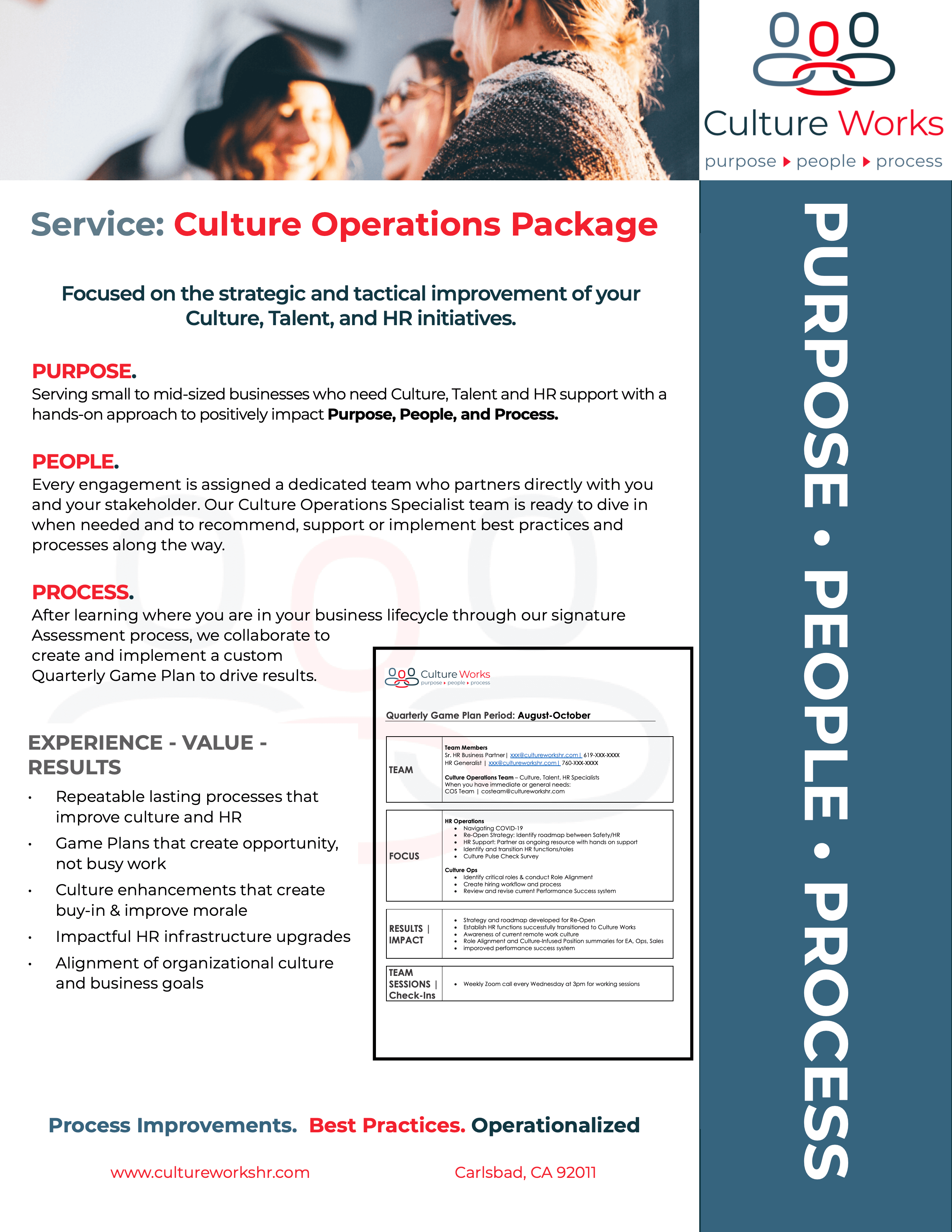
First, let’s define what we mean by “operationalize culture.”  Operationalizing culture is putting purposeful and impactful systems and processes in place and providing effective leadership training to foster culture alignment company-wide.

In other words, it means taking the abstract concept of culture and turning it into something concrete and actionable. This can involve things like defining your company values, establishing rituals and traditions, and incorporating culture into your hiring and onboarding processes.

So, Why is it so Important to Operationalize Culture?

  • The company culture will be aligned and integrated with Purpose
  • The People will evolve and operationalize the company’s culture through talent strategy and development
  • The company will have aligned Processes to support HR, Ops and Leadership

Let’s dive into more of the benefits of operationalizing culture. 

Benefits of Operationalizing Culture

Consistency

Operationalizing culture helps ensure that your company culture is consistent across all departments and levels of the organization. It also helps to reinforce your culture and make it a part of your company’s identity. When culture is operationalized, it becomes a tangible part of your company that employees can see, feel, and experience.

Attracting Talent

Another benefit of operationalizing culture is that it can help you attract top talent. In today’s job market, many candidates are looking for more than just a paycheck. They want to work for a company that shares their values and has a positive culture. When you have a strong, well-defined culture that is visible in your day-to-day operations, it can be a powerful recruiting tool.

Retaining Employees

Furthermore, operationalizing culture can also help you retain your best employees. By fostering a positive work environment that aligns with your values and mission, you can create a sense of belonging and purpose among your team members. This can lead to increased job satisfaction, engagement, and loyalty. When your employees feel valued and connected to your company, they are more likely to stay with you for the long term.

Improving Organizational Performance

When everyone in your company understands and embodies your culture, it can drive more effective decision-making, collaboration, and innovation. Your team members will be better equipped to work together towards a common goal, and to make decisions that align with your values and mission. This can lead to improved productivity, efficiency, and ultimately, profitability.

Building a Strong Brand Reputation

Finally, operationalizing culture can help you build a strong brand reputation. When your company’s culture is well-defined and consistent, it can create a positive image in the minds of your customers, partners, and other stakeholders. This can lead to increased trust, loyalty, and advocacy, which can ultimately drive business growth.

So, how can you operationalize culture in your organization? 

Here are a few tips:

Define your values: Start by identifying the core values that define your company culture. These values should be specific, measurable, and actionable. Once you’ve defined your values, make sure they are communicated to all employees and integrated into your day-to-day operations.

Establish rituals and traditions: Rituals and traditions are a great way to reinforce your company culture and create a sense of community among employees. This could be something as simple as a weekly team meeting or a more elaborate event like an annual company retreat.

Incorporate culture into your hiring process: When hiring new employees, make sure you are looking for candidates who share your company values and are a good fit for your culture. This could involve asking specific questions during the interview process or conducting culture fit assessments.

Make culture part of your performance evaluations: Finally, make sure you are evaluating employees based on how well they embody your company culture. This can help reinforce the importance of culture and ensure that it remains a priority for everyone in the organization.

What Tools and Resources Can Be Used to Help Measure and Operationalize Culture?

Operationalizing culture requires a systematic approach that involves leveraging the resources and tools available to you. Here are some of the tools and resources that can help you measure and operationalize your culture:

  • Surveys: Solicit feedback from your employees to ensure that you are not tone-deaf to their needs and expectations. Listening to your team and taking their feedback into account can help you establish initiatives that are impactful and valued.
  • Company values: Establish company values and integrate them into company practices and branding. When your values are aligned with your practices and branding, it creates a cohesive culture that is easily recognizable both internally and externally.
  • Communication channels: Create company-wide communication channels that improve awareness, emphasize culture expectations, and give recognition. Examples include newsletters, culture-focused email blasts, and communication platforms.
  • Performance Support System (PSS): A PSS can provide the necessary support to employees to enable them to perform their jobs effectively. Providing meaningful PSS can help employees feel supported and empowered.
  • Learning and development: Implement learning and development tools, such as solid training plans for new hires and opportunities for continued education and development internally. This goes beyond just a PIP or through the performance management process.
  • Team outings and events: Foster team building and stronger engagement by organizing team outings, events, and activities that create a sense of unity and purpose.
  • Purposeful meetings: Make meetings more meaningful by aligning them with company goals and values. This can help ensure that meetings are productive and that everyone is working toward the same objectives.
  • Job descriptions and job ads: Specify culture and value expectations in job descriptions and job ads to ensure that there is stronger alignment between your culture and your hiring process.
  • Recruitment process: Maximize the available recruitment tools, such as your LinkedIn page and interview guides, to attract candidates that are aligned with your culture and values.

Final Notes

Operationalizing culture is about taking the abstract concept of culture and making it a tangible part of your day-to-day operations. By defining your values, establishing rituals and traditions, incorporating culture into your hiring process, and making culture part of your performance evaluations, you can create a strong, consistent culture that attracts and retains top talent. 

Need Some Help With Operationalizing Culture?

At Culture Works, we want to partner with your company to create success for your team– whatever that looks like for your specific company. Our passionate HR team has the experience you need in culture ops and hospitality to create success. Our approach is centered upon the importance to humanize, customize, and simplify. We believe in what we do, and we want to help your company operationalize culture, talent, and HR to create ongoing success. Read on to learn more about what we do. Then, read on to learn why hiring the right people can lead your business to success in a recession.


a woman shaking hands with a man in front of her

Whether it’s a new technology implementation, a rebranding effort, or a company-wide restructuring, change is a constant in the world of business. The good news?  There are effective ways to manage change and make the process as smooth as possible. 

So, let’s dive into some strategies for effective change management.

First, What Do We Mean by Effective Change Management?

Effective change management refers to the process of planning, implementing, and managing change in a way that minimizes the negative impacts and maximizes the benefits. 

Why is Change Management Crucial for Small and Mid-size Businesses?

Effective change management can help businesses minimize the negative impacts of change and ensure that changes are implemented successfully. When changes are not managed effectively, it can lead to a range of problems, such as lost productivity, low morale, financial losses, and damage to the business’s reputation.

For small and mid-size businesses, lost productivity can be particularly detrimental, as they may have fewer employees and resources to absorb the impact. Low morale can also be a significant risk, as employees may feel left out of the change process, uncertain about their future, or concerned about their job security. Financial losses hit small and mid-size businesses harder, as they may not have the same financial cushion as larger organizations to absorb the impact of lost revenue or additional expenses.

Finally, poor change management can damage a small or mid-size business’s reputation, making it harder for them to recover and grow. Negative publicity or customer dissatisfaction can harm a business’s brand, leading to a decrease in sales and customer loyalty.

Strategies for Effective Change Management

Create a Plan

Before embarking on any significant change, it’s essential to create a plan. Your plan should outline the reasons for the change, the expected timeline, and the resources needed. 

Here are the essential elements that your plan should have to ensure success:

First, define your strategic goals. What’s the overall objective of this change, and how does it fit into your broader business objectives? Keep your focus on the big picture.

Next, identify the metrics that will measure your success. Establish a baseline, and set clear key performance indicators that will help you track progress.

It’s time to think about implementation. Who’s on your team, who’s overseeing the change, and who needs to sign off on each stage? These details will help ensure that everyone is on the same page.

Lastly, define the project scope. What specific steps and actions are needed to make this change happen? What’s included in the project, and what’s not? Be prepared for any potential roadblocks that may arise along the way.

While it’s important to have a solid plan, it’s also crucial to remain adaptable. The implementation process may throw unexpected challenges your way, so be prepared to adjust as needed. With a thorough plan and some flexibility, you’ll be well on your way to successful change management.

Communicate Effectively

Communication is key when it comes to change management. Be sure to communicate the plan to all relevant parties and be transparent about the reasons for the change. It’s also important to provide regular updates throughout the process to keep everyone informed.

Involve Your Team

Your team is your most valuable asset, so it’s important to involve them in the change process. This includes soliciting feedback and ideas, providing training and support, and encouraging open communication. By involving your team, you can tap into their collective knowledge and expertise, leading to better outcomes.

Stay Flexible

Change can be unpredictable, so it’s essential to remain flexible. Your plan should be adaptable to any unforeseen challenges or opportunities that arise. Be open to feedback and willing to adjust the plan as needed.

Celebrate Successes

Change can be difficult, so it’s important to celebrate successes along the way. Recognize and celebrate milestones and accomplishments throughout the change process. This not only boosts morale but can also help sustain momentum as the organization moves forward.

Review, Revise and Continuously Improve

Change is an ongoing process. It is important to realize that even change management strategies require constant adjustment throughout a project. This process should be integrated into every step to detect and eliminate obstacles, just like communication. The effectiveness of this process depends on the dedication to measurement and analysis, similar to the need for resources and data. Although change can be challenging, it is essential to continuously enhance strategies for optimal results.

Common Challenges in Change Management

Change management can be a tricky task with new approaches and enhancements popping up all the time. But fear not, because with a bit of effort and some cool tools, managing change can be super rewarding.

Organizational change is like a chameleon, always adapting to new consumer expectations and global competition. But let’s be real, change can be tough for us humans. We love our comfort zones and switching things up can be a real struggle. That’s why it’s important to involve people early on and implement processes that work for everyone.

So, what tools can we use to make change management more efficient? Check these out:

  • Product or Business Roadmaps
  • Readiness Assessments
  • Training Tutorials and Education Sessions
  • Stakeholder Feedback Forums
  • Post Mortem Review
  • Measurements and Analytics
  • Resistance Management
  • Continuous Improvement Plan
  • Business Case

There’s no one-size-fits-all approach to change management. Some methods focus on changing the individual to create cultural change, while others look at changing the entire organization to improve things. With a bit of research and planning, a change management strategy can work for any organization, no matter how big or small. The business of change is booming, so let’s embrace it and make some awesome things happen!

Need Some Help With Change Management?

At Culture Works, we want to partner with your company to create success for your team– whatever that looks like for your specific company. Our passionate HR team has the experience you need in culture ops and hospitality to create success. Our approach is centered upon the importance to humanize, customize, and simplify. We believe in what we do, and we want to help your company operationalize culture, talent, and HR to create ongoing success. 

Read on to learn more about what we do. Then, read on to learn why hiring the right people can lead your business to success in a recession.

high angle view of a team of asian and caucasian corporate executives

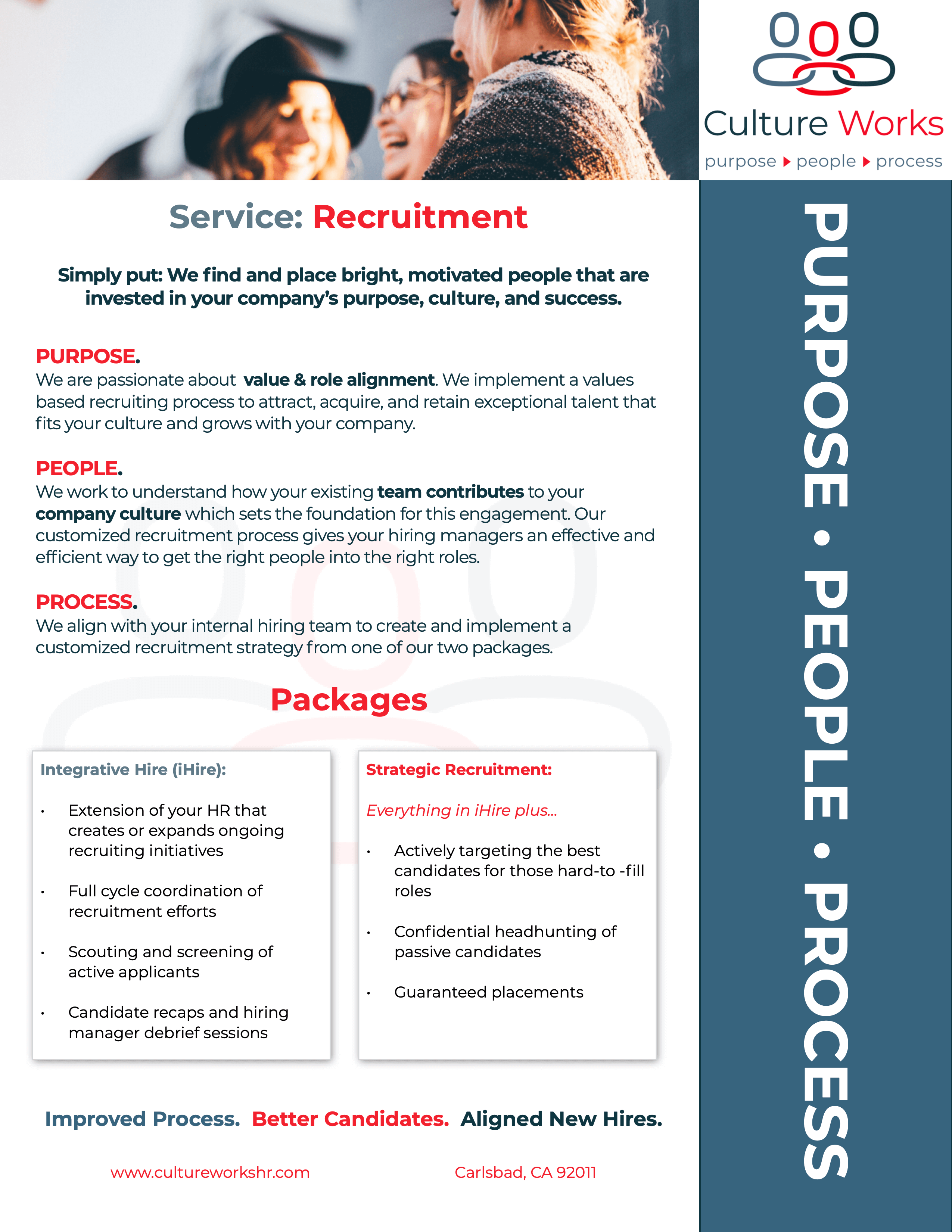
For small business owners, the phrase “HR Team” might sound a little expensive. If you were to create your own in-house team, you’d probably be right. But with an outsourced HR team, and more specifically our Basic: Culture Ops Package, you get a team of experts dedicated to creating a strong culture within your business for an affordable price. And the best part is, you can use us for however long you need us.

Culture is the character and personality of your company. It determines how your clients perceive you, the type of environment your employees operate in, and the overall productivity of the entire business. Cultivating a healthy and dynamic work culture that permeates the business from the top down should be a top priority for any business owner. But how do you create a successful culture?

It starts with you. Your goals, visions, work ethic, and your ability to empathize with clients and employees. But fostering your own positive attributes isn’t enough to instill a great business culture. You need a team that’s solely dedicated to creating and maintaining a positive culture for your business. In other words, the right HR team. 

In this article, we’ll outline what small business owners get from our basic package, and how it can help your business in the long run.

Experience

A diverse team of professionals with 175+ years of collective experience in Operations, People, Talent, and HR is what you get from the Culture Ops team. 

Every member of our Consultants of Service Team is certified and/or degreed in regard to HR and Business Operations. While our team is proud of their merits, they never stop learning and developing to stay ahead of ever-changing trends and practices. Being proactive is a core value of our Consultants. 

Our team also has extensive experience in supporting businesses with a strengths-based team approach. They evaluate the key strengths of your employees and identify how to develop them in a way that emphasizes their strong points. 

Vigilant Service

The Culture Ops: Basic Package comes with a dedicated team that you can rely on week in and week out, all for an affordable price. You’ll get unlimited access to our entire Consultants of Service Team via email and dedicated phone service. 

For more complex issues, you get Live and Virtual assistance when extensive help is required. That may be potential risks that our team has identified or employee relations issue that requires immediate solutions. 

In addition to unlimited access to our team, the Basic Package also comes with an annual Employee Handbook or Culture Operations Playbook to help employees get on the same page. These valuable tools will have you and your employees confident that you are compliant and culture-focused. 

Lastly, you will get quarterly check-ins with our CEO to make sure your relationship with Culture Ops is running smoothly and your company culture is heading in the right direction. 

Real Impact

The Basic Package delivers a real and significant impact on small businesses while remaining financially feasible. That means finding the best practices for your business to proactively promote a positive work culture. As well as reacting to any HR or employee needs with hands-on help the moment an issue comes up. 

Our proactive assistance will drive your People and Culture vision or initiatives to create HR-related solutions. We foster this with ongoing virtual updates and access to:

  • Monthly Legal Update with Legal Counsel
  • Monthly Access to Harassment Training
  • Monthly Access to Learning and Developmental Training Sessions
  • Monthly Culture Blast to be aware of best HR practices 

There’s also an impact that goes beyond the services we offer. When we work on a personal level with our clients, the purpose of their business vision is realized, their employees’ talent and development is optimized, and their entire HR process is finally streamlined. 

Want To Learn More About The Basic Package?

Reading about our basic package can only tell you so much. If you want a real sense of what your business will gain from working with Culture Ops, connect with us today! After all, what makes a great HR and People Operations team is the people behind it. We partner with companies and employees on a personal level, so it’s pretty important we should get to know each other first. 

And if you’re looking for something more than the Basic Package, check out our Full-Integration Package, or better yet, ask us directly. We look forward to connecting. 

California’s new pay transparency law

California’s new pay transparency law is already having a major impact on employers and employees alike. Companies now need to be transparent about what they’re paying and offering to current employees and applicants, while job seekers now have more information when negotiating salary. 

For business owners, having a strong culture and HR team will be more important than ever as our working landscape dramatically changes over the next year. Acquiring and retaining talent will become a more competitive venture as worker compensation becomes more public. 

In this article, we’ll take a look at what the new law is requiring of California business owners, the potential impact of this law in the coming year, and how you can adapt as employee recruitment transforms. 

What Does the New Law Entail?

California’s new pay transparency law requires companies with 15 or more employees to provide workers with pay scale information on their job position as well as a wage range in all job postings. Bonuses, tips, and other benefits do not have to be included in this information.  

All employers regardless of company size must keep records of employees’ job titles and wage rate history for the duration of their time at the company plus three years after they leave. These records must be open to inspection in case of an Equal Pay Act Claim so that the Labor Commissioner can examine if there’s a wage discrepancy.

In addition to the requirements mentioned, companies with 100 or more employees will have to report data to the state on pay and hours worked categorized by the establishment, job category, sex, race, and ethnicity of their employees. 

Failure to comply with these new laws could make business owners subject to penalties of $100 to $10,000 per violation. These laws will require business owners to adapt their recruitment and company culture fast if they haven’t been transparent about pay scales in the past. 

Potential Impact on Employers and Employees

The driving force behind this law is a public demand for pay equity. The hope is that with salaries out in the open, employers will be less inclined to discriminate against workers. For applicants, knowing the wage range for job postings will allow them to properly negotiate pay and make the application process more efficient. 

While some businesses have been slow to adapt to the new law, there could be long-term benefits for business owners that embrace it early. These potential benefits include:

  • Defined salary ranges for employees and applicants can lower the likelihood of pay discrimination and reduce potential legal issues.
  • Defined salary ranges make budgeting and planning easier with less likelihood of overpaying.
  • Pay transparency can build a natural trust within your workforce culture. Employees are more inclined to trust their employer if they know they are being compensated fairly and not being discriminated against.
  • Accurate and specific salary postings make applicants more likely to apply.

There is significant discussion surrounding the advantages that the new law offers to employees, but it is important to note that employers also stand to reap numerous benefits, if not more, from this law. Why? It provides the perfect opportunity to develop a healthy work culture and productive environment through trust. 

How Businesses Can Adapt

The new law has created a highly competitive environment for recruiting talent because applicants now know what they’re going to be entitled to. So besides offering higher salaries, what can you do to attract and keep the best talent for your company?

Before doing anything, you should ensure you are complying with the new law. Conducting a pay equity audit of your company to find discrepancies, determining pay ranges for existing positions, and updating job postings to include pay information are the best ways to make sure you’ll be following the new requirements. 

Next, consider using the 3 Pillars to create a strong company culture that incorporates the new pay transparency requirements.

At Culture Works, we use a 3 Pillar approach when developing a culture for small to mid-sized companies. These pillars are Attract, Engage, and Retain, and they can all be used with the new law.

Attract: Ensuring your HR practices, compensation structures, and talent attraction strategies are aligned with an ever-changing talent pool. 

Having HR operations that know the ins and outs of pay transparency will reduce bad exposure when recruiting talent.

Engage:  Creating performance and culture accountability through culture roadmaps and playbooks. 

Getting everyone on the same page, which pay transparency can aid in, will drive your company’s achievements and success through a motivated and engaged workforce.

Retain: Offer career pathing and promotions to retain your talent and decrease turnover.

Having a clear path for your employees, as well as transparent salary ranges for promotions will serve as a motivator and incentive to stay with your company long-term.

In addition to the 3 Pillars, creating a strong compensation structure will be vital in staying competitive in the new landscape. A compensation structure gives you clear indicators of what pay scale, raises, and bonuses to offer to current employees and applicants. 

Creating and maintaining a good compensation structure consists of gathering relevant data like employee opinions and market research, developing a pay structure that retains and attracts high-level talent, and alignment with a company’s model, life-cycle stage, and workforce plan.

Have More Questions?

The new pay transparency law is radicalizing employee recruitment and retention. Having a strong culture and HR team will be pivotal in adjusting to the new landscape. 

Connect with Culture works today to learn more about the new pay transparency law, adapting to it, and how the right HR team can help your company grow.

Clothing store owners having a discussion

Many small business owners have the same questions when it comes to HR:

  • What is the purpose of my HR department? 
  • What stage of my business growth should I look into HR members? 
  • What different HR roles do I need for my small business?
  • Is a fractional HR team a better option?

In this blog, we’ll break down some of these answers and look into some possible flexible HR solutions for small business owners. 

First Things First: What is HR?

The Society for Human Resource Management (SHRM) defines HR management as “the process of managing an organization’s employees…to effectively meet an organization’s goals.”

What is the Purpose of an HR Department?

If we were to try to simplify the purpose of HR into one sentence, we might say something like: In its most basic function, HR is responsible for employee recruitment, retention, administering employee benefits and training and development. 

However, this is a serious simplification of what HR actually does. 

The duties of a Human Resource Department also typically include:

  • Employee participation and communication
  • Time tracking and attendance
  • Labor law compliance
  • Compensation and benefits management
  • Payroll, including tax compliance
  • Employee satisfaction, engagement, safety, and well-being
  • Onboarding and offboarding
  • Performance reviews
  • Employee rewards and recognition
  • Developing and maintaining employee resources such as training manuals and employee handbooks
  • Creating company culture
  • And more!

​​Key HR Functions for Small Businesses

Key areas of human resources for small businesses are:

  • Recruitment and retention
  • Compensation and benefits
  • Employee engagement
  • Training and development
  • Labor law compliance

What HR Roles Does My Small Business Need?

An HR manager or HR fractional team is your best bet as a small business. There is a difference in cost and outcome in fractional or outsourced HR, but, of course, this all depends on your specific situation. Let’s take a look at these two options.

Fractional HR

Fractional HR tends to be more cost-friendly because hiring a fractional HR team can help reduce the cost of full-time employees while optimizing your existing team’s functionality. The cost of one full-time employee can be the equivalent of receiving a team of employees’ expertise!

Outsourced HR

Outsourcing, on the other hand, can mean a variety of things. It can mean completely relying on the outsourced team instead of hiring an in-house team, or it can be a partnership between your existing team with a company that performs similar or complementary functions. An outsourced team is often a replacement for an in-house team or role.

Need Flexible HR Options? Consider Culture Works

At Culture Works, we work within an extremely focused skillset, we craft Quarterly Game Plans to drive results for your business, and we believe in what we do. Our passionate HR team is here to help your team create success every step of the way. In an effort to give away a few of our secrets, we are sharing a typical 30, 60, and 90-day engagement breakdown as a Culture Works client. 

Let’s take a look at each of these plans in more detail.

30-Day Check-Ins

30-day check-ins begin with the creation of a new 30-day plan and review the commitment to the 30-60-90 day process. This meeting includes stakeholders, team members, and the client success manager. We establish expectations, the approach and working dynamics, the cadence of working sessions, and joint ownership. 

60-Day Check-Ins

60-day check-ins typically included a review of the previous month’s plan and the creation of a new one. In this check-in, we evaluate the partner’s commitment, the results, your team’s experience, the value-add, and how aligned you are feeling with Culture Works’ performance. Next, we work to include a 60-day committed plan for your team.

90 Day Check-Ins

Lastly, the 90-day check-in includes a reflection of the previous two months and an alignment of the next Quarterly Game Plan (QGP) for your team. We will evaluate results up until this point, focusing on your experience, the value you feel Culture Works is bringing to your team, and how aligned you are feeling within your organization. At this time, you will create your first QGP and your stakeholders will receive a complete Client Experience Survey.

Final Thoughts

With Culture Works, we want to partner with your company to create success for your team– whatever that looks like for your specific company. Our passionate HR team has the experience you need in culture ops and hospitality to create success. Our approach is centered upon the importance to humanize, customize, and simplify. We believe in what we do, and we want to help your company operationalize culture, talent, and HR to create ongoing success. 

Read on to learn more about what we do. Then, read on to learn why hiring the right people can lead your business to success in a recession.

Culture Works team

At Culture Works, we get sh*t done, drive results, and take action on undiscovered opportunities. However, this can be a big responsibility and isn’t always as easy as it looks. 

So, how do we do it and why did we start? Today we’re discussing why Culture Works came to be and exploring what the future holds for human resources. 

Let’s hear from Kristi Pastore, the founder and owner of Culture Works. 

[

Read on to learn more about us and why we do what we do (hint: we love it). 

First, Let Us Introduce Ourselves

Our purpose is to operationalize your culture through improved middle management processes that allow the front line to focus on successful operations, and the leadership team to focus on the future.

Culture Works when Purpose, People, and Process are aligned. When people and processes are aligned, you’ll reach your company’s goals faster.

Why Did Kristi Start Culture Works?

Kristi started Culture Works with the intention of building people with an outcome of building businesses. What better way to do that than have a focus on Culture, Talent, and HR? 

Kristi believes in empowering people with information and the right experiences, so they can make informed decisions and drive their true purpose.

What Are Kristi’s Goals For Culture Works Moving Forward?

Kristi’s priority is to maintain a kickass culture while ensuring the safety of each of her team members. She trusts the Culture Works  purpose, process, and team. 

And we have no doubt that creating and practicing our inclusive culture will only continue to lead to greater company success and individual empowerment.

Why is HR Seen as a Police Force And How Do We Stop It?

HR can be seen as a police force due to a dysfunctional culture. What do we mean by dysfunctional? A culture that is not driven by purpose, role alignment and values. 

To put it bluntly, there are some things missing in the culture of the operations or leadership accountability of culture within the workforce. But it’s also where we are as a society, so we all have to get back to developing out of dysfunction. Companies and Teams need to identify the opportunities to develop what is missing. That’s where we help!

How Can Culture Works Help Find What is Missing?

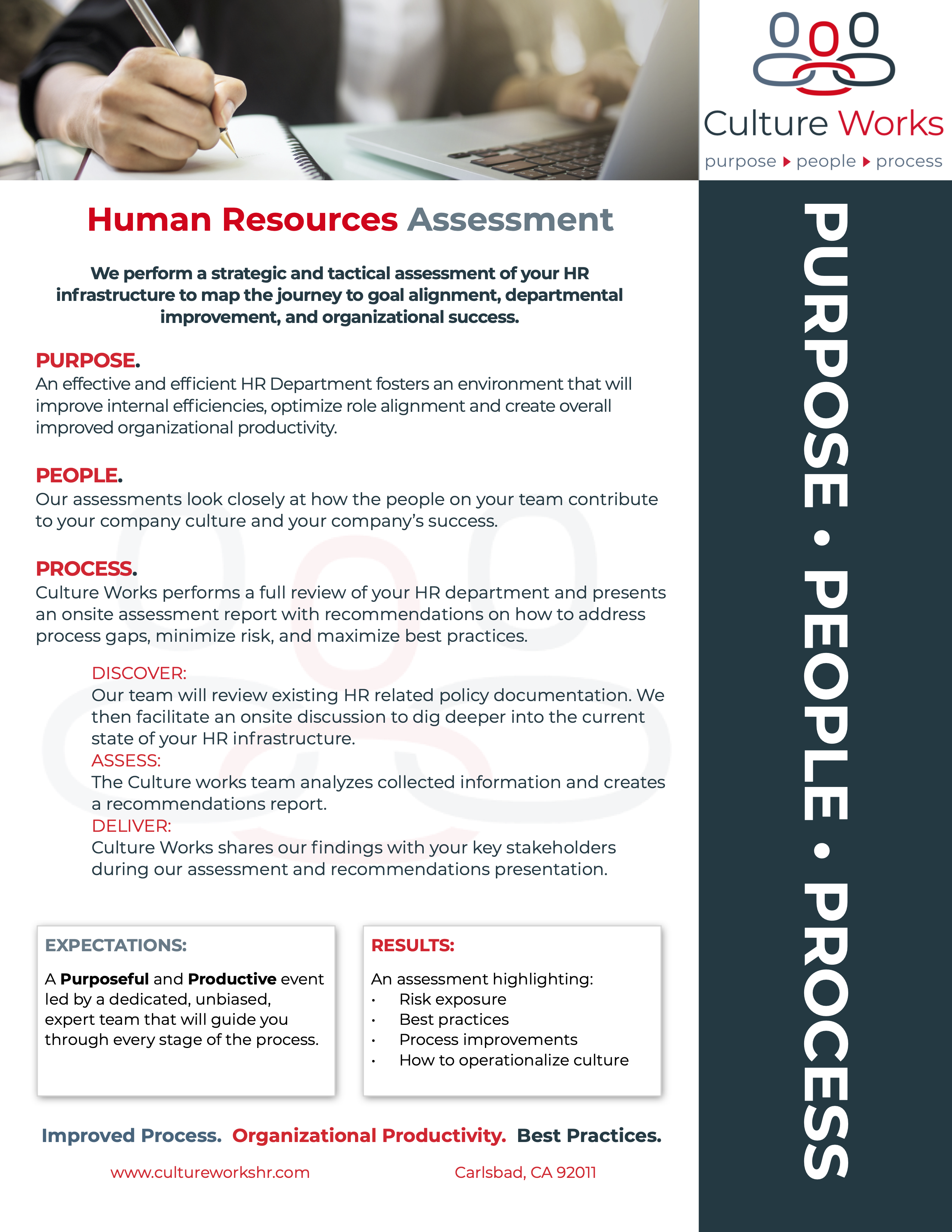
The Culture Works team starts by accessing the culture of an organization. From this assessment, we can find the opportunities and underdeveloped initiatives to kickstart culture in the right direction.

How do we do it? Let’s discuss our assessments.

Culture Works Assessments 

Purpose

Our Culture Assessment focuses on purpose, values, & leadership alignment that serve as building blocks for creating your company’s culture strategy, goal alignment, and operationalizing culture.

People

We explore your current company culture by partnering with leadership and culture influencers, learning from them and inviting them to be a part of the process.

Process

We collaboratively develop a custom assessment process that includes coordination strategy, data collection targets, surveys, and interviews. We then deliver an assessment and roadmap.

What is Commonly Missing?

Some organizations are run solely by money and metrics. We’ll let you in on a little secret: money and metrics are not enough to produce a successful company culture. We focus on factoring in people and purpose with money and metrics to create a thriving workplace culture. 

At Culture Works, We Put People First

We prioritize valuing employees and contributing to employee growth, engagement, and retention. Why? People are often driving the success of an organization: they innovate, they engage, they collaborate.  The people at an organization contribute in a variety of ways that doesn’t just include their job duties. 

That’s why we think it’s so important to have a powerful community of people in your organization and to support them in their roles and development.

Let’s Talk About the Future of HR: What Will It Look Like?

HR in the future will not look like HR today – and we’re okay with that.

Automated Processes

Many of HR’s operational functions will be automated and optimized. This can include functions such as payroll, for example. Why do we think this? Technology is advancing quickly and can be an efficient option in taking over some of the operations. 

That’s why the future HR will bring the human element to organizations.

The Future of Human Resources: The Human Element

We think the future of human resources will be talent development, talent strategy, and building purpose and people-driven businesses.  

While we can trust technology to take care of some processes, we still need HR to bring a human connection to operations such as team and client interactions, as well as talent strategy and talent development.

Learn More About Us

Consider Culture Works. Our goal is to work with you for as long as you and your owners, operators and stakeholders need us!  We do this by operationalizing your culture, fostering the development of your leadership teams, and driving HR initiatives.  

We build Quarterly Game Plans and Culture Success Roadmaps that are focused on Culture, Talent, and HR initiatives and real results.Learn more about our services, here.

learning and development program at an office

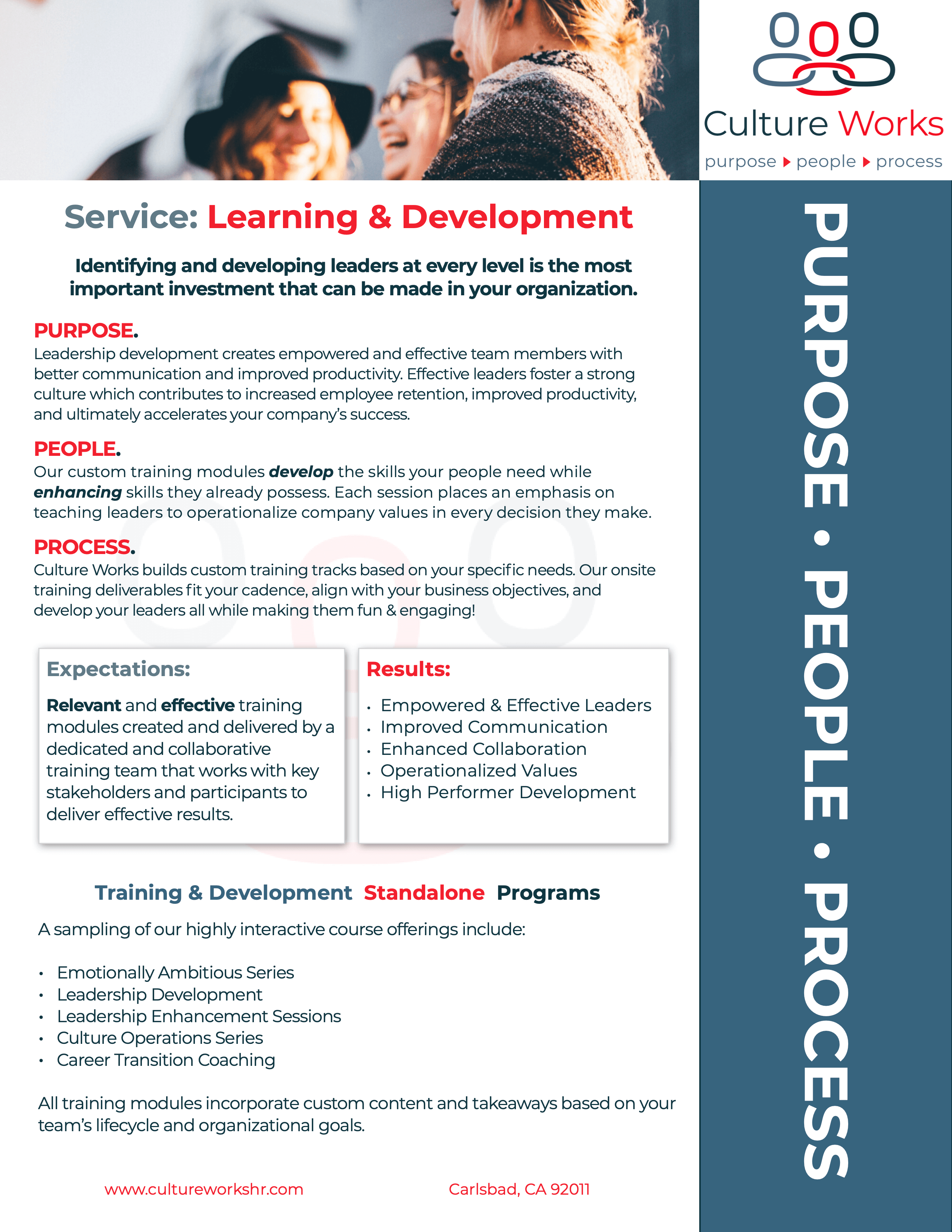
Did you know that 93% of employees say they will stay longer at a company that invests in their career development? Wow! Learning and development programs are directly related to greater employee retention and satisfaction. 

Learning and development isn’t just about lunch and learns or a quick presentation on a Tuesday afternoon. So, how do we avoid those glazed over eyes and make programs that actually help our employees grow?

Let’s hear from Sabrina, the Culture Works L&D Specialist.

[

Read on for more information about learning and development programs and how to implement these programs in your organization. Let’s dive in.

First, What Are Learning and Development Programs?

Learning and development (L&D), also known as training and development, is a part of HR that aligns employee goals and performance with that of the organization. Leaders of learning and development within your organization should identify skill gaps within teams and develop and deliver training to help bridge those gaps.

What Are the Responsibilities of Learning and Development Programs?

A learning and development team typically takes on a few responsibilities. These include: 

  • Evaluating organizational and individual employee development needs
  • Ensuring alignment of proposed L&D programs with business goals
  • Developing and implementing learning strategies and programs to meet the needs of the business and its employees. 
  • Designing or hiring the right team to provide eLearning courses, interactive group training, and a variety of other training content.
  • Marketing the training programs to get management and employee buy-in.

We understand this list can seem a bit daunting and organizations may not be sure where to start. The good news? Leaders can use purposeful strategies to better implement L&D into their business. These strategies focus on creating an environment where employees can learn, practice, and apply their skills. 

Let’s take a look at some strategies to implement L&D into your organization. 

Successful Strategies to Implement Learning and Development Programs

Learning and development programs can be an excellent step toward improving retention. These programs can make employees feel valued, supported, and productive as well as build a strong company culture.

From our experience, we’ve found the biggest challenge for employers is creating a learning and development environment that helps their employees succeed. In order to create this environment, you need to know what you’re creating–a clear goal can help drive the process forward smoothly and efficiently.  

Contextualize the Learning 

Research has shown that learners are less likely to apply what they learn if it is taught in a different context than it will be applied. 

One strategy to combat this issue is to create customized training programs. In these programs, instructors target specific topics on a team or individual level. 

Break Trainings into Portions

Research suggests that dividing training into smaller increments can help learners retain and apply information. Leaders may experience more positive benefits of learning and development programs if they break up training into small, structured portions. 

Measure Progress and Benchmark Performance 

Your L&D strategy should include clear objectives and performance indicators. Leaders should consistently measure progress by utilizing these indicators. In reviewing the performance of the L&D strategies, leaders can review:

  • Employee retention and satisfaction
  • Cohesion among teams 
  • Employee growth 

Provide Helpful Reminders

Leaders can offer short, helpful reminders for their teams to use the skills from the learning and development trainings. These reminders, which can take the form of an email or push notification,  should be contextual, friendly, and just a few sentences. These nudges can be as simple as “this project would be a great opportunity to try this skill that we learned!”

The purpose of these reminders is to keep the ideas from the training at the front of the learner’s mind as they navigate their day-to-day responsibilities.

Follow Up and Reflect

To effectively employ learning and development strategies, leaders should encourage learners to reflect on how the skills and tools they have learned can be used in the workday. 

Learn more about each of these strategies in our guide to implementing L&D into your organization, here.

Need Help Implementing L&D into Your Business?

At Culture Works, we value the opportunity to help businesses implement learning and development programs into their company culture. Our team of experts is ready to partner with your team to build greater organizational success. 

Contact us today to learn how we can help your business implement these programs and contribute to positive company culture.Interested in more information? Read on to see how learning and development can transform your company culture here.

woman explaining people operations to her co-workers

Some companies may use the terms “people operations” and “human resources” interchangeably. However,  while people operations falls under the umbrella of human resources, the two are separate entities and maintain a few key differences. 

These differences include varying goals, strategies and functions. Let’s start with some definitions.

First, What is People Operations?

Human resources has been around for decades. In fact, the first human resources department might have originated in 1901! So, where did this new term “people operations” come from? 

The answer is: Google in the early 2000’s. After Google pioneered the term, it quickly began gaining popularity throughout human resources. Let’s take a look at its definition.

People Operations – also referred to as People Ops or POPs– is a people-focused approach to managing a workforce. 

How is People Operations Different from Human Resources?

Human resources tends to focus on elements such as productivity and compliance, whereas people operations places emphasis on employee satisfaction, happiness and development.

Let’s review a few examples.

Main Focuses

The main focuses of traditional HR may include enforcing rules and reducing liability. The main focus of people operations, on the other hand, includes valuing employees and contributing to employee growth, engagement, and retention.

Conflict Prevention and Resolution

Old HR often responds to issues as or after they arise. People operations make an effort to proactively prevent issues through people, purpose, and processes.  

Hiring and Role Alignment

Old HR fills vacant positions at organizations. People operations place more emphasis on retaining employees.

Further, traditional human resources may speak with employees about poor performance. People operations value role alignment and place employees in the best position for success. 

While this shift may seem small, there are significant impacts. For instance, a people-first approach results in higher employee engagement and retention. 

What Are the Main Responsibilities of People Operations?

Any People Ops department has several key priorities they’re striving to meet in an organization. While some of these goals may differ, there are a few that every People Ops department likely shares. Let’s take a look.  

Connecting With Employees

The main goal of people operations is to strengthen the connection between HR and employees. At Culture Works, we believe that successful HR practitioners put their people first. 

Making HR a Resource Instead of Policing Employees

Some may associate HR with awkward conversations enforcing rules and policies. People operations shifts these impersonal conversations into humanized processes.  The new HR will use these processes not to enable people, but rather to empower them. 

Operating With a Mindset of Growth

People operations places importance on the growth and development of employees. 

How Is People Operations Implemented?

All of these benefits sound pretty great, right? We think so too. However, many HR practitioners may be wondering: how exactly does people operations work?

Shifting From Manual to Automation

Use technology instead of humans for repetitive tasks. These tasks can include, for example, payroll, data entry, or processing and reporting. 

Prioritizing Data Over Guesswork

Capture, review and share insights driven by data about the workforce. What kind of data, you may ask? We’re all about HR metrics and KPIs. 

HR metrics and KPIs help human resources (HR) professionals guide the development of their organization and track its efficiency. Key performance indicators, or KPIs, are quantifiable measures of performance over time for a specific objective. KPIs clearly articulate what an organization needs to achieve to reach its long-term objectives.

Through using this data – and not just gut feelings or quick conversations – HR practitioners can focus on concrete improvements and where the organization is thriving.

Learn more about HR metrics and KPIs, here. 

We understand that some parts of HR will have to stay. However, many of these systems and processes can be upgraded or automated.

This is the New HR. Ready to Get Started?

Consider Culture Works. Our goal is to work with you for as long as you and your stakeholders need us!  We do this by operationalizing your culture, fostering the development of your leadership teams, and driving HR initiatives.  

We build Quarterly Game Plans that are focused on Culture, Talent, and HR initiatives and real results.

Learn more about our services, here.

talent development

Talent development—designed to attract, develop, motivate, and retain productive, engaged employees—is essential to an organization’s success and sustainability.

According to LinkedIn’s 2019 Workforce Learning Report, 94% of employees say that they would stay at a company longer if the company invested in their employee learning.

This considered, leaders should prioritize continuous efforts to:

  • Engage talent
  • Identify opportunities for learning and development (L&D)
  • Train for expectations, and
  • Manage outcomes

So, how can you facilitate talent development in your organization? Let’s find out.

Why Is It Important to Develop Talent in the Workplace?

At its core, talent development is the process of building your people in line with your company’s goals and plans (and just a little secret from us: your people are your greatest asset).

Let’s be honest: When organizations are not actively striving to help employees achieve their potential and goals, people are more likely to jump ship and look for something better.

This harsh reality is WHY talent development is so important in your organization!

Talent development can make employees feel seen and supported; therefore, making them more likely to stay and grow within their current organization.

What is the Process of Developing Talent?

The process of developing talent is not as quick as a bi-monthly “learn and lunch,” a set of slides for employees to click through, or a brief meeting before the team heads out for the weekend. 

What does this mean for leaders? It might be time to ditch the idea of leaving new hires to complete courses on computers or grouping the whole team together for all learning and development efforts.

Instead, the process of training and development is continuous throughout the lifecycle of an employee and should be performed on an individual, ongoing basis.

The good news? Leaders can kickstart and maintain talent development in just a few simple steps (and some patience and dedication never hurt anyone either!)

Wondering what these steps are? Let’s dive in. 

What Are the Four Steps of Talent Development in Your Organization?

Engage the Talent

Leaders can access the talent of the team as well as get employees involved with the process. A cookie-cutter approach to developing talent won’t have the same results as a collaborative, adaptable process.

But what does this process look like?

Employees can play an active role in how they want to develop their talent. For example, the skills they want to perfect, career opportunities they may want to pursue down the line, and how the company can help them accomplish these goals (i.e. what learning opportunities will work best for them).

Identify Learning and Development Opportunities

Leaders can take an inventory of current employee skills and identify opportunities for learning and development within their team.

Leaders can do this by asking questions like:

  • What skills are utilized?
  • How can the team improve our soft skills?
  • Are there any gaps in the workforce?
  • Is the team gaining hands-on experience?
  • Is the team lacking any particular KSAs (knowledge, skills, and abilities)?
  • How is the company supporting career development?

Train For Expectations

Leaders can consider company objectives and strategies, effectively training employees to meet these expectations. These expectations can include:

  • Role requirements
  • Role alignment
  • Value alignment, and
  • Culture accountability

Leaders may implement the strategies of upskilling, reskilling, or cross-skilling to meet expectations.

Let’s Talk Upskilling, Reskilling, and Cross-Skilling

What the heck is upskilling, reskilling, and cross-skilling!? Don’t worry—we’ve got you covered.

Upskilling

Providing existing employees with new or more advanced skills within their role through education and training. Read on to learn more about upskilling.

Reskilling

Helps employees learn new skills that will be useful in an entirely different role.

Cross-Skilling

Gives employees the skills to perform multiple functions at a company. 

What is the Difference Between Talent Development and Upskilling?

Talent development and upskilling are similar but have a few key differences.

We like to think of it like this:

Upskilling focuses on just that: Skills! Talent development, on the other hand, takes a broad approach to encourage employees to learn and grow.

Moreover, talent development includes skills and upskilling but is not just limited to those attributes. A talent development strategy may include more soft skills, culture, and role alignment than upskilling does.

Manage Outcomes

A talent development strategy should include clear objectives and performance indicators. Leaders can consistently measure progress by utilizing these indicators. 

Need Help Developing Talent in Your Organization?

At Culture Works, we value the opportunity to help businesses implement learning and development programs into their company culture. Our team of experts is ready to partner with your team to build greater organizational success.

Contact us today to learn how we can help your business implement these programs and contribute to positive company culture.

Interested in more information? Read on to see how learning and development can transform your company culture.

HR team tracking HR metrics and KPIs

HR metrics and KPIs help human resources (HR) professionals guide the development of their organization and track its efficiency.

Peter Drucker, management guru, famously stated: “What gets measured, gets managed.”

These measurements show the methods that are working, aren’t working, and where to focus future efforts. But what measurements should HR professionals be tracking to drive their organization toward success? Let’s take a look at some key metrics.

What are HR Metrics?

Human resources metrics, or HR metrics, provide data on a business’s performance.

What are Key Performance Indicators (KPIs)?

Key performance indicators, or KPIs, are quantifiable measures of performance over time for a specific objective. KPIs clearly articulate what an organization needs to achieve to reach its long-term objectives.

 KPIs provide:

  • Goals a team should aim for
  • Milestones to measure progress, and
  • Insight from team members across the organization

Successful strategic plans may have between five and seven key performance indicators to keep a pulse on how a team is performing.

What’s the Difference Between HR Metrics and KPIs?

While ‘HR metrics’ and ‘KPIs’ are often used interchangeably, there are a couple of important differences.

We like to break it down like this:

Key performance indicators help to define strategy and provide a clear focus for an organization. Metrics are measures of everyday activities that add value to an organization but aren’t the critical measure for achievable goals.

Think of it like this: Every KPI is a metric, but not every metric is a KPI.

For instance, ‘organic inbound website traffic’ is an example of a metric. While this metric is important to track, it is not as considered, or clearly defined as, a KPI.

An example of a KPI would be ‘targeted new clients per month.’

Now that we understand what each of these measurements is, let’s dive into what HR metrics and KPIs you should be tracking.

What HR Metrics You Should be Tracking

HR metrics help HR professionals understand and maintain efficiency in the daily operations of their organization.

While there are dozens of important HR metrics, let’s focus on a few that may be valuable for your business:

Quality of Hire

Quality of hire is an essential metric for evaluating the effectiveness of an organization’s hiring process.

A healthy quality of hire metric shows that:

  • The hiring team brings in good people
  • Managers support retention efforts, and
  • New hires are consistently thriving in their roles

However, attempting to define this measurement can be difficult.

HR professionals may choose to review turnover, performance reviews, and hiring manager satisfaction as proxy measurements. The combination of these results can help indicate if a new hire is happy and performing well in their position.

Demographics and Diversity

Diverse teams are necessary for any company–but they don’t build themselves! HR professionals and hiring teams should be making cognizant efforts to build and maintain diverse teams.

To gain an understanding of their company’s demographics and diversity, HR professionals can analyze data such as the gender diversity ratio and pay gap.

Let’s take a brief look at each of these metrics.

The Gender Diversity Ratio 

This ratio helps HR professionals determine whether there is an equitable or fair representation of different genders within a company. While this metric is most commonly used to measure the ratio of men vs. women, it can also include people who identify as non-binary or other gender identities.

Pay Gaps 

HR professionals can make closing pay gaps a priority in their organization. 

In the United States, the gender pay gap between men and women is approximately 18%. However, this gap varies by race and ethnicity as well.

According to the Bureau of Labor Statistics, white women earned 82% as much as white men, black women earned 85% as much as black men, and Asian women earned just 70% as much as Asian men.

By reviewing these gaps, HR professionals can understand their organization’s culture and how their policies apply to different gender groups.

Absenteeism Rates

Absenteeism rates are important for HR professionals to review because they can indicate poor management, employee burnout, workplace stress, and/or employee disengagement.

If an HR professional notices an employee is taking short absences regularly, they can schedule a 1:1 to check in on their health, well-being, and company satisfaction.

What KPIs You Should be Tracking

Time to Fill

Time to fill is the measure of days a company takes to fill an open position from the date the job is listed to the date the new hire accepts the position.

This metric is often expressed through dividing the total number of days for each position by the number of new hires or positions filled.

Typically, organizations measure time to fill for external candidates because hiring internal candidates includes a different process.

The Society for Human Resource Management (SHRM) set the benchmark for time-to-fill at 42 days.

Employee Turnover Rate

High employee turnover can have a range of negative effects on an organization. For example, high turnover can be costly, cause reduced morale, and make it difficult for employers to hire and retain high-potential talent.

To thoroughly measure employee turnover, HR professionals may choose to monitor several different metrics, including:

  • Overall Turnover Rate: The percentage of employees that have exited the company over some time.
  • Voluntary Turnover: Employees who leave a company on their own, whether for an opportunity at another company or to pursue other goals (i.e. going to school).
  • Involuntary Turnover: Employees who are laid off or otherwise terminated.

By analyzing these rates, an HR professional can understand where the organization is excelling and where it may need improvement in terms of employee retention.

What is the Purpose of Tracking These Metrics?

HR metrics and KPIs help HR professionals to address company issues head-on, maintaining a clear understanding of where their company is at using data.

Determining which metrics should be tracked as KPI’s can vary based on an organization’s goals, values, areas for improvement, and needed areas to highlight in reporting. All metrics are important to keep a pulse on, but KPI’s are highlighted to provide a spotlight on those metrics that need focus.

According to the SHRM HR Magazine, HR is held back by the following shortcomings:

  • 46% – Failure to identify shared priorities and strategic goals
  • 34% – Inability to communicate effectively in real-time
  • 27% – Failure to reference the most up-to-date, accurate data
  • 24% – Lack of automation for shared HR/finance processes
  • 21% – Use of different systems to access data

By tracking metrics, identifying high-impact KPI’s, and using data to drive your people-minded decisions, you can align your HR initiatives with your organization’s goals, obtain buy in from stakeholders, and have a clear vision of where to focus your efforts. 

Need Help Tracking Your HR Metrics and KPIs?

At Culture Works, our assessments focus on purpose, values, and leadership alignment that serve as building blocks for creating your company’s culture strategy, goal alignment, and operationalizing culture.
Read on for more information about our culture assessment and other services. Then, check out our article to learn how to bring emotional intelligence into the workplace.

Count me in!

Practical steps you can take to make your company culture (and yourself) even better.

Signup for our newsletter below to stay up-to-date on our latest HR news & insights!

LINKS

CONTACT

(760) 334-4094

info@cultureworkshr.com

29970 Technology Drive
Murrieta, CA 92563

HOURS

Mon-Fri: 7:00-4:00
Sat: Closed
Sun: Closed

CONNECT WITH US!

© 2026 Culture Works – all rights reserved

site design by digitalstoryteller.io

© 2024 Culture Works – all rights reserved
site design by digitalstoryteller.io