work celebration party with confetti pink company culture

It’s official! Our company, Culture Works, is two—happy anniversary to us! We are so excited to continue working with our amazing clients to make productivity soar, reduce churn, and operationalize culture through:

  • HR Consulting
  • Culture Operations
  • Talent Recruitment
  • And more!

We love operationalizing the vision of role and value alignment through true culture operations and culture accountability, and can’t wait to do more of it.

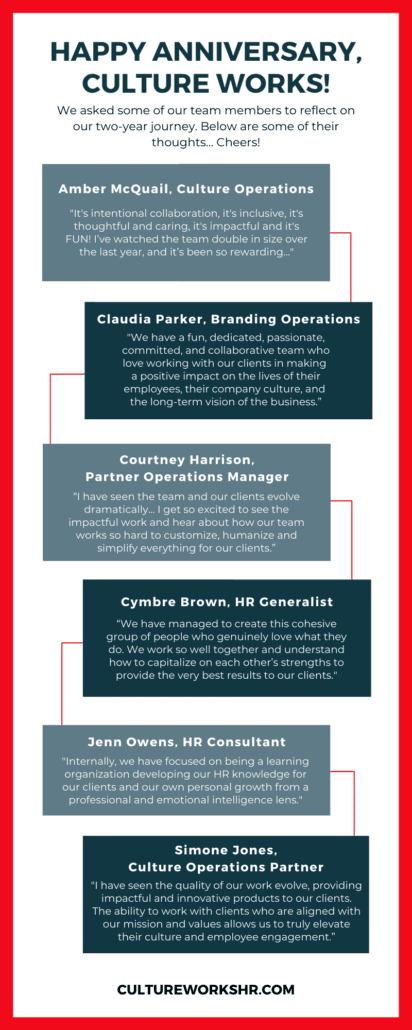
In the spirit of Culture Works turning two, we asked some of our team members to reflect on our two-year journey. Below are a few of their thoughts… Cheers!

Reflecting On Our Two-Year Journey

Who? Amber McQuail, Culture Operations

What She Has to Say: “Culture Works’ mission and values are not just words on a page, EVERYONE definitely walks the walk and talks the talk. It’s intentional collaboration, it’s inclusive, it’s thoughtful and caring, it’s impactful and it’s FUN!  I’ve watched the team double in size over the last year, and it’s been so rewarding to see an entire group of professionals grow and thrive alongside their clients and always be eager for more.”


Who? Claudia Parker, Branding Operations

What She Has to Say: “It is exciting to partner with companies that share our passion for employees and company culture. We have a fun, dedicated, passionate, committed, and collaborative team who love working with our clients in making a positive impact on the lives of their employees, their company culture, and the long-term vision of the business.”


Who? Courtney Harrison, Partner Operations Manager

What She Has to Say: “Since I have been with Culture Works I have seen the team and our clients evolve dramatically. Our team collaborates and elevates the level of work product for our clients to unbelievable heights. I get so excited to see the impactful work and hear about how our team works so hard to customize, humanize and simplify everything for our clients.”


Who? Cymbre Brown, HR Generalist

What She Has to Say: “We have managed to create this cohesive group of people who genuinely love what they do. We work so well together and understand how to capitalize on each other’s strengths to provide the very best results to our clients. I have never worked with a group of people that are so committed to a company’s vision. I am so proud of all that WE have accomplished.”


Who? Jenn Owens, HR Consultant

What She Has to Say: “Internally, we have focused on being a learning organization developing our HR knowledge for our clients and our own personal growth from a professional and emotional intelligence lens. Externally, our focus on partnering with companies to better understand their business and how we can help them build an amazing place for their employees to work has shown that HR is a partner here to help make company culture better.”


Who? Lea Vergara, HR Generalist

What She Has to Say: “Joining Culture Works has been the most exciting and rewarding experience of my career. Our team is so supportive – of each other and our clients. I love that we genuinely care for our clients, and it is rewarding to see them change for the better as organizations through their partnership with Culture Works.”


Who? Margie Holmstrom, Senior HR Generalist

What She Has to Say: “I have been with Culture Works for about 7 months now and I am so impressed with the company and its leader, Kristi! She ‘walks the talk’ in every way and that’s not something you see every day in business. Whenever we provide HR guidance, work products, or process improvements, clients never fail to express how grateful they are. I’m so excited for Culture Works’ 2-year anniversary – I can’t wait to see what our future holds! I’m thankful to be a part of this amazing company and team!”


Who? Sabrina Vonch, L&D Specialist

What She Has to Say: “I was recently asked, ‘What would I change about Culture Works?’ This question, in sincerity, stumped me. As a learning organization, Culture Works is committed to a growth mindset. This mindset allows us to stay innovative not only for our team but also for our clients. If something is not working, we learn from it, make the necessary changes to improve and keep moving forward. We are inherently fostering change and embracing our company values daily – I wouldn’t have it any other way.”


Who? Simone Jones, Culture Operations Partner

What She Has to Say: “Since I joined Culture Works, I have seen the quality of our work evolve, providing impactful and innovative products to our clients. The ability to work with clients who are aligned with our mission and values allows us to truly elevate their culture and employee engagement.”

Interested in learning more about how the Culture Works team works? Read on to learn how we retain our top talent (and how you should, too!)

culture works anniversary
HRIS HCM HXM

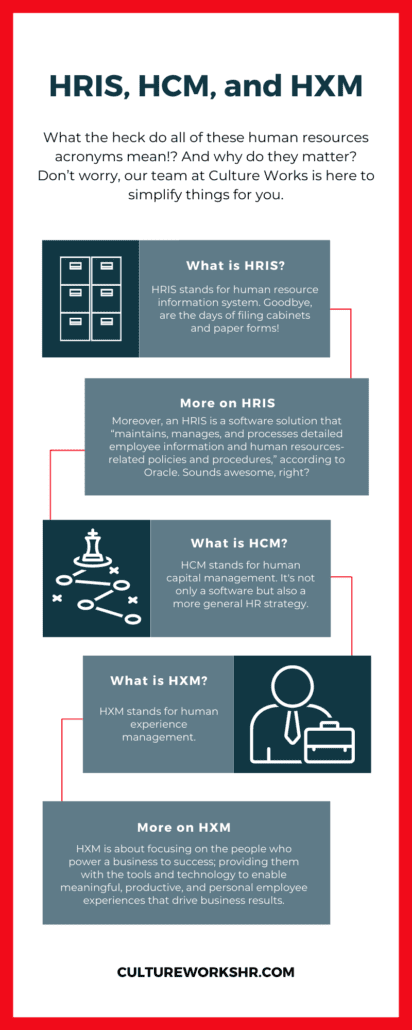
HRIS, HCM, HXM… What the heck do all of these human resources acronyms mean!? And why do they matter? Don’t worry, our team at Culture Works is here to simplify things for you.

Let’s get down to the explanations, starting with HRIS.

What is HRIS?

HRIS stands for human resource information system. Gone are the days of filing cabinets and paper forms!

Moreover, an HRIS is a software solution that “maintains, manages, and processes detailed employee information and human resources-related policies and procedures,” according to Oracle. Sounds awesome, right?

“The HRIS standardizes human resources (HR) tasks and processes while facilitating accurate record-keeping and reporting.”

What Are the Benefits of HRIS?

Potential benefits of implementing an HRIS include:

  • Increased productivity
  • The ability to make data-driven decisions
  • Improved operational efficiency
  • Increased employee satisfaction
  • Enhance user experiences
  • Accommodate business growth
  • Maintain compliance

HRIS Examples

Here are some HRIS software examples, courtesy of Adam Enfroy.

  • ADP
  • Namely HR
  • Paycor HR
  • Bamboo HR
  • Workday
  • Zenefits
  • UKG Pro
  • Sapling

What is HCM?

HCM stands for human capital management.

Similar to HRIS, HCM is a great tool for overworked HR teams and line managers, as it frees up time from various HR tasks. To clarify, human capital management is not only software but also a more general HR strategy.

According to ADP, human capital management is “the process of hiring the right people, managing workforces effectively and optimizing productivity… [This strategy is] made up of a series of administrative and strategic applications that include:

  • Recruitment
  • Onboarding
  • Payroll
  • Time and attendance
  • Benefits and retirement services
  • Talent management
  • Training
  • Reporting and analytics
  • Compliance”

So, has your company spent time developing a quality HCM strategy? Look below for its primary benefit.

The Primary Benefit of HCM

Most importantly, an effective HCM strategy helps increase workforce productivity while helping HR managers hire, engage, and retain employees.

What is HXM?

Let’s address our final acronym: HXM. HXM stands for human experience management. Human experience management continues to build upon human capital management (HCM).

The Future of Customer Engagement, Experience, and Engagement describes HXM best. Unlike HCM—which focuses “on facilitating transactions and pushing top-down HR processes”—HXM is “all about focusing on the people who power a business to success; providing them with the tools and technology to enable meaningful, productive, and personal employee experiences that drive business results.” Awesome, right?

After all, we all know that when your employees have positive work experiences, their productivity, creativity, and ability to serve all increase. On the contrary, a negative employee experience can result in decreased productivity, poor performance, and therefore, negative customer or client experiences.

The newly emerging idea of HXM manages the role that employee experience plays in developing high-performing companies. Don’t believe in the importance of HXM? Check out this article by Forbes, “5 Reasons Why Human Experience Management Is The Future Of HR.”

A Final Word

The fact of the matter is that your business doesn’t want to be focusing on HRIS, HCM, and HXM solely to protect itself, or because it’s what you “should be doing.”

HRIS, HCM, and HXM help foster amazing company culture—and are why it’s important to build a team that is focused on building this standup culture. Interested in learning more? Read on for ten unique ways to support your company culture through human connection.

A woman using a tablet

Planning on exiting your business? Let’s discuss the first step you should take when doing so as a business owner: revisiting your org chart. But you might be wondering, what is an org chart, and why is it important?

What is an Org Chart?

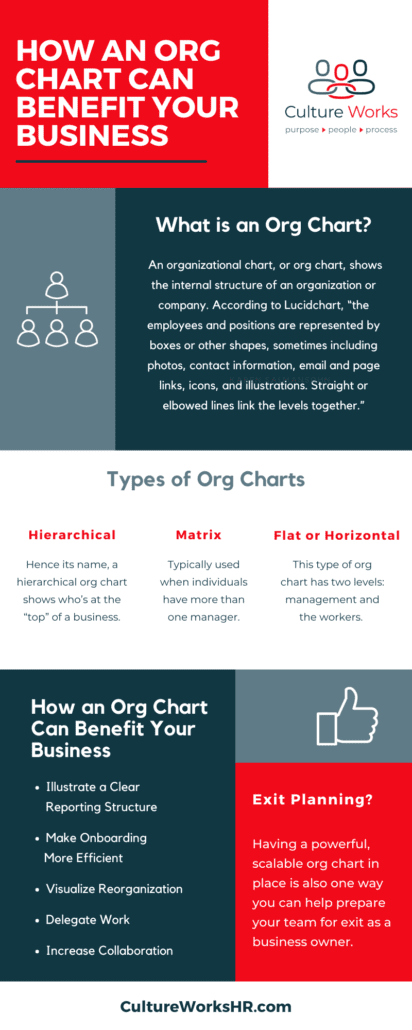
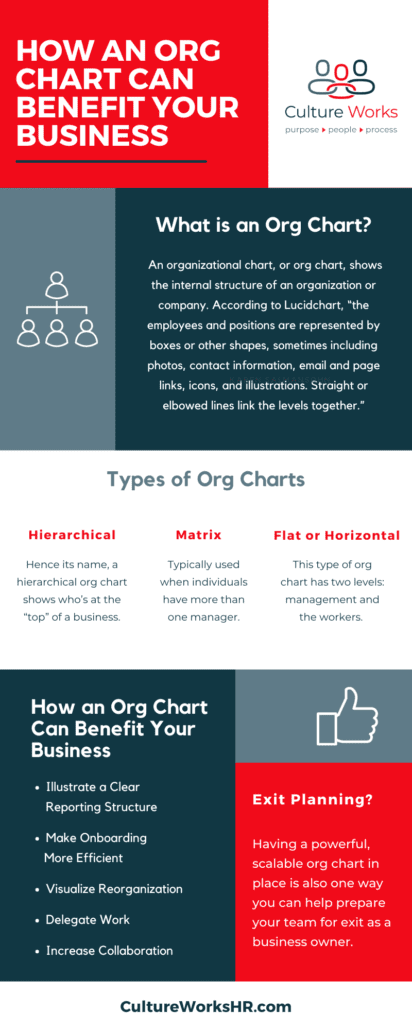
First, for those who need a refresher, what is an org chart? An organizational chart, or org chart, shows the internal structure of an organization or company.

This considered, org charts house a lot of information. Also, there are many different types of org charts. For example:

  • Hierarchical Org Chart: Hence its name, shows who’s at the “top” of a business.
  • Matrix Org Chart: Typically used when individuals have more than one manager.
  • Flat or Horizontal Org Chart: This type of org chart is simple with just two levels: management and the workers. There are little or no levels of middle management in flat and horizontal org charts.
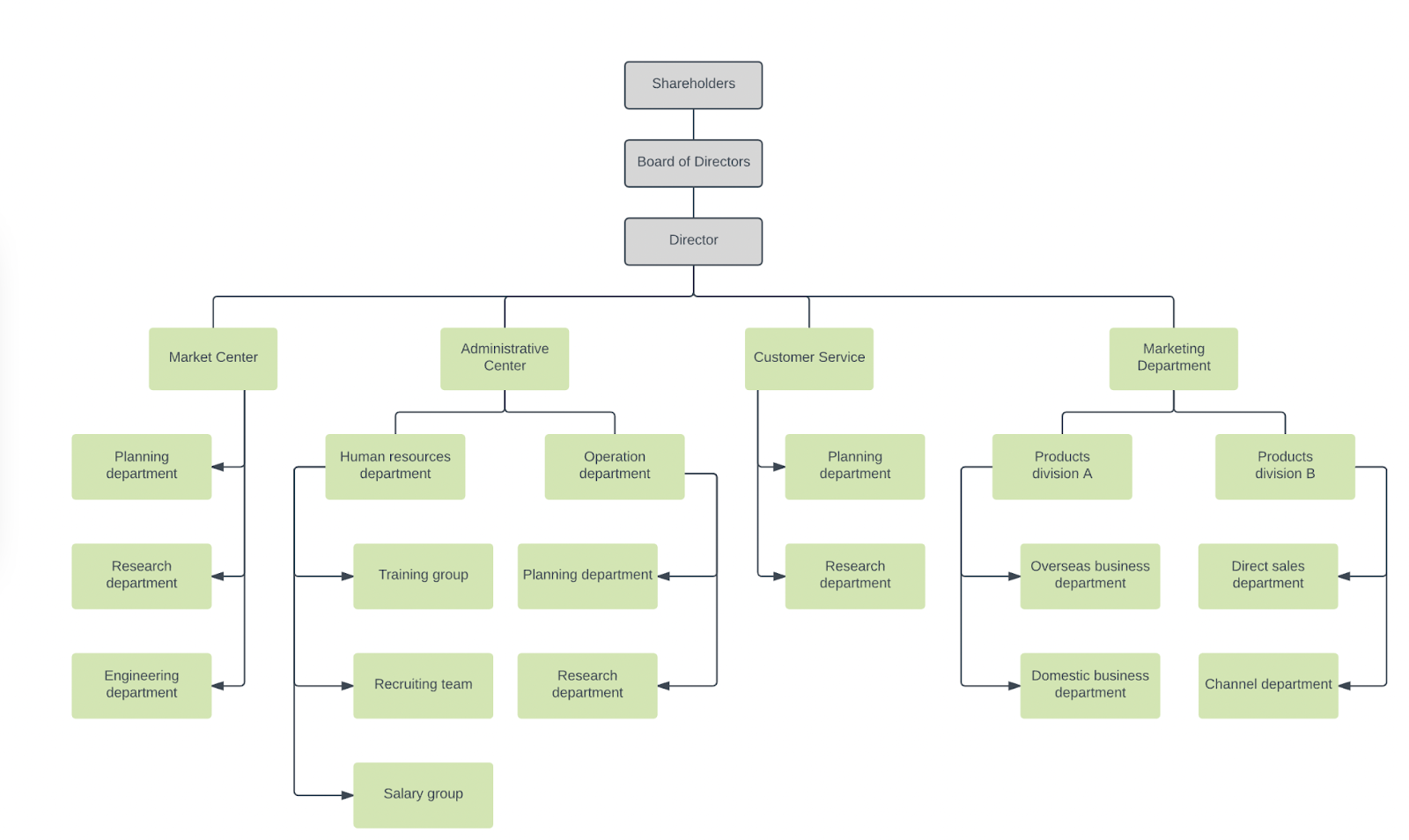
Org Chart
Above is an example of a “Matrix Org Chart” from Lucidchart.com.

How an Org Chart Can Benefit Your Business

So, now that we’ve refreshed your memory about org charts, how can they benefit your business? As a business owner, there are many benefits to using and maintaining your org chart. An org chart can help…

Org Charts for your business

Illustrate a Clear Reporting Structure

For big companies especially, org charts are extremely useful in illustrating who is a part of the company, who reports to who, who manages each department, and so on.

(Could we say “who” any more times!?)

By using an organizational chart, your company increases its efficiency; employees know exactly who to go to as needed.

Make Onboarding More Efficient

The onboarding process can be a thorn in your side as a business owner. There are so many people for your new hire to meet and remember! Creating an org chart can make your new hire more comfortable and help them put names to faces quicker.

Visualize Reorganization

The fact of the matter is that most of your employees won’t stay in the same role forever. Whether you have individuals shifting from department to department or from role to role, investing in quality org chart software can help you visualize your business’s reorganization with ease.

Delegate Work

A top notch org chart can help employees see their workload clearly. Additionally, an org chart can be helpful to identify when/if department heads need support. For example, are they managing a team of seven when they only have the bandwidth to manage five or six? An org chart can clearly paint this picture to help delegate work.

Increase Collaboration

When you have an awesome org chart, it’s something that can be shared all throughout your business. It then becomes a practical company-wide tool for planning and collaboration. An org chart can be especially helpful when it comes to scaling for growth, restructuring, and workforce planning.

How Org Charts Support Exit Planning

So, what the heck does an org chart have to do with exit planning? Well, we’re glad you asked…

Having an org chart helps you plan for exit. All of these benefits we’ve listed above—illustrating a clear reporting structure, increasing onboarding efficiency and collaboration, etc.—help support a smooth exit strategy.

After all, leaving behind your business takes forethought, and how could you leave behind your business without first identifying its internal structure?

One of the biggest challenges when it comes to exit planning is making sure your business won’t crumble when you leave. Having a powerful, scalable org chart in place is one of the many ways that you can help prepare your team for exit.

Want to Learn More?

So, you’re on your way to having an awesome org chart in place, plus you have a great team of employees! But how does your company fare culture wise? Here are five signs you have a positive company culture.

Employee Retention

When you consider talent retention, chances are the first thing you think of doing as a business owner or CEO is offering competitive compensation to your employees.

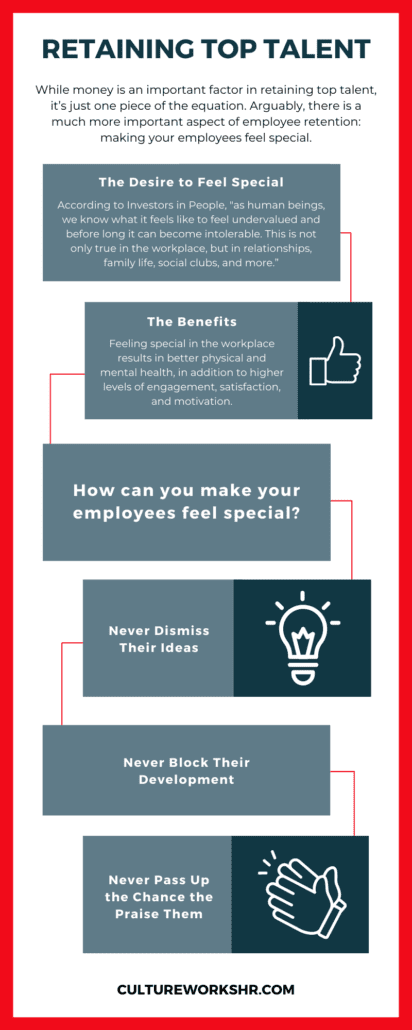
While money is an important factor in attracting and retaining top talent, it’s not the entire cake. Rather, it’s an ingredient in the cake. Arguably, there is a much more important ingredient in the cake that is employee retention. According to a recent Harvard Business Review article on employee retention, the most important ingredient is making your employees feel special.

Now, wait a minute … Before you roll your eyes at how cheesy or “unprofessional” you might think this is, give it some serious thought.

Here, we’ll help you.

Feeling Valued and Special in the Workplace

Don’t worry, we’re not going to get all mushy gushy.

But why is it important to feel valued and special in the workplace? Well, according to Investors in People, the need to feel valued is not an abstract concept.

They write, “As human beings, we know what it feels like to feel undervalued and before long it can become intolerable. This is not only true in the workplace, but in relationships, family life, social clubs, and more.”

Feeling special in the workplace results in a number of positive benefits, according to the American Psychological Association (APA), including:

  • Better physical and mental health
  • Higher levels of engagement, satisfaction, and motivation.

“All the things that lead to a healthy and productive relationship between employer and employee,” says Investors in People.

How Can You Make Employees Feel Special?

So, how can you ensure your employees—more specifically your top talent—feel special in order to attract and retain them? Don’t worry, we’re not going to advise you to take your employees out for a happy hour every week (although we’re sure they wouldn’t complain!) or to buy them flowers and chocolates (kind of weird…)

Harvard Business Reviews narrows making your top talent feel special to three things you should never do. Here’s what they are.

Never Dismiss Their Ideas

Regardless of whether or not the idea is immediately actionable, ensure that your employees’ ideas are heard. Do not dismiss their ideas. Also, it’s important to remember that chances are, when an employee comes to you with an idea, it’s because they’re able to see an issue on the horizon.

Never Block Their Development

Offer your employees opportunities to grow. Is there a seminar or conference you know they’d like to attend to grow their knowledge? Support them in this! As an employer, you should always be championing your employees’ development.

Never Pass Up the Chance the Praise Them

Words of praise go a long way. Chances are your top talent works around the clock on difficult projects and tasks. When you fail to recognize this, employees might become resentful or look for other places of employment.

A Final Word

There you have it! The secret to retaining your top talent: making them feel special. (See, it’s not rocket science!) Read on for tips for attracting and retaining great talent.

Effective Offer Letter

Congratulations, your hiring team has reviewed resumes, endured the interview process, and has found a candidate to join your team! Now you just have to send out an offer and hope they accept the position! But wait, what should you write in an offer letter?

Offer letters are typically about two pages but contain a range of essential information, such as the expectations, conditions, and details of the job.

Before you spend the next fifteen minutes staring at a document with only “dear candidate” written at the top, don’t worry –we got you!

Read on to learn how to write an effective, concise offer letter that presents all the information the candidate needs. Then, you can focus on the exciting part: adding a new member to your team!

Why Send an Offer Letter?

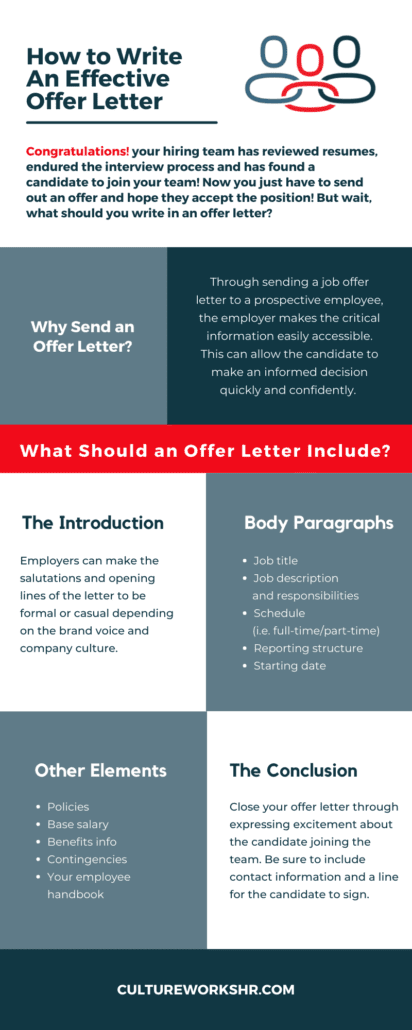
The letter serves as an invitation for the candidate to work at your company. Further, it will make all the critical information easily accessible to the candidate as they make their decision on whether or not to accept the job offer.

By sending a job offer letter to a prospective employee, the employer makes the critical information easily accessible. This can allow the candidate to make an informed decision on whether or not they will accept the position quickly and confidently. In addition to these advantages for the employee, the employer also benefits from a prompt decision. These benefits may include, for example:

  • If the candidate accepts, the company has the opportunity to begin to onboarding process immediately
  • If the candidate declines, the employer can quickly send an offer to another candidate who would be a good fit for the position

First, Consider Extending a Verbal Offer 

A verbal offer can save time for an employer by ensuring the candidate is still interested in the position and willing to negotiate. Who wants to take the time to write an offer letter just to send it over to a candidate who accepted an offer from another company yesterday?

We recommend extending a verbal offer and securing interest before drafting an efficient offer letter. 

We don’t suggest employers extend only a verbal offer to candidates because candidates should have easy access to all the information provided in the offer letter. 

The Introduction

Let’s Talk Salutations

Employers should choose the appropriate salutations to greet the candidate. Consider the company’s brand voice.

If the brand voice is more casual, the employer may choose to simply use the candidates first names in the offer letter. If the brand voice is more formal, employers may opt to use a title indicator like “Mr.,” “Mrs.,” “Ms.”

The Opening Line

Similar to the salutations, an employer can make the first line(s) of the letter formal or casual depending on the brand voice or company culture.

The Body Paragraphs: What Information Should Employers Include in an Offer Letter?

Offer letters may vary depending on the position and industry but generally contain about three paragraphs. According to The Balance Careers, an offer letter confirms employment details including:

  • Job title
  • Job description and responsibilities
  • Schedule (i.e. full-time/part-time)
  • Reporting structure
  • Starting date of employment
  • Base salary
  • Benefits information
  • Acknowledgment of offer and confirmation of acceptance

Additional Elements to Include in an Offer Letter

According to the Society for Human Resource Management, depending on the state and/or employer, an effective offer letter might also include:

  • Policies: For example, “employment will be subject to the company’s policies, procedures, and handbook (if applicable) as adopted, revised or deleted from time to time.”
  • At-will employment: Explains that “either the employee or the company can terminate the relationship at any time, with or without cause or advance notice.”
  • Contingencies: “State that the offer is contingent upon a background check clearance, reference check, and proof of the employee’s right to work in the U.S., as required by law.”
  • Prior employer confidential information and restrictions
  • Your employee handbook

The Conclusion

Close your offer letter by expressing excitement about the candidate joining the team. Be sure to include contact information, a line for the candidate to sign as well as a date they should provide a decision.

Disclaimer

Think about including a disclaimer to clarify the letter is not a legally binding contract or agreement.

Let’s Review Examples of a Successful Offer Letter

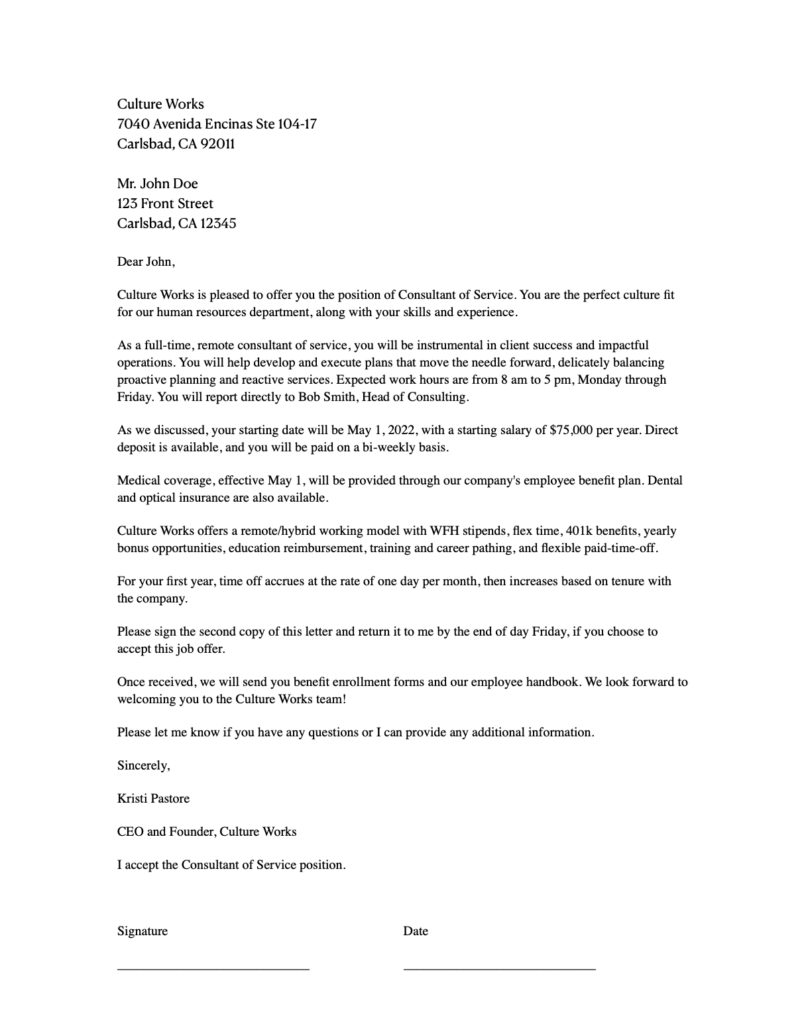
Below, we’ve included an example of an effective offer letter (minus the additional elements listed above). We’ve written this letter as if we were adding another member to our team.

How to Retain Employees

Now that you’ve successfully hired some new employees with an efficient offer letter, it’s time to learn how to retain your top talent.Learn more about Culture Works and why we do what we do, here.

Human Connection Company Culture

The topic of human connection is more important now than ever.

Many of us are returning to the office. It’s been a while … Some of you might be thinking, “How the heck do we do this again?!”

Harvard Business Review writes that returning to in-person work can be tricky. “Whether you’re excited or anxious about re-entry, you can expect being around other people to require a lot of energy that you probably haven’t had to expend in a while. Why is in-person interaction such a drain, and how can you muster up the energy to reconnect with your colleagues?”

Harvard Business Review recommends getting back to the basics of human connection.

In this blog post, we’ll detail 10 unique ways to support your company culture through human connection during this time.

What is Company Culture?

First things first, what is company culture, and why is it important?

Company culture is defined as “how you do what you do in the workplace.” This includes both the formal systems and the informal behaviors in the workplace, as well as:

  • Work environment
  • Company mission
  • Leadership style
  • Values
  • Ethics
  • Expectations
  • Goals
  • And more

Typically, company culture is something you can feel (even as an outsider!).

10 Unique Ways to Support Your Company Culture through Human Connection

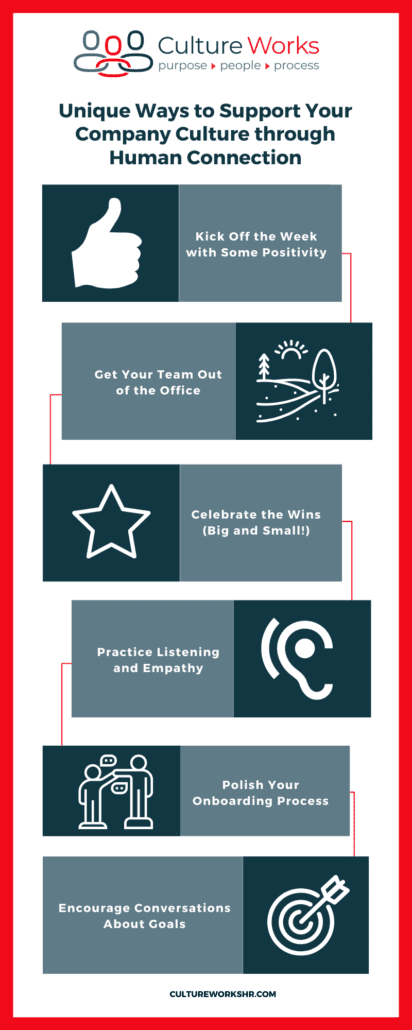
There are many ways you can improve your company culture. Prioritizing human connection is one of them. Here are 10 unique ways you can support your company culture through human connection.

  1. Kick Off the Week with Some Positivity

Chances are your company has some sort of touch-base at the beginning of the week—whether remote or in-person. 

A great way to foster human connection is to kick off the week by sharing a “personal win” and a “professional win.”

For example, maybe one of your employees went skiing over the weekend and didn’t break a bone. That’s their personal win! Their professional win could be something along the lines of meeting an important deadline or managing their time well during the previous week.

Kicking off the week with some positives helps team members get to know one another on a more personal level and start their week on a positive note. It’s also a great way to share and celebrate accomplishments!

  1. One-on-Ones

Prioritizing one-on-one meetings helps build rapport between leadership and employees. During these one-on-ones, whether bi-weekly, monthly, or quarterly, you have the opportunity to learn more about your employees’ goals and experiences within your business.

It demonstrates to your employees that you care.

  1. Get Your Team Out of the Office

If distance allows it, get your employees out of the office. Take them out for a walk, coffee, drinks, the options are endless.

Fresh air and a change of scenery can help build trust; compared to having conversations in the same old meeting rooms.

  1. Encourage Conversations about Goals

Ask your team members about some of their personal and professional goals. What are their challenges and desires? How can you support them?

Some examples might include gaining the courage to speak up more in meetings or to better prioritize their time. Keep these conversations honest and light.

  1. Celebrate the Wins (Big and Small!)

In an article published by Forbes, they discuss the importance of creating a company culture where employees come together to connect and celebrate the hard work that’s been done.

It doesn’t matter if the win was big or small—it deserves acknowledgment!

  1. Ask a Community Question

Maria Leggett of Forbes recommends asking a ‘community question’ each week.

“Ask about a favorite vacation place, a most memorable trip, or even a funny story that happened at work. Describing the craziest call you ever received at the office can generate great responses and tell you a lot about how people handle the unexpected.”

This is a fun, easy way to foster human connection, thus improving your company culture!

  1. Practice Listening

Like, really listening … Active listening is a skill that, surprisingly, many of us don’t naturally have. When you’re in conversation with someone, it can be easy to get caught up in your own thoughts and distractions, thinking of what you’re going to say next—especially if you’re tense.

Active listening is a skill that can go a long way in creating authentic human connections. When you practice active listening, you’ll be able to hear what is actually being said, as opposed to misunderstanding, anticipating, or assuming.

  1. Encourage Sharing

Not quite like show and tell, but almost! As an employer, you should encourage sharing personal stories and interests. Consider talking about a new trending show on Netflix, who you’re rooting for in the Super Bowl, or an upcoming vacation at your next meeting.

This will help get to know your team members on a personal level.

  1. Polish Your Onboarding Process

The onboarding process can be overwhelming—which is why it’s important for executives to take the time to meet with new hires across the business, regardless of department.

This is especially important in the era of remote work, where employees can feel a bit more isolated than in-person.

  1. Practice Empathy

The tenth and final tip is to practice empathy! As the old adage goes, “Before you judge a man, walk a mile in his shoes.” This adage stands as a reminder to practice empathy.

When in conversation with someone, consider where they might be coming from. What is their perspective? How is it different from yours? How can you validate their experience?

Harvard Business Review recommends you “consider what barriers you may face in trying to understand the other person, like assumptions you may be making about them, what you need from them, or your own reactivity…. [By] cultivating a level of self and other-focused compassion, [this] can aid in navigating conflict or disagreements more gracefully.”

A Final Word

There are many ways you can increase human connection within your business to bolster company culture; above are simply 10 ways. Interested in learning more? Read on to learn more about how learning and development (L&D) can transform your company culture.

people sitting on a chair holding a paper

Today’s job market is HOT! As an employer, how can you attract the right talent and build your bench?

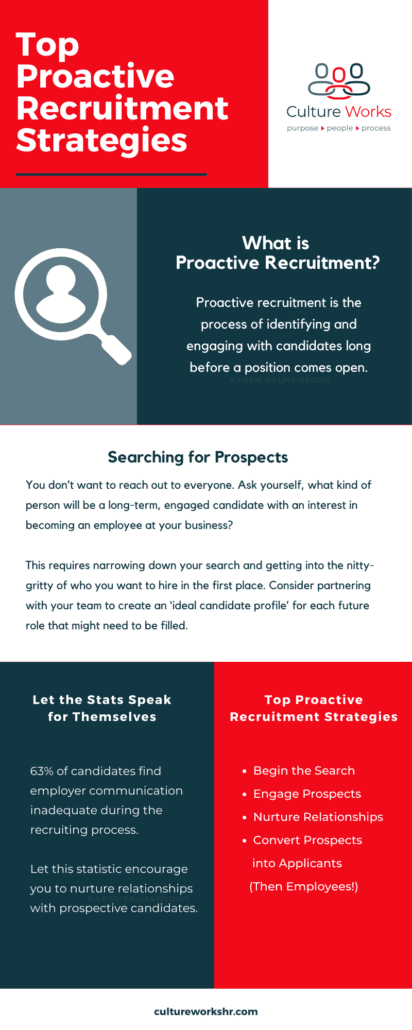
The answer? Proactive recruitment.

Let’s talk about proactive recruiting – what is it and what are some strategies your business can implement to do it well? 

What is Proactive Recruitment?

Proactive recruitment is exactly what it sounds like. If you’ve visited the Culture Works site or have been in the human resources space for long enough, chances are you’ve heard of it.

According to Ideal, proactive recruitment is “the process of identifying and engaging with candidates long before a position comes open.” This means they’re not actually “candidates” at that point. “Rather, they’re people with skill sets in a given geographic area and job role, and you build relationships with them.”

Proactive recruitment is a practical tool to utilize, and with remote work being more popular than ever, proactive recruitment has become even more tangible in the workforce.

Top Proactive Recruitment Strategies

As we wrote in our article on proactive recruiting to build a killer bench, most companies today practice a reactive recruitment approach. Reactive recruiting means not posting about your business or job until a position needs to be filled. 

Proactive recruitment searches for the right people before you need them and is a much more effective method. In fact, at Culture Works we believe building a killer bench can take six months to a year.

Here are our top proactive recruitment strategies.

Begin the Search

When it comes to proactive recruitment, the first thing to do is look for and reach out to prospective candidates.

Remember, you don’t want to be reaching out to just anyone. Ask yourself, what kind of person will be a long-term, engaged candidate with an interest in becoming an employee at my business?

This requires narrowing down your search and getting down to the nitty-gritty of who you want to hire in the first place. Consider partnering with your team to create an ‘ideal candidate profile’ for each future role that might need to be filled.

Find candidates by using:

  • Social platforms
  • Your candidate database
  • Social or networking events
  • Relevant communities and/or groups

Engage Prospects

When it comes to engaging prospective candidates, personalization is key. After deciding who your ideal candidate is, you must pique their interest.

Although you might have found someone or a group of prospects, hiring is a two-way street. Remember, they aren’t the candidate yet.

Engage prospective candidates by sending them a personalized message. You can:

  • Tell them about yourself
  • Tell them about your business
  • Ask them what they’re looking for in a job

Nurture Relationships

In sales, lead nurturing is “the process of developing and maintaining relationships with customers at every stage of their journey, usually through marketing and communications messaging.”

Similarly, in this phase of proactive recruitment, you need to develop and maintain relationships with prospective candidates.

Let the stats speak for themselves. According to Finances Online, 63% of candidates find employer communication inadequate during the recruiting process. Let this statistic encourage you to nurture relationships with prospective candidates.

Nurturing these relationships helps keep prospective candidates interested, and likely, with proper nurturing, your business will be top of mind if they begin to seek out a job.

Nurturing might look like keeping in touch through:

  • Social media marketing
  • Ongoing content strategy
  • Emails

Convert Prospects into Applicants (Then Employees!)

At this point in your proactive recruitment strategy, you’ve laid a solid foundation for prospective candidates and future hires.

When a job now opens up, chances are the individuals in this funnel will be encouraged to apply. After you receive their application, however, it’s up to you to make sure the experience with your business exceeds their expectations.

Josh Tolan, Spark Hire’s CEO and Founder says, “In a competitive market, the ability to move candidates through the process quickly can be the difference between making the hire and not.

Efficiency, communication, and understanding are especially key in the world of remote work. If you don’t have a team designated to streamline your hiring processes, consider implementing recruiting software to stay on top of things.

A Final Word

Surely, the tips listed above are not all you can do to maximize your proactive recruitment strategy. Read on to learn more about how your business can attract the right talent and proactive recruitment. And, happy hiring!

How to ensure successful culture integration post-M&A

The M&A process is an exciting but lengthy one. It can last anywhere from months to years depending on the size of the company involved. During this period, the merging of two company cultures can create culture shock, damaging productivity, profitability, and morale. Let’s talk about how to avoid that!

Entering into a merger can be challenging for both companies. Whatever the reasoning behind the merger, one thing is for sure—change is coming. According to Harvard Business Review, between 70 and 90% of mergers and acquisitions fail. A culture clash is often to blame for this extremely high number. 

Due Diligence

Preparing for a merger or acquisition requires time and planning. A large portion of this time is dedicated to conducting due diligence. Not sure how to go about your due diligence? Check out our due diligence checklist to ensure a smooth transition during an M&A

Due diligence happens during the process of an M&A — But what about the potential culture shock post-M&A? 

Leadership can help bring together the best of both cultures.

Employee engagement doesn’t have to suffer when you merge two different cultures. The leaders of both companies hold the power to protect employees and help them successfully share their cultures. One strategy is a weekly leadership meeting in which everyone steps back from the chaos of the merger to highlight the advantages of both cultures and strategize on ways to bring the best of each culture together to create a new, optimized company culture that works for everyone.

Creating a successful company culture requires an investment from everyone on the team and is essential to retaining employees and keeping them engaged in their work. Here’s how to get started.

Redefine your company’s core values.

Your culture and your purpose are defined by your core values. Merging two different sets of core values can be challenging. In many cases, the acquiring company attempts to keep its core values and share them with the other team.  This frequently results in a sense of disenfranchisement by the acquired company’s employees and results in reduced morale, productivity, and in turn, profitability.  A more egalitarian approach incorporates a process in which the leadership, often facilitated by an outside coach or consulting team, finds the best elements of both sets of principles and works to merge them, creating a new set of core values that speak to the merged company.

Training and development.

As you work to merge two different cultures together, it’s important to engage in team-building activities and ongoing training for all levels of the organization. 

Another aspect of the development of your team is ensuring your team members are aligned in their roles. Role alignment is essential to the success of your new merged business. When employees are aligned in roles that match their strengths they will be more engaged and excited about work.

Through training and development programs, team members who are not role aligned can discover their optimal roles and, in the process of reconfiguring the companies in the merger, change roles to be more productive and set up for success.  

Check-in with employees regularly. 

During a merger, it is essential that leadership and HR communicate regularly with all employees to ensure their concerns are being addressed. This can be done through informal check-ins, and/or formal employee engagement surveys. Monthly performance reviews can focus on an employee’s individual contributions to the overall company goals and assure them that their role is secure in the transition

Communication

One of the top reasons mergers and acquisitions fail is a lack of communication. When communication is lacking between managers and employees, employees are left asking questions: Why is the company merging? How will I be affected? How will I be supported throughout this merger? Am I about to lose my job?

Lack of communication with your employees may leave them confused and unmotivated to work hard for the newly merged company. Keep employees updated on the context of the merger, the timeline of what’s next, and other frequently asked questions related to the merger. Like restructuring the Org chart.  

Employee engagement before and after the merger.

Analyzing employee data before and after the merger can help you better understand how your organization has been impacted by the merger. In doing so, you can identify areas of your culture that may need work.

Employee retention

Employees will likely feel on edge during this major transition. They may be faced with fears of losing their jobs, being asked to re-apply for their job, or drastic company culture changes. Losing employees during the merger will negatively affect profitability. So focus on communication, incentives, clear goals, and strategies to keep your team engaged and in the know.

How to Prevent the Great Resignation in your Business

CBS News reported that in the second half of 2021, over 20 million people left their jobs for various reasons. Reasons for the increased resignation rates are likely due to culture, compensation, and flexibility. Although this is an alarming statistic, there are a few steps business owners can take to prevent the great resignation from affecting their business. 

What is the Great Resignation? 

The Great Resignation is described by Investopedia as a “higher-than-normal quit rate of American workers that began in the spring of 2021 and continued into the fall.” 

Why are so many people quitting their jobs? 

Over the course of 2 years, people have created a clear image of what they want their work-life balance to look like. The requirement to work from home over the last few years created a world of possibilities for many companies. Employees now understand what is possible, in terms of workplace flexibility. 

The collective experience of the last two years has also caused more people to focus on company culture and the employee experience. According to IDC, some of the most important focuses in terms of employee experience include:

  • Transparency, trust, and consistent communication from employers
  • A collaborative work environment with remote experiences allowed
  • A culture focused on belonging and inclusion
  • Employee listening, engagement, and recognition from management and peers
  • Career development and educational opportunities
  • Demonstrated corporate social responsibility

Employee Burnout and the Great Resignation

Another area of employee experience that has become a huge topic of discussion for most employers, is burnout.

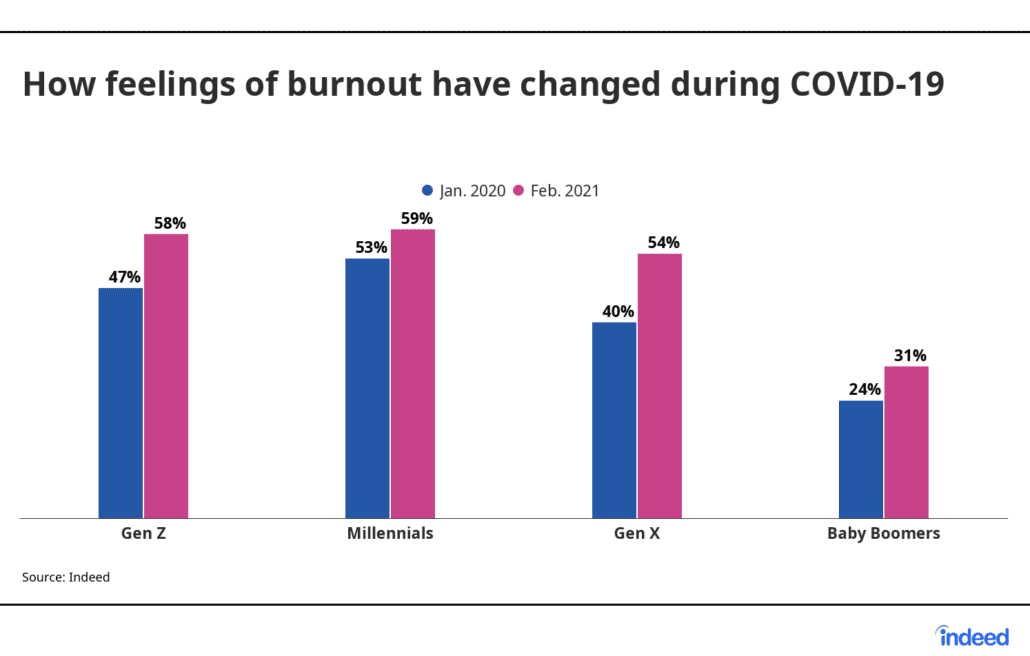
Indeed released a study on workplace burnout that reported: “67% of all workers believe burnout has worsened during the pandemic.” They also found that “53% of millennials were already burned out pre-COVID, and remain the most affected population with 59% experiencing it [burnout] today.” 

The chart featured below shows the level of burnout among different generations over the span of COVID-19. 

Chart courtesy of Indeed.

How to spot employee burnout

As mentioned above, Forbes reported that even companies with a positive work culture are being affected by the Great Resignation. This is most likely due to the increased burnout rate over the last few years. 

So, one of the most preventative steps an employer can look out for is employee burnout. Forbes lists the three warning signs of burnout as: 

  1. “Decreased Productivity and Performance
  2. Increased Cynicism towards coworkers and clients
  3. Detached from the company.” 

How can you prevent the Great Resignation from influencing your company?

There are actions your company can take to prevent your employee retention rate from taking a hit this year. Companies that have provided a great work environment are also being affected by the Great Resignation, so how can you retain your employees? 

Let’s look into some preventive measures that companies can take in 2022. 

Foster Positive Company Culture

There are a LOT of factors that go into creating positive company culture. Some aspects of work that improve by strong company culture include:  

  • Office interpersonal relationships 
  • Employee retention
  • Team communication 
  • Ongoing employee growth and learning 

As you try to attract and retain the best and brightest workers in your business, you can be sure that potential employees are looking for a place where they will feel valued, and enjoy coming to work.  That doesn’t always mean smiles and high-fives. Positive company culture means one where accountability, high standards, and the ability to give and receive feedback are present. 

At Culture Works, we start with purpose, people, and process. First: align with a higher purpose, then, get your people on board with how they bring value and are integral to the company’s success, and finally, implement processes that put HR and operations into action to make company culture repeatable and actionable every day. 

Implementing HR processes is at the core of building aligned organizational culture and reaching your business goals. 

Not all team-building exercises involve trust falls or baby pictures. There are many team-building exercises that don’t suck. Some examples include: 

  • Corporate Recess (incorporating play into work)
  • Emotional Intelligence training
  • Learning outings (hands-on projects)

Read our blog to see if your company checks off the 5 signs of positive company culture

Learning and Development

Culture Works believes that Learning and Development (L&D) plays a major role in fostering a positive and productive work environment. 

Investing in your team means more than buying lunch every month (although, who doesn’t appreciate a free meal!?). Quality L&D means investing in your employees daily and encouraging their personal and professional growth. One of the best ways to invest in the learning and development of your employees is to provide additional courses that increase your employee’s skills and bring them to the next level, so they can be promoted within!

Allowing for a Flexible Work Environment

CNBC reports that 57% of workers require employers to provide options for a flexible work environment. This means creating a space where employees can successfully complete their roles remotely, in person, or with a hybrid work model. 

The moral of the story is: A flexible workplace can be the difference between you and another employer.

Combating burnout, finding value-aligned employees, and creating a positive company culture are only a few ways you can work to prevent the Great Resignation from affecting your business. 

How long has it been since you thought about your company’s culture? Do you bring your company’s values into your daily conversations? We’ve put together an article explaining how you can start setting team goals, with your values in mind, to foster company culture and increase employee retention. Read more here.

hiring trends in the new year

The hiring process has changed over the last year and will continue to change in 2022. 

Culture Works believes that intentional hiring can be achieved in the new year with the use of role alignment and culture operations

These are some of the tools that Culture Works uses with clients, but what other hiring trends are coming in 2022?

Proactive Recruitment

A buzzword that is being thrown around in the HR sector is “proactive recruitment.” Well, it turns out that proactive recruitment is more than a buzzword, it’s also a practical tool to utilize.

Proactive recruitment is exactly what it sounds like. A company might actively talk to candidates who are already hired in another role at another company. It sounds risky, but the main hiring trend of 2022 is that anything goes. The remote work culture has additionally made proactive recruitment more tangible in the workforce.

Remote Work is Here to Stay

LinkedIn did a worldwide analysis on the job market and determined that the most sought-after jobs in the new year are remote.


This can be explained for many reasons. One of the biggest draws towards remote work is that location doesn’t matter anymore! A couple of years ago, the “Are you willing to relocate?” section of job applications might have been a scary thing to check off. Now, relocating isn’t required as often.

How Does Remote Work Affect Employee Benefits for the Future? 

Business Insider warns future job seekers to look out for “too good to be true” scenarios. This means that a company may offer a tight-knit community full of happy hours, free lunches, and other one-off perks.

While these offers are tempting, there are sometimes factors about the workplace that are not ideal to work in (despite the tempting happy hour offers).

Some questions to ask about benefits and company culture in 2022 might include:

  • How does this company address burnout? 
  • How does the company implement work-life balance? 
  • Do employees feel they are working in a safe environment? 
  • How is communication handled in the office? 

These questions are a starting point for understanding what companies are painting themselves as—compared to how they actually operate.

How to Narrow Your Search (AKA Avoid the Black Hole of LinkedIn!)

The remote workforce often means remote recruiting and hiring.

If your company posts a job offer, chances are hundreds of applicants are going to see the job posting on LinkedIn. So, how do you narrow down your talent search in the age of “one-click” job recruitment?

On LinkedIn’s blog, they highlight the best practices to use as a company using LinkedIn for hiring. Some of their main focuses for LinkedIn specifically include:

  • “Convert your company followers into new hires
  • Align your search and pipeline in one place
  • Search for new talent based on the profiles of your current top performers
  • Once you’ve found people who seem like a good fit, send them an effective InMail message” 

These are all great tips for after people have applied for a job through LinkedIn, but the time is just as valuable as your own. How can you make the process as simple but effective as possible? Some great guidelines to follow include:

  • Writing job descriptions that are detailed and very clear
  • Use the Search Insights Feature available for recruiters
  • Always, always respond, even if the response is a rejection of their application

The communication process through hiring has shifted. If a potential hire has spent an hour crafting a cover letter and application, and they never hear back regardless of the outcome, then there is less credibility tied to your business based on word-of-mouth.

Market Yourself to Potential Employees

If your company doesn’t have a marketing strategy, you’re already behind. 

While your competitors are marketing themselves to clients and future employees on various social media platforms, you have stayed in the same networking circle.

People love and value the human side of a company.  So, if your company isn’t ready to step into hiring an outsourced marketing agency, there are small steps you can take to start attracting high-value hires.

One of these steps is sharing client and employee testimonials and stories on LinkedIn or any social platforms your company has. This builds a trusting brand that new hires will be looking for when applying for jobs.

Top Skills to Be on the Lookout For

Okay, now you’re active on LinkedIn and have put effort into marketing yourself to potential employees — What’s next?

There are top skills that are being sought after in the 2022 job hiring market. These skills revolve around an individual being adaptable to situations and roles. Along with being adaptable, these following traits should be considered as a hiring manager listed by Hire Digital:

  • Technology 
  • Problem-Solving
  • Project Management
  • Digital Marketing
  • Team Player in a Remote Environment

Are you positive your company has a positive company culture? Oftentimes the positive phrases plastered over a company website don’t ring true for current employees. Learn more by reading the five signs you have a company culture on our blog.

Count me in!

Practical steps you can take to make your company culture (and yourself) even better.

Signup for our newsletter below to stay up-to-date on our latest HR news & insights!

LINKS

CONTACT

(760) 334-4094

info@cultureworkshr.com

29970 Technology Drive
Murrieta, CA 92563

HOURS

Mon-Fri: 7:00-4:00
Sat: Closed
Sun: Closed

CONNECT WITH US!

© 2026 Culture Works – all rights reserved

site design by digitalstoryteller.io

© 2024 Culture Works – all rights reserved
site design by digitalstoryteller.io