how to set new year's resolutions to foster company culture

You’ve made it to the new year, congratulations! There are often a lot of goals and New Year’s resolutions that people make for their personal life. The good news is, there’s a way to set goals in the office that foster company culture.

Setting team goals for 2022

Maybe your office normally sets goals each New Year. How realistic are the goals normally? 

We love the optimism of shooting for the stars, truly. But maybe “Fly to Mars with Elon Musk” isn’t as doable this year. It helps as a team to create a combination of goals that are tangible and goals that are long shots. Creating a balanced list means that there will most likely be moments of checking a goal off the list— which feels great— to learning moments. 

One important aspect of setting team goals is speaking in simple terms. The simpler the goal, the easier it will be to reach that goal and check it off the list! 

Keep in mind that simple language does not mean vague. Another factor to consider is to keep goals specific. For example, simply stating “In 2022 I want the team to get closer” is hard to navigate because there are no tangible ways to measure the success of a goal. One way to switch the language to be more specific could be, “In 2022 we want to have 10 different team bonding days marked in the calendar.” 

See? Much more manageable. If you need help figuring out what team bonding exercises to do, read our blog, “5 team-bonding exercises that don’t suck.” 

Creating a Collaborative Culture

So, what happens after you make the perfect list of goals for 2022? A list is only as strong as the collaborative effort that continues on with those goals. 

Forbes discusses how to create attainable goals, with the main tips centered around: 

  • “Tangible goals means real results
  • Accountability
  • Follow Approach-Oriented goals
  • Identify pitfalls
  • Set yourself up for success.”

Let’s dive deeper into how these tips can be implemented into your team. 

Accountability in the workplace

As mentioned above, tangible goals will lead to real results. But how does accountability play into reaching a point where real results are accomplished? 

Accountability is key. 

If the set goals are simple and clear for everyone, then accountability will be easier to implement. For example, using the example above of the goal “In 2022 we want to have 10 different team bonding days marked in the calendar.”

Well, If it’s halfway through 2022 and there has only been one team-bonding activity, with no more planned in sight, then a conversation can be had between the team about how to still make that goal achievable. 

Identify internal challenges

The learning process is a part of any goal. As a team, it’s important to identify the internal challenges that could be limiting the ability to achieve the New Year’s resolutions. 

Taking a step back and looking at the processes that are set in place is a great way to start looking at internal challenges. What is holding the team back from achieving their goals? It might be resources, time, culture fit, and everything in between that impacts human nature. If the internal challenges are identified and addressed, then a positive company culture is more likely to follow. 

Are you positive your company has a positive company culture? Learn the “Five Indications of a Positive Company Culture” on our blog. 

5 team-building exercises that don’t suck

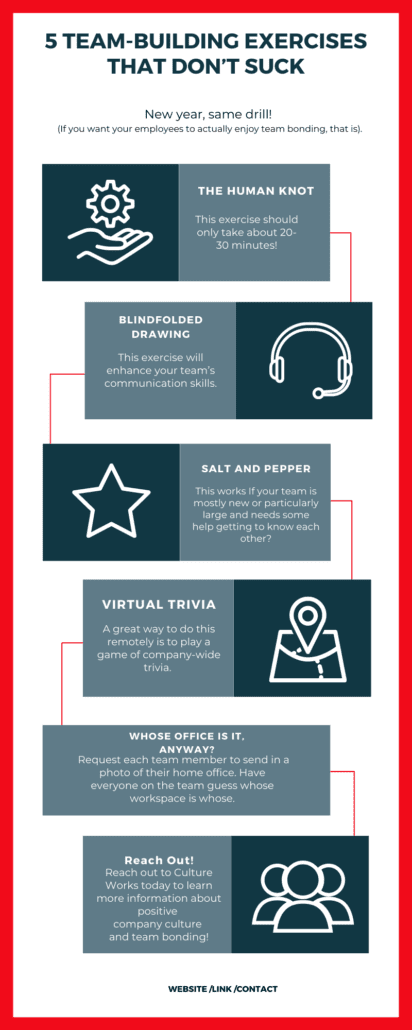
5 Team-Building Exercises That Don’t Suck

Here, stand on a table and fall backward into my arms: 5 team-building exercises that don’t suck

New year, same drill! (If you want your employees to actually enjoy team bonding, that is).

Picture this: your manager walks into your office, tells you to be in the common room in 15 minutes for ‘team-building’ exercises. What’s your first instinct? Speaking from experience… we’d argue you’re thinking “run!”

But what if we told you the days of dreaded, forced team-building exercises are over? Believe it or not, it’s possible to make team-building a positive experience for everyone involved. We know… ground-breaking.

In order to make team-building effective and fun, you need to gain your team’s buy-in. In other words, you need to understand your team members. 

For some teams, a beach bonfire or a backyard BBQ will be enough to bring employees together. Other teams, however, may want something structured, exercises that can be done in the office together, or team-building that can be completed in 20 minutes. If that sounds like a better fit for your team, here are a few simple, effective team-building exercises for you to try today!

5 TEAM-BUILDING EXERCISES THAT DON’T SUCK

The Human Knot

Depending on your team’s ability to communicate with each other, this exercise should only take about 20-30 minutes! You can include anywhere between 8-20 people in this activity. Start by creating a circle with your team with everyone standing shoulder to shoulder.

Once everyone is in the circle, each member puts their right hand out and grabs someone across the circle. Then, have them repeat this with their left hands. Once everyone is holding two different people’s hands, it’s time to untangle!

This team-building activity builds communication, teamwork, and comradery between coworkers. Disclaimer: this may be a better activity to try out post-pandemic. 

Blindfolded Drawing

This next team-building activity, blindfolded drawing, can serve as a socially distanced option! This exercise will enhance your team’s communication skills. 

For this exercise, one person has a pen and paper, the other has a picture of the organizer’s choice. The employee with the picture has to describe in detail how to draw what they’re looking at. The employee with a pen and paper has to interpret what the other is saying and draw what they think they are describing. This one is sure to solicit some laughs!

Salt and Pepper

Is your team mostly new or particularly large and needs some help getting to know each other? If so, this activity is perfect for you! 

Ensure you have an even number of participants before beginning. Start by creating a list of well-known pairs (salt/pepper, peanut butter/jelly, yin/yang … you get the idea) and write these pairs on separate pieces of paper.

Once all pairs are written, tape one word on each person’s back– but don’t let them see it! After everyone has a word, allow everyone to mingle. Players are only allowed to ask yes or no questions to try to figure out what their tag says.

Once they’ve figured out their word, they need to find their pair. After everyone has found their partner, instruct them to sit down and discuss 3 things they have in common or 3 interesting facts about one another.

Virtual Trivia

Even in remote situations, team building is important. As many companies continue to work remotely in 2021, it’s important to implement a few team-building activities to boost morale and connect teams. A great way to team-build remotely is to play a game of company-wide trivia. 

In order to facilitate this event, you’ll need a host to ask questions, count answers, and keep score. Divide your team into smaller teams and organize breakout rooms in Zoom so they can discuss each set of questions. Each section of questions should include about 5-10 questions.

Think about common trivia subjects, but also get creative! You can even include a company trivia section with questions about your CEO and leadership team. 

Whose Office Is it, Anyway?

Another way for your team to bond while working remotely is to play ‘Whose Office is it, Anyway?’ Request for each team member to send in a photo of their home office. Have everyone on the team guess whose workspace is whose.

Continue the game with Whose Coffee Mug is it, Anyway? Whose desktop background is it Anyway? And Whose View is it Anyway? This is a simple, easy, and quick way to unify your team and have some fun while they’re out of the office.  

As we mentioned before, team building doesn’t have to be something your employees dread. Think of a few simple ways to create a community within your company, while hopefully sharing a laugh!

For those interested in learning more about how to nail your remote company culture, read on here.


What it looks like to work for (and with!) Culture Works

Have you wondered what happens behind the scenes at the Culture Works office? Or, what partnering with us looks like? We have many roles and systems in place to make sure we provide the best possible service for your company, which also means hiring the right people.

Culture Works is Your Recruiting Partner

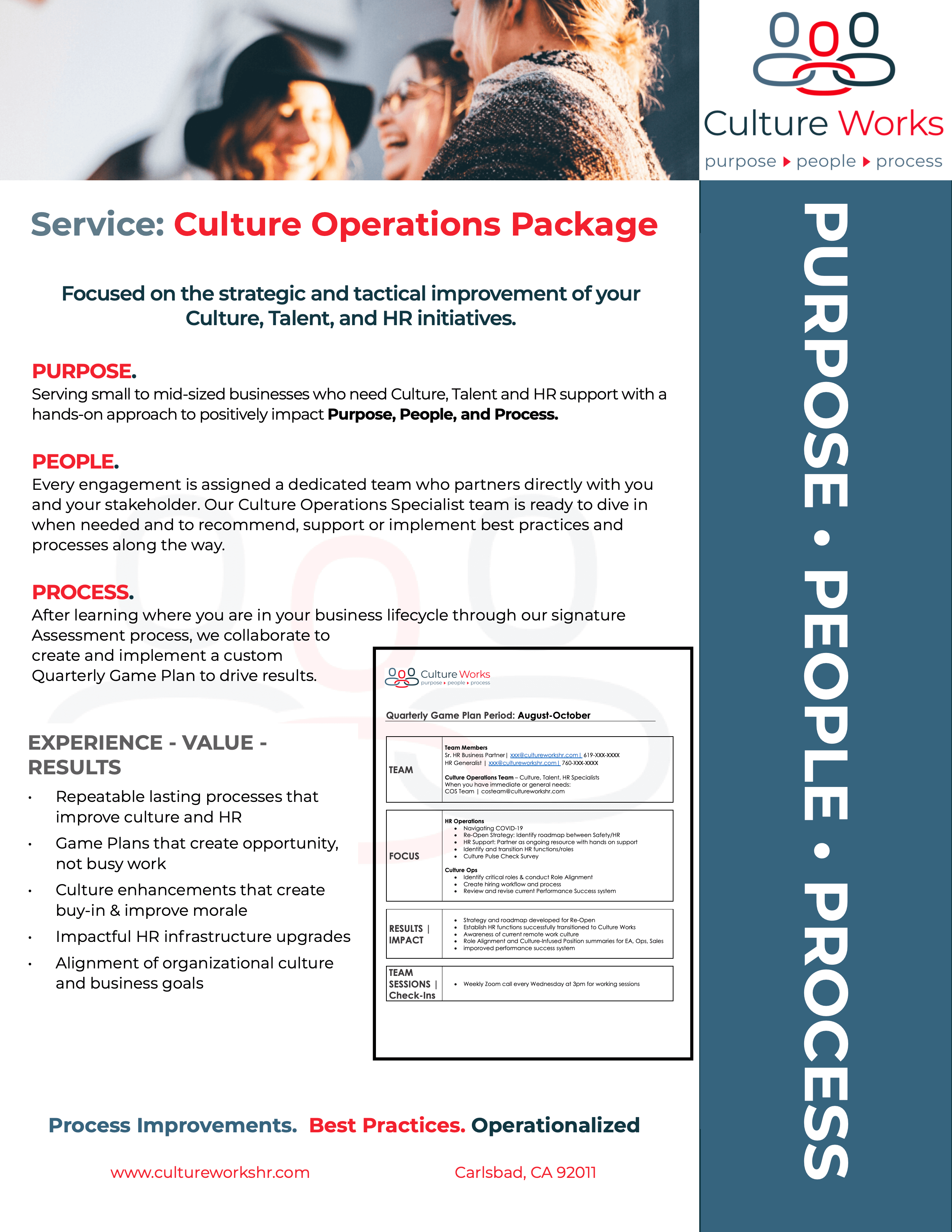
If you partner with Culture Works, we help make the recruitment process as painless as possible (yes, there are many ways to do this without scrolling through hundreds of LinkedIn applications).

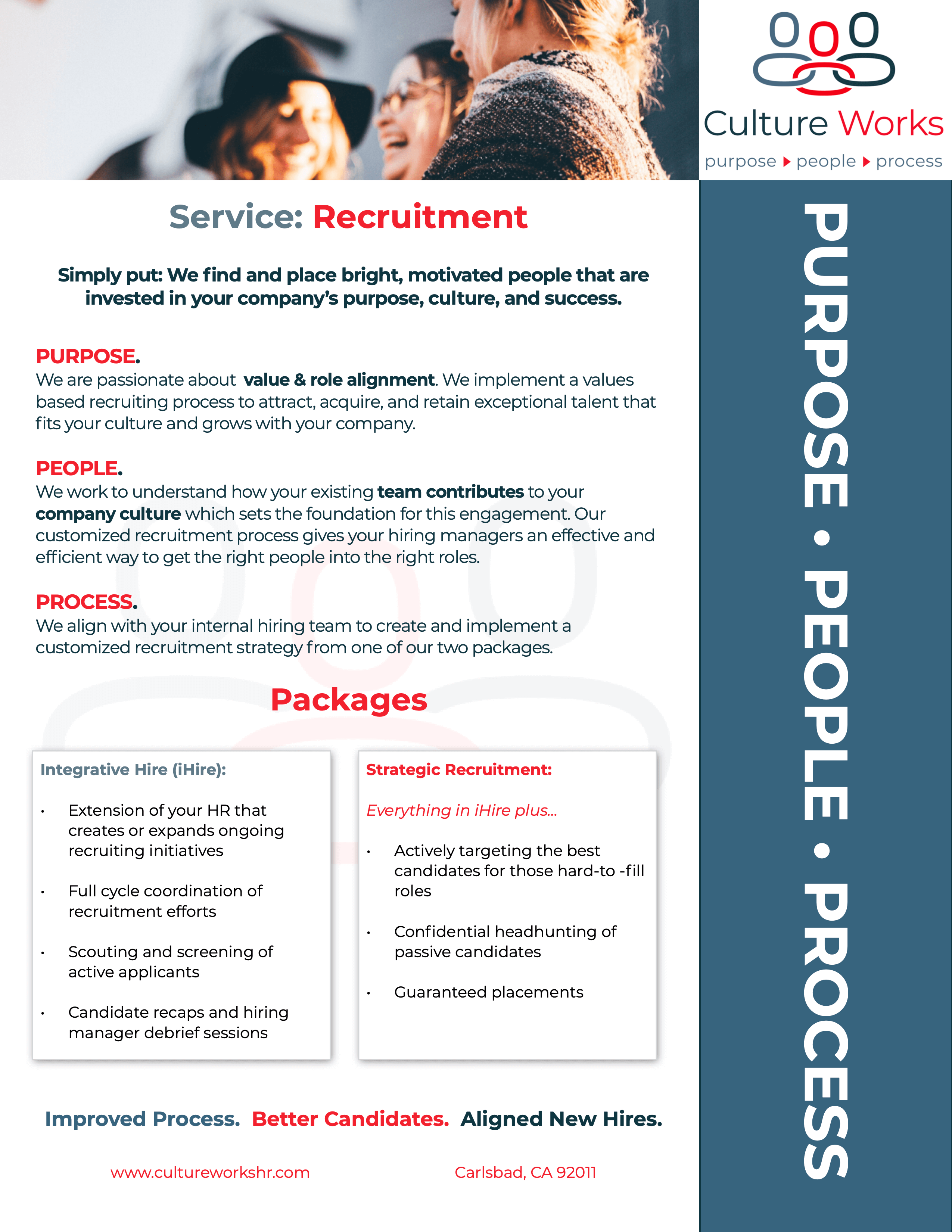
We follow a unique process that aligns with your internal hiring team to create and implement a customized recruitment strategy. 

What this process looks like in practice is:

  • Culture Works strives to be an extension of your human resources department that creates or expands ongoing recruiting initiatives 
  • Full cycle coordination of recruitment efforts
  • Scouting and screening of active applicants
  • Candidate recaps and hiring manager debrief sessions

Value and role alignment is at the core of everything we do in recruiting. Why is it important? With the right people in roles that enhance their strengths and interests, you will likely see more productive employees, more engaged employees, and a happier workforce all around.

Value Alignment

Our team spends countless hours creating a “bench” of great talent. So, when you’re ready to find a great team member, we know just the people to start your search. 

Glassdoor published a study that highlights what employees value most in the workplace. The culture and values of a company are what employees placed the most emphasis on. Translation? Value alignment is extremely important in ensuring your top employees remain with your company. 

What do we mean when we say value alignment? Value alignment is the process by which your established company values are a match with the candidate you’re speaking with. If your employees value honesty and transparency, but that’s not part of your core functions as a company, you will likely run into problems down the road.  

Oftentimes, miscommunication within a company arises because company values are unclear. One way to avoid this miscommunication is to clearly state your company values and to frequently come back to them.

While you’re running your business, there may be adjustments in your company values, and that’s OK! The process of establishing core values that align with both you and your company is the starting point to aligning on a recruitment strategy that really works. 

Role Alignment

Another area of focus for the Culture Works team when recruiting both internally and for our clients is role alignment. What, you ask, is role alignment?

Role alignment is uncovering the strengths, weaknesses, and interests of your candidate and finding a role that fits those areas. If you have a non-detail-oriented person in a heavy-detail-focused role, they will likely be unhappy and you could lose what could be a great member of your team.

Our team prioritizes role alignment in every recruiting engagement we participate in. When your employees are aligned in their roles, based on experience, personality type, and strengths, they are more likely to succeed. 

It can be tempting to dismiss people who haven’t ticked every box required for the role, but we suggest that you look past the confining checklist under the job description and potentially uncover where they may be a better fit. 

Our process encourages you to focus on other values that can’t be taught. For example, flexibility is crucial for any employee to thrive in a new environment. The employee might not check all the boxes on the job description, but they are eager and quick learners. This sets the company up for a more successful retention rate. 

Talent Strategy

Talent strategy is another factor we encourage in our recruiting partnerships. We help your company attract the right talent. Some of these strategies include:

  • Create an enjoyable work environment
  • Give your employees opportunities for growth
  • Take time to consider who is placed in leadership positions
  • Show recognition to your employees
  • Offer unbeatable compensation and job flexibility
  • Be involved with your employees and foster relationships

The best way to attract future employees is to pay attention to what is happening internally. When you create a company culture that is ideal for both the company and your employees, more people will want to join your organization.

Working for Culture Works

At Culture Works, we like to practice what we preach by fostering a positive work environment that encourages our team to grow both in their career and personally. This means implementing everything mentioned above, and more.

Perks and Benefits 

We value transparency on all levels. This is highlighted on our website where we outline the perks and benefits that all Culture Works employees have access to: 

0-90 Days Onboarding

  • Monthly WFH Stipend
  • 1 time desk experience stipend
  • Participation in awesome company culture events!

90 Days to 1 Year

  • Monthly WFH stipend
  • Participation in company operations and accountability 
  • Flex time
  • Education reimbursement

1 to 5 Years

  • Monthly WFH stipend
  • Participation in company operations and accountability
  • Flex time
  • 401k eligible 

5+ Years

  • Monthly WFH stipend
  • Participation in company culture operations and accountability
  • Flex time
  • Education reimbursement 
  • 401k eligible 

Growth and Development

Logistics aside, there are personal growth opportunities within our company.

How? 

We develop and empower our own team by valuing security, attention to detail, and expertise. We are teachers and students. We are proactive, gritty, and all the way bought into the vision of Culture Works. This means we follow this plan for each employee: 

0-90 Days Onboarding

  • 50% Gameplan
  • 50% Role Aligned with Client-Facing or Client Projects
  • Performance Success System (Gameplan is 30-60-90 and weekly Check Ins with Kristi, founder of Culture Works)

90 days to 1 Year

  • Client team: 100% client facing or client projects 
  • Ops: 100% role aligned with functional ownership
  • Performance Success System: Monthly Check Ins with Kristi)

1 to 5 Years

  • Client and Ops team: Eligible to remove 100% capacity from role or clients, and add VC capacity in leading leaders, leading process, or leading business
  • Quarterly Check Ins with Kristi 

5+ Years

  • Client and Ops team: Eligible to remove 100% capacity from role or clients, and add VC capacity in leading leaders, leading process, or leading business
  • Quarterly Check Ins with Kristi 

Do you still have questions about what it’s like to work with or for Culture Works? Reach out today for more information.

Want to dive deeper into the role alignment conversation? Take a look at this article on our blog, to understand the importance of role alignment in hiring.


How to Incorporate Company Culture into your ‘Corporate Gift Giving’

Let’s be real: Gift receiving is everyone’s love language.

It’s the Holiday Season!

The Holiday season is just around the corner! As a company, you don’t want to wait until the last minute to figure out your corporate gift-giving plan.

It’s important to understand that there is a way to incorporate your company culture into corporate gift giving (yes, gifts for employees and clients!) Corporate gifting is a great way to continue connecting with your employees and clients during a busy season to show that you care, value your partnership, and are thinking of them.

In the past, companies might have missed the mark with cheesy mousepads, so let’s step it up! This doesn’t mean your gift has to be expensive. All it takes is some thought and planning.

The Psychology of Gift-Giving

Let’s first chat a little bit about the psychology behind giving and receiving gifts. There are many benefits to corporate gift giving—tangible and psychological.

Picture this: you’re a stressed employee around the holiday season. Work has piled up and there are personal distractions causing more stress than usual (family dynamics are SO fun during the holidays, right?)

Then, you receive an unexpected gift from your boss. Odds are, your day will move forward a lot more positively because of the gift, and more importantly, because it’s an act of appreciation.

From Boss to Staff

One primary way that corporate giving is incorporated is from a boss to an employee. While most companies do include holiday bonuses, there are a few other tokens of appreciation that can help you align company culture and corporate giving.

Again, don’t miss the mark with a mousepad with your company logo on it… Gifts like these come off as a last-minute thought and don’t show true appreciation.

A more thoughtful suggestion is a leatherbound notebook. A notebook can be used for planning work or as a personal writing tool. Either way, if your company focuses on the continued education of employees, this is a great way to show that their mental health is also important to the company.

If you’re unsure about what to give, try and listen to office chatter, hear what they might need or want. It could be something as simple as their favorite bottle of wine or chocolate!

Another great idea: If your company has a favorite place around the corner to get lunch, a gift card is a great, practical gift.

Gifting to Clients

Sending gifts to your clientele is a different story. You might not know them on a personal level like an employee, but don’t fret—there are still ways to show your appreciation.

One thing to avoid is sending tacky merch with your company logo. They already hired you, you don’t need to try and sell them anything.

Perhaps a personalized bottle of wine, fancy cheese, or something else that is specific to your expertise? Gifting something useful is a win. Because let’s be honest, how many branded stress balls have you received, that you still use or even have? Our guess is none.

Another idea is to add personalized touches to client gifts. For example, if you opt for the wine bottle, a wine opener with your client’s logo or name on it would show that extra level of effort and appreciation.

Company Culture

The act of corporate gifting can also provide the opportunity for team bonding. Worried about having boring team bonding exercises? Learn five team bonding exercises that don’t suck, here on our blog

One example of a bonding exercise that doesn’t suck is a ‘white elephant’ event with a set price limit. This brings the office together for a laugh and takes away the pressure of getting gifts for multiple coworkers.

Small Businesses: How to Know When You Need HR

Small Business Saturday just happened, so we’re giving all the love to our small businesses! As a small business owner, it’s very important to know when you need HR.


Some of the questions that Culture Works receives on a regular basis are: 

  • What is the purpose of my HR department? 
  • What stage of my business growth should I look into HR members? 
  • What different HR roles do I need for my small business?
  • Is a fractional HR team a better option?

We’re going to break down some of these answers, and hopefully, guide you to understanding the role that HR can play in your small business.

What Is the Purpose of Your HR Department?

Before investing in an HR fractional team or hiring new employees, it can be helpful to gauge what your new team members would be doing for your small business.

Whether you decide to hire a fractional team or HR Manager, these are some of the roles and responsibilities they might cover:

  • Employee handbooks and manuals
  • Employee conflict
  • Upper management
  • Onboarding
  • Payroll
  • Benefits administration
  • Paid time off and leave
  • Enforcing company policies
  • Contract violations
  • And so much more!

When Should My Business Start Looking for HR Team Members?

There are different factors that contribute to the level of HR needed for any company. In the next year, under the Affordable Care Act, the IRS is planning to increase employer penalties. As a small business, there is not much room for a financial error or blow.

One key element that is important to acknowledge is the update in the Employer Mandate:

“In accordance with the Employer Shared Responsibility Provisions (ESRP) of the ACA, employers with 50 or more full-time employees and full-time equivalent (FTE) employees identified by the IRS as Applicable Large Employers (ALEs), are required to offer Minimum Essential Coverage (MEC) to at least 95% (70% for 2015 only) of their full-time workforce and their dependents whereby such coverage meets Minimum Value (MV) and is affordable to the employee or be subject to penalties.” 

Depending on the size of your small business, this would be a reason to make your company either partner with a fractional HR team or hire a HR manager to monitor employee benefits and payroll in compliance with the new ACA standards. 

What HR Roles Do You Need?

As mentioned above, an HR manager or HR fractional team is your best bet as a small business. There is a difference in cost and outcome in fractional or outsourced HR, but, of course, this all depends on your specific situation. 

Fractional HR tends to be more cost-friendly because hiring a fractional HR team can help reduce the cost of full-time employees while optimizing your existing team’s functionality. The cost of one full-time employee can be the equivalent of receiving a team of employees’ expertise!

Outsourcing, on the other hand, can mean a variety of things. It can mean completely relying on the outsourced team instead of hiring an in-house team, or it can be a partnership between your existing team with a company that performs similar or complementary functions. An outsourced team is often a replacement for an in-house team or role.

Still wondering if you may need to invest in an HR Manager or Employment Law Attorney? Read on.

What Culture Works is Grateful for This Year

It’s the season of gratitude, and the Culture Works team wanted to express what they’re thankful for. Read on to hear their responses, and get to know the team a little better!

 What Are You Grateful for This Year?
AmberI am thankful for my kids, and the inspiration they bring to me to be a better person every day. My home, there’s no place like home. And my health, so that I can enjoy so many special moments in life.
AlexisI am thankful for my growing family and the time that I get to have with my daughter. Thankful for my health and wellness and those around me that support me. I am thankful for all the new experiences that I will have as a new mom.
ClaudiaI am thankful for my amazing husband, family, friends and community, and the health of those around me. I am grateful for life itself and the personal growth that comes from traveling to new (and old) places. Last, but not least, having an awesome job where we get to impact so many people!
CourtneyI am grateful for life. I love the life I live. I am healthy, and I have healthy kids and a supportive and loving husband. My family lives close and are all healthy and loving and involved. I try to take in all the small things. Breathing the ocean air, looking at bugs with my boys, taking nature walks, and snuggling. I am grateful for all the little moments that make up life. 
CymbreI am grateful for my health and my family’s health. I am grateful to wake up everyday and have the ability to positively impact the people I encounter.
DianeI have always been grateful for my health and the health of those around me. We can never take that for granted because without it, we cannot experience and share in what this beautiful life has to offer – we need to care for everyone and everything in this world!
HowieI am grateful for my amazing family and friends and always being surrounded by loved ones. I am grateful for music, colors, and the ocean. I am grateful for laughter and for the challenges in life that shape who I am. I am especially grateful for my incredibly loving wife who always reminds me to be grateful.
Jenn There is so much to be grateful for. I am forever thankful for the health and happiness of the people I love. Every day is a gift and I am so blessed to spend them with my family, friends, and loved ones.
KarlaThere is so much I am both grateful and thankful for year-round, but especially around this time of the year. My blessings consist of my sweet and loving family, fur babies, friends, work-family, and always, God.
KateI am most grateful that I get to wake up every morning to a family that is happy and healthy and work that I am passionate about. I have wonderful people in my life that keep me laughing and give me perspective and I will never take that for granted.
KristiI am grateful for time with my mom and family, having the best husband and son in the world, the most amazing best friends, and the best team I’ve ever been honored to work with and drive our purpose!
LeaI am immensely grateful for the continued health and safety of my family and friends.  I’m also thankful for the small pleasures in life: a hot cup of tea, a good book, the smell of the ocean, and fresh doughnuts.
MargieWhat I’m thankful for this Thanksgiving is my good health, my loving family and friends as well as having an awesome job . . . All of these provide for a happy, fulfilling, and peaceful life for which I am deeply grateful!
MichelleI am thankful for the most amazing family. I have the most supportive blood and chosen family who are gracious and wonderful humans.
SabrinaI am grateful for the love from my children, the support from my friends, and the air in my lungs.
SimoneI am grateful for where I am at in my life and everyone who is a part of it. My husband, family, friends, and co-workers make each day’s journey more exciting, fun, and purposeful, and I am extremely thankful for that. 

At Culture Works, we love our team! Interested in learning more about them? With the holiday season coming up, now is the perfect time to read about their favorite holiday traditions (including secret mistletoe and boozy dreidels!)

How to Nail your Remote Company Culture

If you think that working remotely as a company automatically means that positive company culture is out the door, then think again. 

There are steps that you can take as a company to ensure that your employees feel heard and understand that they are valued, even when working from home (WFH). 

Defining your Purpose

At Culture Works we believe that defining your company’s purpose is one of the most important foundations for a positive culture. 

Would you be surprised to hear that your company culture is actually defined by your purpose

There’s a statistic that states, “¼ employees are either indifferent or don’t know much about their company’s mission.” 

The numbers speak for themselves, and if an employee has no level of commitment or passion towards the company’s purpose, then fostering a positive work culture will become a more difficult feat. 

If employees are working from home and don’t fully understand the company’s purpose, then the odds are they aren’t going to seek it out. This is the role of the higher up’s to implement constant purpose-driven actions. 

One way to define your purpose is to ask yourself some questions: 

  • How fulfilled are your employees?
  • How does your work impact others? 
  • What’s the meaning behind your work? 
  • What was the original goal of the company — has that changed?
  • Are you spinning your wheels or losing money because of a lack of intentional culture?  

Although those are some big questions to tackle, it’s necessary to define your company’s purpose and improve the remote work culture. 

Defining your Culture with a Hybrid Work Model

Defining your culture through Zoom has proven to be a challenge for many companies. Theresa Larkin from Zoom posted a blog highlighting ways to maintain company culture through a hybrid workforce. 

One of the key tips as many companies are returning to a hybrid model is to “create equity between on-site and remote workers.” 

Some of the ways listed to create a common ground and culture include: 

  • “Create space for hobbies and activities
  • Communicate through a company or team-wide channels
  • Host fun activities
  • Keep everyone informed on your whereabouts.” 

These are some tangible action items that will hopefully jump-start the defining of your company culture. 

Role Alignment in a Remote Workforce

Understanding each employee and their skillset on a deep level will help the whole team dive into positive company culture, this can be done with value and role alignment. 

Forbes speaks of role alignment highly claiming that role alignment can be “getting everyone on the same page” as a long-term goal, or even “understanding everyone’s role.” 

While companies commit to staying remote or moving into a hybrid model, there are bound to be changes in employee roles. People adapt and change, and as a higher-up, it’s important to keep company culture at the core of change. 

Do you dread making mistakes at work? You should actually embrace them! Learn more about why you should make mistakes at work here

What should be top of mind for your HR Manager

There are constant changes happening in the Human Resources space, so it can be important as a higher-up to acknowledge the constant changes and how those changes can impact your company. 

What does an HR Manager do? 

The role of an HR Manager might look different every day, but in general, their role falls under anything to do with:

  • Employee Recruitment
  • Learning and Development Programs
  • Adjustment to Employee Handbooks and Manuals
  • Payroll Management
  • Compliance
  • Culture Issues (We’ll expand more on this later) 
  • And so much more! 


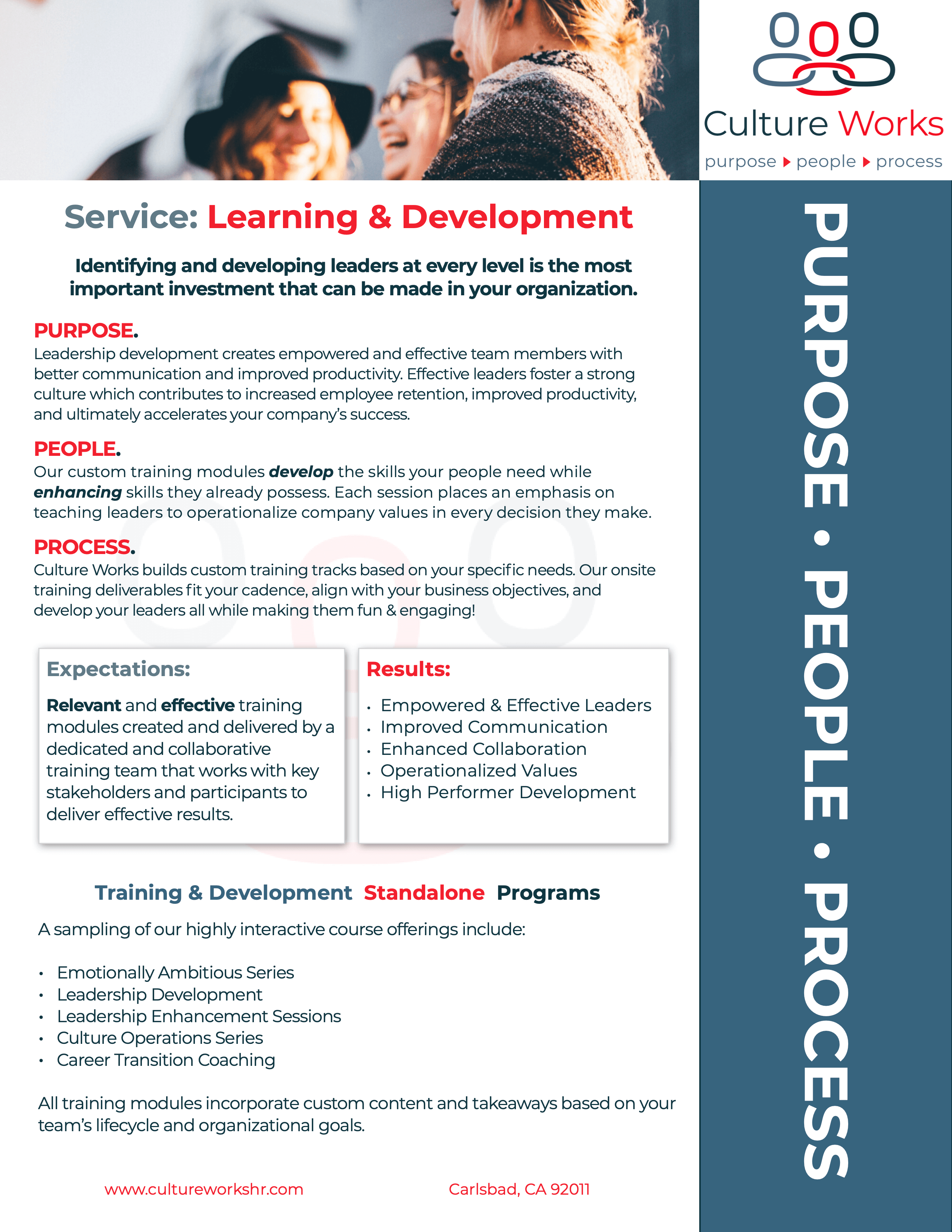
Not sure what a Learning and Development program is? Learn more here

Throughout these daily tasks, there are current adjustments and guidelines that your HR Manager should be aware of to avoid key risks. 

DEI (Diversity Equity Inclusion) 

Diversity Equity Inclusion covers a wide range of topics and individuals. As an HR Manager, it can be helpful to know what regulations and HR Law changes might be coming up in the new year. 

Does the phrase “HR Law” send chills down your spine? Don’t worry, it’s not as scary as it sounds, Kristi Pastore explains the importance of HR law in the workplace and its relation to company culture here

The Chief Diversity Officer at the University of Michigan, Robert Sellers, explains the difference between classifications: 

“Diversity is where everyone is invited to the party, Inclusion means that everyone gets to contribute to the playlist, and Equity means that everyone has the opportunity to dance.” 

Under the role of implementing DEI efforts into company culture there are many topics, groups, and identifications that could come up including: 

  • Age
  • Race and ethnicity
  • Marital Status
  • Sexual Orientation
  • Religion
  • Language
  • Socioeconomic Standing
  • Gender Identity
  • Mental and Physical ability
  • Veteran status 

Keeping this list of factors in mind when cultivating a company culture through HR is essential for making that culture a positive one. 

The U.S. Office of Personnel Management states that as a reflection and goal for the future, “Government-wide, we have made important progress toward hiring a workforce that truly reflects America’s diversity, and we will continue to pursue that goal. But merely hiring a diverse workforce is not enough.” 

This mentality is one that will lead towards a more positive workplace and one that HR managers should do their best to follow.

Technology Advancements

There are a LOT of tools out there that can assist any HR Manager in their role. GetApp outlines some of the most-used programs used in the HR space in 2021. Here’s a couple of the most popular HR technology tools: 

Rippling

Rippling is a platform that lets you “Effortlessly manage your employees’ payroll, time & attendance, benefits, compliance, and more— all in one place.” 

Beekeeper

Beekeeper makes reaching frontline workers easier, and also has a feature that helps, “Build a company culture that transcends language barriers through automated translations.” 

Monday.com

Monday.com is committed to streamlining all of your HR processes on one collaborative platform. This includes:

  • Onboarding
  • HR requests
  • Employment engagement surveys
  • Vacation requests
  • Event planning

It’s time to upgrade the way you manage HR and lean into the perks of the rise of technology. 

Compliance

Regulatory and business compliance is difficult to manage. This is a huge topic to dive into, but in general, your HR Manager should be fully knowledgeable of the following acts.

Wages and the Fair Labor Standards Act (FLSA)

The U.S. Department of Labor claims that the FLSA, “Establishes minimum wage, overtime pay, recordkeeping, and youth employment standards affecting employees in the private sector, and in Federal, State, and local governments.” 

Equal Employment Opportunity

The U.S. Equal Opportunity Commission has a page dedicated to updated law that would apply to HR, which can be found here

How we work with Internal HR Stakeholders

Culture Works believes that fractional HR relationships are built on the idea of adding another team member (or members) to your existing team. The fractional team partners with your in-house HR stakeholder and team to develop a strategic partnership. 

Learn about what working with an outsourced company would look like here

Working with an outsourcing company: What you need to know

If your human resources team feels like they don’t have enough time in the day to contribute to crafting your company culture in a profound way, you may want to consider hiring a fractional HR team. At Culture Works, our team sets out to assist your HR professionals with all their operational processes. Let’s dive deeper into how a fractional human resources team can help your organization see greater success.

man using a laptop

Yes, you read that right.
You might not believe us at first, but read through the rest of this article and you’ll see why making mistakes at work (and in life!) is crucial for growth.
Like the brilliant Stephen Hawking once said, “One of the basic rules of the universe is that nothing is perfect. Perfection simply doesn’t exist… Without imperfection, neither you nor I would exist.”

Count me in!

Practical steps you can take to make your company culture (and yourself) even better.

Signup for our newsletter below to stay up-to-date on our latest HR news & insights!

LINKS

CONTACT

(760) 334-4094

info@cultureworkshr.com

29970 Technology Drive
Murrieta, CA 92563

HOURS

Mon-Fri: 7:00-4:00
Sat: Closed
Sun: Closed

CONNECT WITH US!

© 2026 Culture Works – all rights reserved

site design by digitalstoryteller.io

© 2024 Culture Works – all rights reserved
site design by digitalstoryteller.io