Culture Works
  • What We Do
    • Fractional HR: Integrative HR
    • Recruiting
    • Consulting
  • Who We Are
    • Our Awesome Team
    • Our Purpose
    • Our Values
    • Case Stories
  • Connect with Us
    • Applicants
    • Partners
  • Free Sh*t
    • Blog
    • Wellness Resources
    • Educational Videos
    • Infographics
  • Connect With Us
  • Menu Menu
  • Link to Facebook
  • Link to LinkedIn
  • Link to Instagram
  • Link to Youtube
  • Link to Mail

How to Create an Employee Handbook

Uncategorized
How to Create an Employee Handbook

(You need a lot more than in a traditional handbook!)

There are many terms thrown around the HR space: employee handbook, manual, pamphlet, and review. Same, same but different.

Although there are various terms used, they all have the same goal for your business—security and prevention.

At Culture Works, we receive a lot of questions about employee handbooks, manuals, whatever the heck you want to call them!

Some common questions we receive include:

  • What is an employee handbook?
  • Does my small business need a handbook?
  • What should be included in my employee handbook?
  • What should I avoid while creating an employee handbook?
  • How often should I restructure the handbook?

So, let’s take a closer look into why employee handbooks are essential for any business, and how they can transform your business’s workforce planning. 

What is an Employee Handbook? 

Simply put, an employee handbook is a book or online PDF containing employee and employer guidelines to reference for all job-related information.

No matter the size of the business, an employee handbook is a necessary tool. (We understand that as a small business, you wear a lot of hats for the company, but this doesn’t mean an employee handbook should take the backburner).

In general, an employee handbook is reviewed and signed when a new hire is onboarded. Although the handbook is primarily used for onboarding, it’s important to acknowledge that an employee handbook is not only a resource for employees but is also a resource for employers as well.

Additionally, having a thorough, up-to-date HR handbook can reduce your business’s insurance costs. Clearly, there are many pros to having an employee handbook, regardless of business size.

What Should be Included in an Employee Handbook? 

An employee handbook is normally a large document with guidelines covering the following topics:

  • Equal Opportunity Guidelines
  • Company Culture
  • Paid Time Off (PTO) and Holiday Time
  • Job Expectations
  • Company Mission Statement
  • Company Policies
  • Work Performance Expectations
  • Who to Contact if an Issue Arises

Surprisingly enough, employee handbooks are not required by law. They are, however, as we’ve noted, very helpful and highly recommended.

Most HR representatives consider the employer’s handbook as an active document, which means that throughout the year, notes can be added and reviewed when policies and employment laws change.

What Should I Avoid When Creating an Employee Handbook? 

Creating and maintaining employee manuals in California is more difficult than in other states. This is because policies and guidelines are constantly being adjusted. 

It’s almost impossible to keep up, which is why adding notes and using the employee handbook as an active document is a helpful practice to follow.

Ideally, an employee handbook should be written by an HR consultant or professional, or an employment attorney. Although there are tools that can help employers build a handbook, it’s better to practice to collaborate with a professional. 

Forbes lists common mistakes that are made when creating an employee handbook, and they are worth paying attention to. Key takeaways include:

  • Not having a process for reconstructing the handbook
  • Using the handbook as a form of control
  • Failing to notify employees if there are changes to the handbook
  • Using only a template 
  • Vague language

Again, your company mission and values should align with the handbook.

When Should You Review Your Employee Handbook? 

The simple answer? Always.

Again, most HR representatives see the handbook as an active document. This means that throughout the year when policies and general guidelines change, notes can be added and reviewed.

An employee handbook is most helpful when constantly added to and reviewed. This way, the handbook will stay perfectly up-to-date without annual revisions, which is important if an issue arises. A handbook is a great reference point.

A Final Word

As an employer, it can be helpful to see the employee handbook as a resource, not just another box to check off the list.

It should essentially be seen as a big information source. There is a lot of information to keep track of as an employer. If an employee gets called to jury duty, for example, do they receive paid time off? Check the employee handbook.If you’re a small business and haven’t officially created an employee handbook, it would be helpful to contact an HR professional to assist in the process. Read our blog, “Small Businesses: How to know when you need HR” for more information.


February 14, 2022
Share this entry
  • Share on Facebook
  • Share on LinkedIn
  • Share by Mail
  • Link to Instagram
  • Link to Youtube
https://www.cultureworkshr.com/wp-content/uploads/2022/01/iStock-1314595934-scaled.jpg 1711 2560 Culture Works https://www.cultureworkshr.com/wp-content/uploads/2025/02/cultureworks_logo.png Culture Works2022-02-14 14:28:002022-01-24 14:36:03How to Create an Employee Handbook
You might also like
Your Due Diligence Checklist Your Due Diligence Checklist: How to Ensure a Smooth Transition During Your M&A
What should be top of mind for your HR Manager What should be top of mind for your HR Manager
How to Nail your Remote Company Culture How to Nail your Remote Company Culture
fostering healthy culture with remote teams 4 Ways to foster healthy culture within your remote team
When to Hire a Fractional HR Team When to Hire a Fractional HR Team
proactive recruitment Proactive Recruiting Tips- Building a Killer Bench
HRIS HCM HXM HRIS, HCM, and HXM: What Are They and Why Do They Matter?
how to set new year's resolutions to foster company culture How to Set New Year’s Resolutions that Foster Company Culture

Search

Search Search

Categories

Latest News

  • Goal Setting and Goal Getting: Why Creating and Achieving Goals Matters for Personal and Professional GrowthFebruary 6, 2026 - 11:41 am
  • Role Models in Leadership: Why They’re Important and How to be OneJanuary 30, 2026 - 2:44 pm
  • Inland Empire Guide to HR Roles and ResponsibilitiesJanuary 23, 2026 - 2:32 pm

CONNECT WITH US

  • Facebook
  • Instagram
  • LinkedIn
  • YouTube

Count me in!

Practical steps you can take to make your company culture (and yourself) even better.

Signup for our newsletter below to stay up-to-date on our latest HR news & insights!

LINKS

Privacy Policy

FAQs

CONTACT

(760) 334-4094

info@cultureworkshr.com

29970 Technology Drive
Murrieta, CA 92563

HOURS

Mon-Fri: 7:00-4:00
Sat: Closed
Sun: Closed

CONNECT WITH US!

  • Facebook
  • Instagram
  • LinkedIn
  • YouTube

© 2026 Culture Works – all rights reserved

site design by digitalstoryteller.io

© 2026 Culture Works – all rights reserved
site design by digitalstoryteller.io

Link to: How to Prevent the Great Resignation in your Business Link to: How to Prevent the Great Resignation in your Business How to Prevent the Great Resignation in your BusinessHow to Prevent the Great Resignation in your BusinessLink to: How to ensure successful culture integration post-M&A Link to: How to ensure successful culture integration post-M&A How to ensure successful culture integration post-M&AHow to ensure successful culture integration post-M&A Scroll to top Scroll to top Scroll to top

This site uses cookies. By continuing to browse the site, you are agreeing to our use of cookies.

Accept settings

Cookie and Privacy Settings


How we use cookies

We may request cookies to be set on your device. We use cookies to let us know when you visit our websites, how you interact with us, to enrich your user experience, and to customize your relationship with our website.

Click on the different category headings to find out more. You can also change some of your preferences. Note that blocking some types of cookies may impact your experience on our websites and the services we are able to offer.

Essential Website Cookies

These cookies are strictly necessary to provide you with services available through our website and to use some of its features.

Because these cookies are strictly necessary to deliver the website, refusing them will have impact how our site functions. You always can block or delete cookies by changing your browser settings and force blocking all cookies on this website. But this will always prompt you to accept/refuse cookies when revisiting our site.

We fully respect if you want to refuse cookies but to avoid asking you again and again kindly allow us to store a cookie for that. You are free to opt out any time or opt in for other cookies to get a better experience. If you refuse cookies we will remove all set cookies in our domain.

We provide you with a list of stored cookies on your computer in our domain so you can check what we stored. Due to security reasons we are not able to show or modify cookies from other domains. You can check these in your browser security settings.

Google Analytics Cookies

These cookies collect information that is used either in aggregate form to help us understand how our website is being used or how effective our marketing campaigns are, or to help us customize our website and application for you in order to enhance your experience.

If you do not want that we track your visit to our site you can disable tracking in your browser here:

Other external services

We also use different external services like Google Webfonts, Google Maps, and external Video providers. Since these providers may collect personal data like your IP address we allow you to block them here. Please be aware that this might heavily reduce the functionality and appearance of our site. Changes will take effect once you reload the page.

Google Webfont Settings:

Google Map Settings:

Google reCaptcha Settings:

Vimeo and Youtube video embeds:

Other cookies

The following cookies are also needed - You can choose if you want to allow them:

Privacy Policy

You can read about our cookies and privacy settings in detail on our Privacy Policy Page.

Accept settings

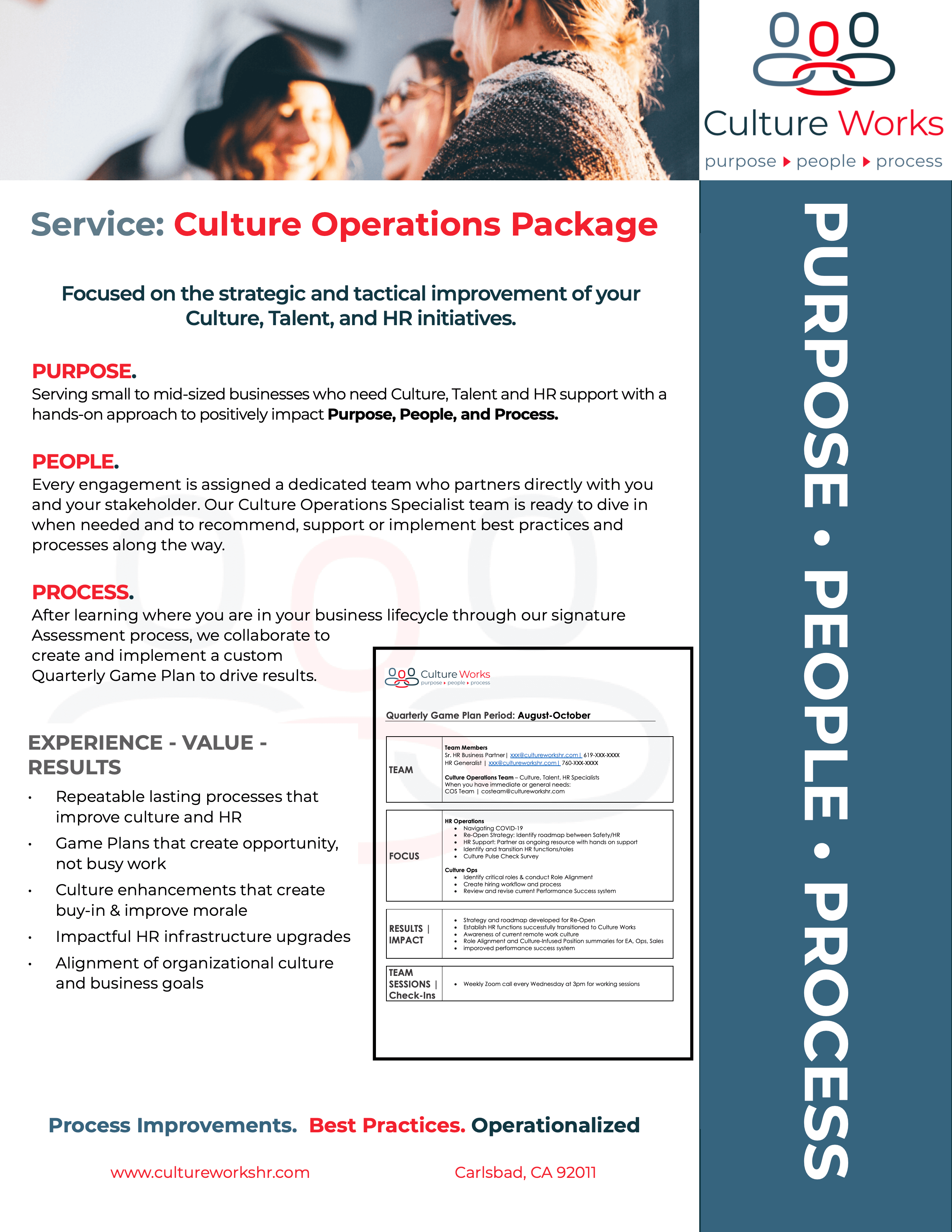
CW Culture Operations Package

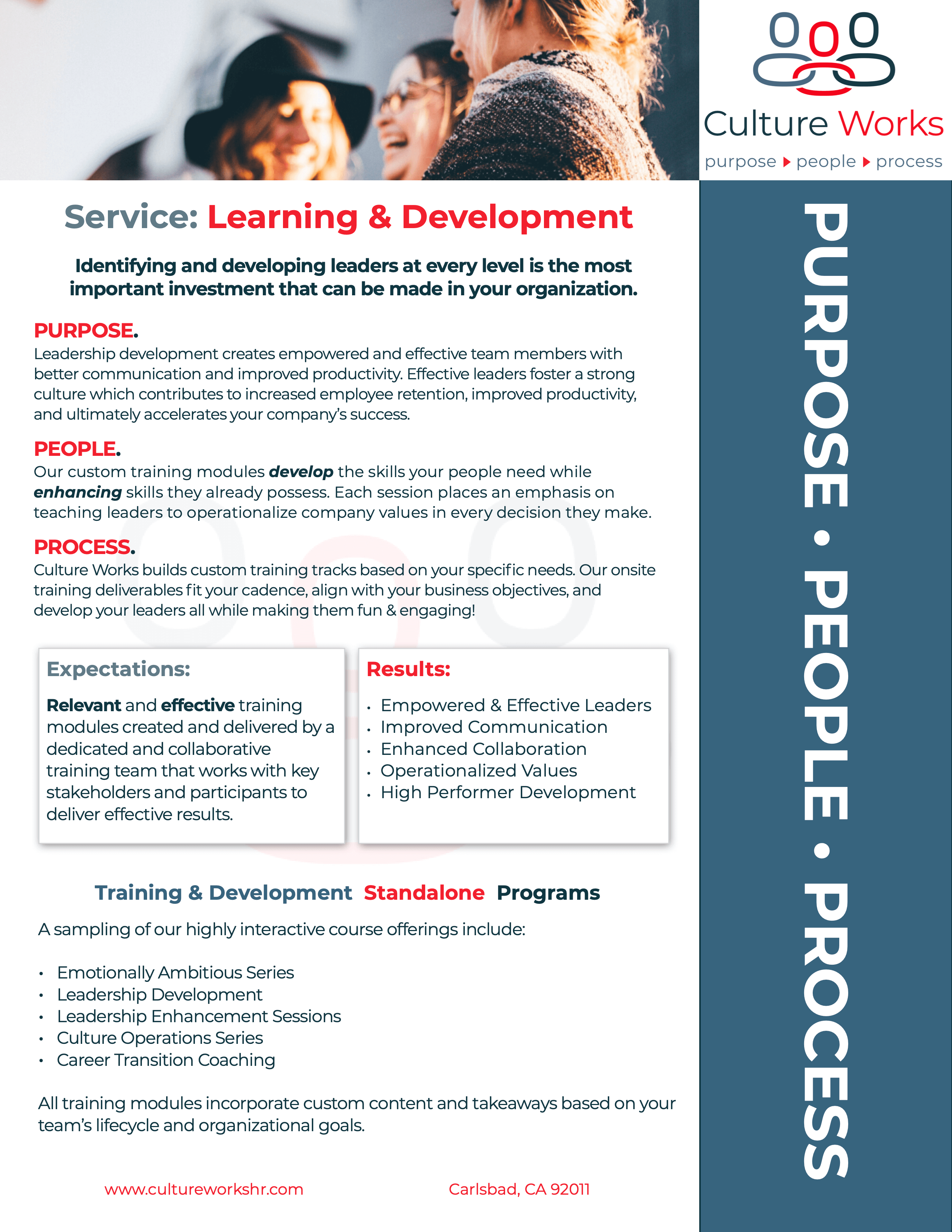
Learning and Development

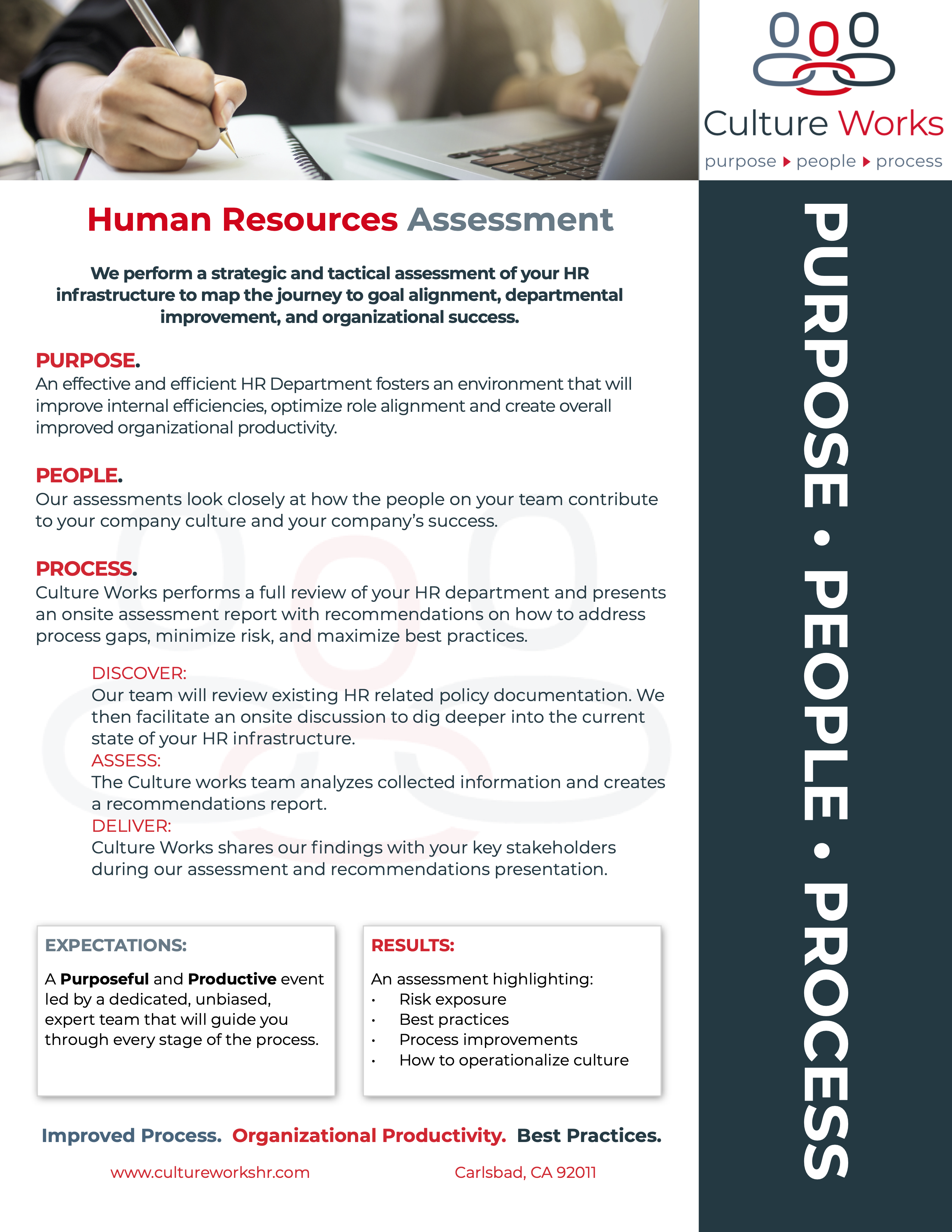
Human Resources Assessment

Culture Works Logo


Howdy Partner


Culture Works Logo